Araínga Mariluz, Edagwa Benson, Mosley R Lee, Poluektova Larisa Y, Gorantla Santhi, Gendelman Howard E
Department of Pharmacology and Experimental Neuroscience, 985880 Nebraska Medical Center, College of Medicine, University of Nebraska Medical Center, Omaha, NE, 68198-5880, USA.
Retrovirology. 2017 Mar 9;14(1):17. doi: 10.1186/s12977-017-0344-7.
Despite improved clinical outcomes seen following antiretroviral therapy (ART), resting CD4+ T cells continue to harbor latent human immunodeficiency virus type one (HIV-1). However, such cells are not likely the solitary viral reservoir and as such defining where and how others harbor virus is imperative for eradication measures. To such ends, we used HIV-1-infected NOD.Cg-Prkdc Il2rg /SzJ mice reconstituted with a human immune system to explore two long-acting ART regimens investigating their abilities to affect viral cell infection and latency. At 6 weeks of infection animals were divided into four groups. One received long-acting (LA) cabotegravir (CAB) and rilpivirine (RVP) (2ART), a second received LA CAB, lamivudine, abacavir and RVP (4ART), a third were left untreated and a fourth served as an uninfected control. After 4 weeks of LA ART treatment, blood, spleen and bone marrow (BM) cells were collected then phenotypically characterized. CD4+ T cell subsets, macrophages and hematopoietic progenitor cells were analyzed for HIV-1 nucleic acids by droplet digital PCR.
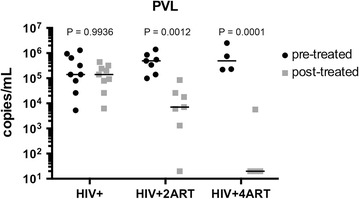
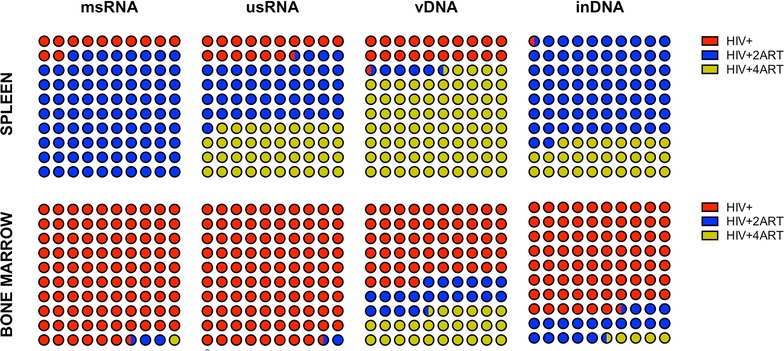
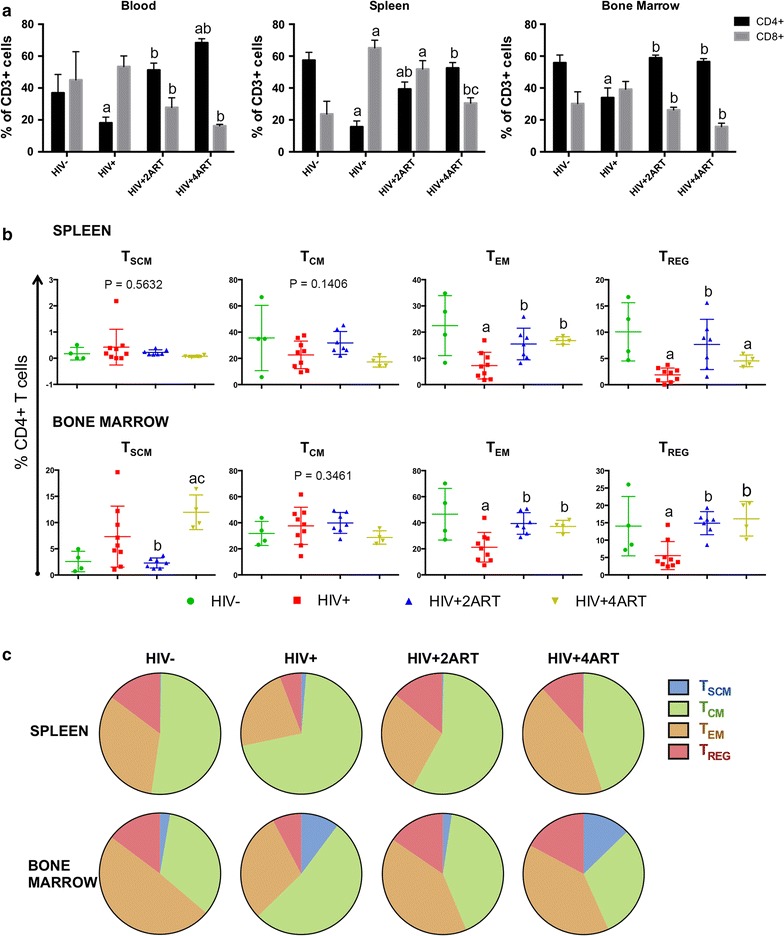
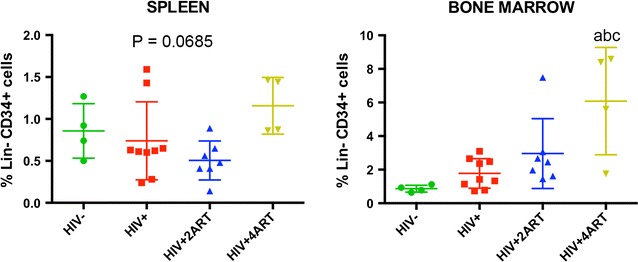
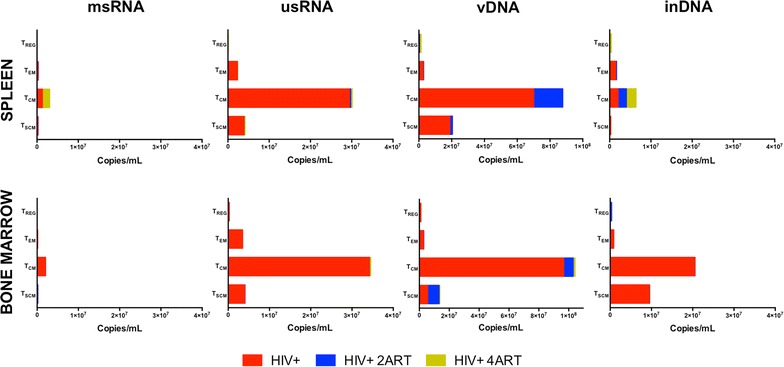
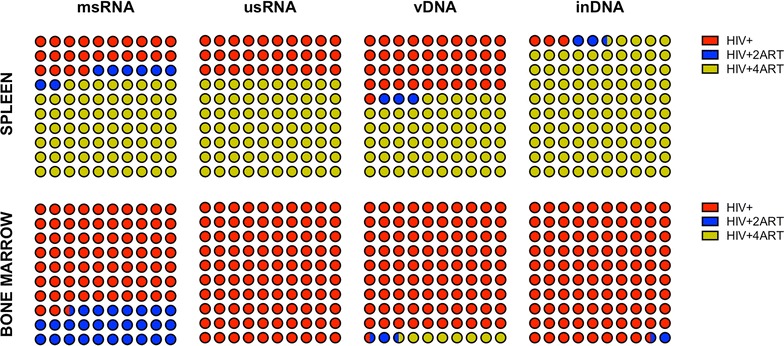
Plasma viral loads were reduced by two log or to undetectable levels in the 2 and 4ART regimens, respectively. Numbers and distributions of CD4+ memory and regulatory T cells, macrophages and hematopoietic progenitor cells were significantly altered by HIV-1 infection and by both ART regimens. ART reduced viral DNA and RNA in all cell and tissue compartments. While memory cells were the dominant T cell reservoir, integrated HIV-1 DNA was also detected in the BM and spleen macrophages in both regimen-treated mice.
Despite vigorous ART regimens, HIV-1 DNA and RNA were easily detected in mature macrophages supporting their potential role as an infectious viral reservoir.
尽管抗逆转录病毒疗法(ART)后临床结果有所改善,但静息CD4 + T细胞仍潜藏着1型人类免疫缺陷病毒(HIV-1)。然而,这类细胞不太可能是唯一的病毒储存库,因此明确其他病毒储存库的位置及方式对于根除措施至关重要。为此,我们使用用人免疫系统重建的HIV-1感染的NOD.Cg-Prkdc Il2rg /SzJ小鼠,探索两种长效ART方案,研究它们影响病毒细胞感染和潜伏的能力。在感染6周时,将动物分为四组。一组接受长效(LA)卡博特韦(CAB)和利匹韦林(RVP)(2药联合ART),第二组接受LA CAB、拉米夫定、阿巴卡韦和RVP(4药联合ART),第三组不接受治疗,第四组作为未感染对照。在LA ART治疗4周后,收集血液、脾脏和骨髓(BM)细胞,然后进行表型特征分析。通过液滴数字PCR分析CD4 + T细胞亚群、巨噬细胞和造血祖细胞中的HIV-1核酸。
在2药联合和4药联合ART方案中,血浆病毒载量分别降低了两个对数或降至无法检测的水平。HIV-1感染以及两种ART方案均显著改变了CD4 +记忆和调节性T细胞、巨噬细胞和造血祖细胞的数量及分布。ART降低了所有细胞和组织区室中的病毒DNA和RNA。虽然记忆细胞是主要的T细胞储存库,但在两种方案治疗的小鼠的BM和脾脏巨噬细胞中也检测到了整合的HIV-1 DNA。
尽管采用了强效ART方案,但在成熟巨噬细胞中仍很容易检测到HIV-1 DNA和RNA,这支持了它们作为传染性病毒储存库的潜在作用。