Hu Aizhen, Zaongo Silvere D, Harypursat Vijay, Wang Xin, Ouyang Jing, Chen Yaokai
Clinical Research Center, Chongqing Public Health Medical Center, Chongqing, China.
Department of Infectious Diseases, Chongqing Public Health Medical Center, Chongqing, China.
Front Microbiol. 2024 Aug 2;15:1428239. doi: 10.3389/fmicb.2024.1428239. eCollection 2024.
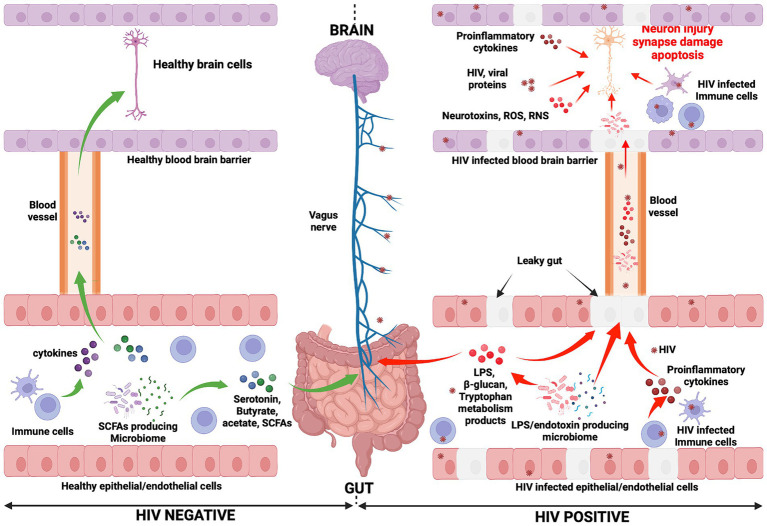
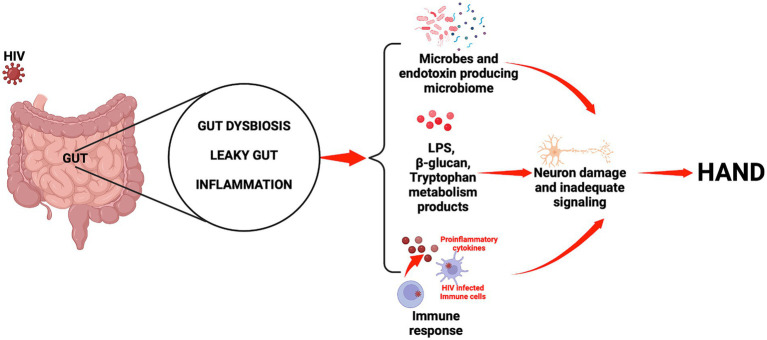
HIV-associated neurocognitive disorder (HAND) is now recognized to be relatively common in people living with HIV (PLWH), and remains a common cause of cognitive impairment. Unfortunately, the fundamental pathogenic processes underlying this specific outcome of HIV infection have not as yet been fully elucidated. With increased interest in research related to the microbiota-gut-brain axis, the gut-brain axis has been shown to play critical roles in regulating central nervous system disorders such as Alzheimer's disease and Parkinson's disease. PLWH are characterized by a particular affliction, referred to as gut-associated dysbiosis syndrome, which provokes an alteration in microbial composition and diversity, and of their associated metabolite composition within the gut. Interestingly, the gut microbiota has also been recognized as a key element, which both positively and negatively influences human brain health, including the functioning and development of the central nervous system (CNS). In this review, based on published evidence, we critically discuss the relevant interactions between the microbiota-gut-brain axis and the pathogenesis of HAND in the context of HIV infection. It is likely that HAND manifestation in PLWH mainly results from (i) gut-associated dysbiosis syndrome and a leaky gut on the one hand and (ii) inflammation on the other hand. In other words, the preceding features of HIV infection negatively alter the composition of the gut microbiota (microbes and their associated metabolites) and promote proinflammatory immune responses which singularly or in tandem damage neurons and/or induce inadequate neuronal signaling. Thus, HAND is fairly prevalent in PLWH. This work aims to demonstrate that in the quest to prevent and possibly treat HAND, the gut microbiota may ultimately represent a therapeutically targetable "host factor."
现在人们认识到,与人类免疫缺陷病毒(HIV)相关的神经认知障碍(HAND)在HIV感染者(PLWH)中相对常见,并且仍然是认知障碍的常见原因。不幸的是,HIV感染这一特定结果背后的基本致病过程尚未完全阐明。随着对微生物群-肠-脑轴相关研究的兴趣增加,已表明肠-脑轴在调节中枢神经系统疾病(如阿尔茨海默病和帕金森病)中起关键作用。PLWH的特征是一种特殊的疾病,称为肠道相关生态失调综合征,它会引发肠道内微生物组成和多样性及其相关代谢物组成的改变。有趣的是,肠道微生物群也被认为是一个关键因素,它对人类大脑健康,包括中枢神经系统(CNS)的功能和发育,既有积极影响也有消极影响。在这篇综述中,基于已发表的证据,我们批判性地讨论了在HIV感染背景下微生物群-肠-脑轴与HAND发病机制之间的相关相互作用。PLWH中HAND的表现可能主要源于:一方面是肠道相关生态失调综合征和肠道通透性增加,另一方面是炎症。换句话说,HIV感染的上述特征会负面改变肠道微生物群(微生物及其相关代谢物)的组成,并促进促炎免疫反应,这些反应单独或共同损害神经元和/或导致神经元信号传导不足。因此,HAND在PLWH中相当普遍。这项工作旨在表明,在预防和可能治疗HAND的探索中,肠道微生物群最终可能代表一个可作为治疗靶点的“宿主因素”。