Hellebrekers Pien, Leenen Luke P H, Hoekstra Meriam, Hietbrink Falco
Department of Surgery, University Medical Center Utrecht, P.O. Box 85500, 3508 GA, Utrecht, The Netherlands.
J Orthop Surg Res. 2017 Mar 9;12(1):41. doi: 10.1186/s13018-017-0535-x.
Infection after osteosynthesis is an important complication with significant morbidity and even mortality. These infections are often caused by biofilm-producing bacteria. Treatment algorithms dictate an aggressive approach with surgical debridement and antibiotic treatment. The aim of this study is to analyze the effect of such an aggressive standardized treatment regime with implant retention for acute, existing <3 weeks, infection after osteosynthesis.
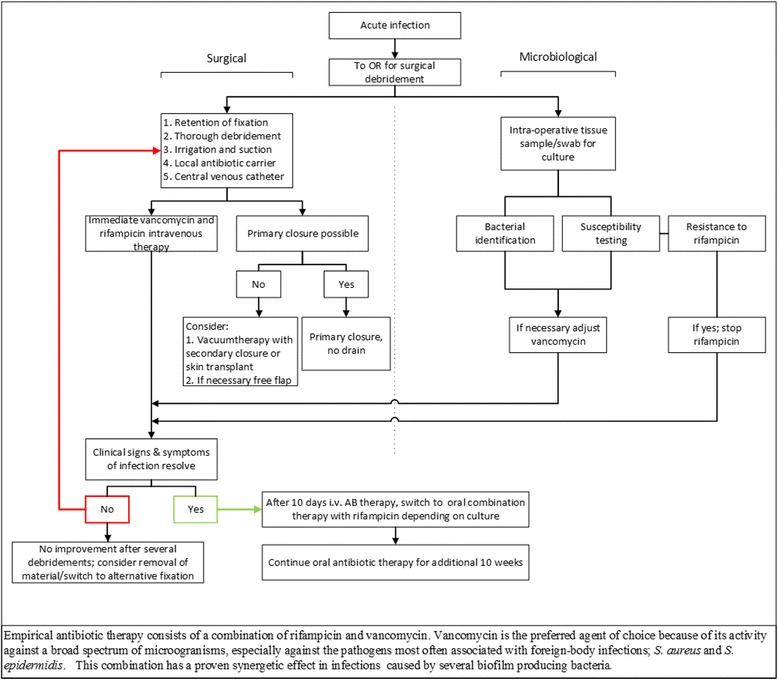
We conducted a retrospective 2-year cohort in a single, level 1 trauma center on infection occurring within 12 months following any osteosynthesis surgery. The standardized treatment regime consisted of implant retention, thorough surgical debridement, and immediate antibiotic combination therapy with rifampicin. The primary outcome was success. Success was defined as consolidation of the fracture and resolved symptoms of infection. Culture and susceptibility testing were performed to identify bacteria and resistance patterns. Univariate analysis was conducted on patient-related factors in association with primary success and antibiotic resistance.
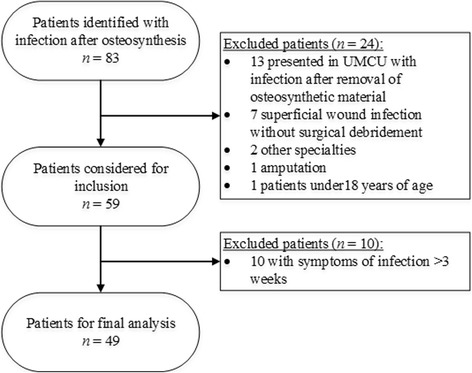
Forty-nine patients were included for analysis. The primary success rate was 63% and overall success rate 88%. Factors negatively associated with primary success were the following: Gustilo classification (P = 0.023), higher number of debridements needed (P = 0.015), inability of primary closure (P = 0.017), and subsequent application of vacuum therapy (P = 0.030). Adherence to the treatment regime was positively related to primary success (P = 0.034).
The described treatment protocol results in high success rates, comparable with success rates achieved in staged exchange in prosthetic joint infection treatment.
骨固定术后感染是一种重要的并发症,具有较高的发病率甚至死亡率。这些感染通常由产生生物膜的细菌引起。治疗方案要求采取积极的方法,包括手术清创和抗生素治疗。本研究的目的是分析这种积极的标准化治疗方案(保留植入物)对急性(病程<3周)骨固定术后现有感染的效果。
我们在一家一级创伤中心进行了一项为期2年的回顾性队列研究,研究对象为任何骨固定手术后12个月内发生的感染。标准化治疗方案包括保留植入物、彻底的手术清创以及立即使用利福平进行联合抗生素治疗。主要结局是成功。成功定义为骨折愈合且感染症状消失。进行培养和药敏试验以鉴定细菌和耐药模式。对与主要成功和抗生素耐药相关的患者因素进行单因素分析。
纳入49例患者进行分析。主要成功率为63%,总成功率为88%。与主要成功呈负相关的因素如下: Gustilo分类(P = 0.023)、需要清创的次数较多(P = 0.015)、无法一期缝合(P = 0.017)以及随后应用负压治疗(P = 0.030)。对治疗方案的依从性与主要成功呈正相关(P = 0.034)。
所描述的治疗方案成功率较高,与假体关节感染治疗中分期更换的成功率相当。