Passow Susanne, Thurm Franka, Li Shu-Chen
Chair of Lifespan Developmental Neuroscience, Department of Psychology, TU Dresden Dresden, Germany.
Front Aging Neurosci. 2017 Feb 23;9:33. doi: 10.3389/fnagi.2017.00033. eCollection 2017.
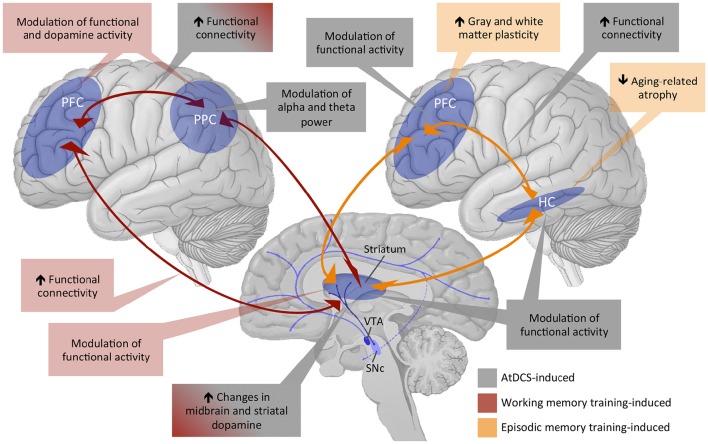
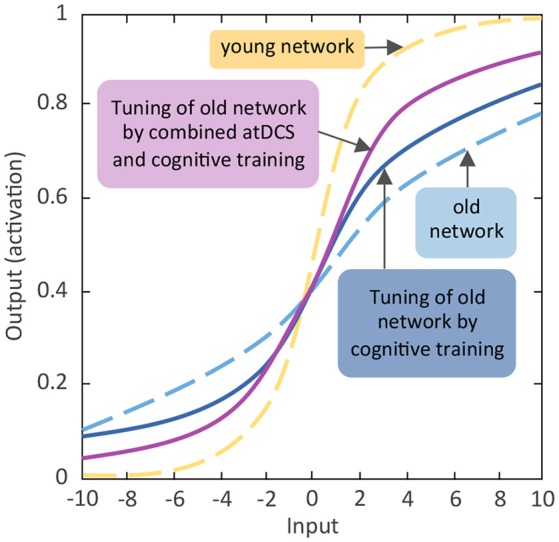
Existing neurocomputational and empirical data link deficient neuromodulation of the fronto-parietal and hippocampal-striatal circuitries with aging-related increase in processing noise and declines in various cognitive functions. Specifically, the theory of aging neuronal gain control postulates that aging-related suboptimal neuromodulation may attenuate neuronal gain control, which yields computational consequences on reducing the signal-to-noise-ratio of synaptic signal transmission and hampering information processing within and between cortical networks. Intervention methods such as cognitive training and non-invasive brain stimulation, e.g., transcranial direct current stimulation (tDCS), have been considered as means to buffer cognitive functions or delay cognitive decline in old age. However, to date the reported effect sizes of immediate training gains and maintenance effects of a variety of cognitive trainings are small to moderate at best; moreover, training-related transfer effects to non-trained but closely related (i.e., near-transfer) or other (i.e., far-transfer) cognitive functions are inconsistent or lacking. Similarly, although applying different tDCS protocols to reduce aging-related cognitive impairments by inducing temporary changes in cortical excitability seem somewhat promising, evidence of effects on short- and long-term plasticity is still equivocal. In this article, we will review and critically discuss existing findings of cognitive training- and stimulation-related behavioral and neural plasticity effects in the context of cognitive aging, focusing specifically on working memory and episodic memory functions, which are subserved by the fronto-parietal and hippocampal-striatal networks, respectively. Furthermore, in line with the theory of aging neuronal gain control we will highlight that developing age-specific brain stimulation protocols and the concurrent applications of tDCS during cognitive training may potentially facilitate short- and long-term cognitive and brain plasticity in old age.
现有的神经计算和实证数据表明,随着年龄增长,额叶 - 顶叶和海马 - 纹状体回路的神经调节不足与处理噪声增加以及各种认知功能下降有关。具体而言,衰老神经元增益控制理论假定,与衰老相关的次优神经调节可能会减弱神经元增益控制,这会在降低突触信号传输的信噪比以及阻碍皮质网络内部和之间的信息处理方面产生计算后果。诸如认知训练和非侵入性脑刺激(例如经颅直流电刺激(tDCS))等干预方法已被视为缓冲认知功能或延缓老年人认知衰退 的手段。然而,迄今为止,各种认知训练所报告的即时训练增益和维持效果的效应大小充其量只是小到中等;此外,训练对未训练但密切相关(即近迁移)或其他(即远迁移)认知功能的迁移效应并不一致或缺乏。同样,尽管应用不同的tDCS方案通过诱导皮质兴奋性的暂时变化来减少与衰老相关的认知障碍似乎有些前景,但对短期和长期可塑性影响的证据仍然模棱两可。在本文中,我们将回顾并批判性地讨论在认知衰老背景下认知训练和刺激相关的行为和神经可塑性效应的现有发现,特别关注工作记忆和情景记忆功能,它们分别由额叶 - 顶叶和海马 - 纹状体网络支持。此外,根据衰老神经元增益控制理论,我们将强调制定针对特定年龄阶段的脑刺激方案以及在认知训练期间同时应用tDCS可能潜在地促进老年人的短期和长期认知及脑可塑性。