Feher Michael, Vega-Hernandez Gabriela, Mocevic Emina, Buysse Brian, Myland Melissa, Power Geraldine S, Nystrup Husemoen Lise L, Kim Joseph, Witte Daniel R
Chelsea and Westminster Hospital, London, UK.
Novo Nordisk, West Sussex, UK.
Diabetes Ther. 2017 Apr;8(2):417-431. doi: 10.1007/s13300-017-0241-z. Epub 2017 Mar 9.
The glucagon-like peptide-1 receptor agonists liraglutide and lixisenatide are effective at reducing glycated hemoglobin (HbA1c) levels in patients with type 2 diabetes mellitus (T2DM). Although liraglutide has demonstrated superior efficacy in head-to-head clinical trials, real-world evidence of comparative effectiveness is lacking. This observational study aimed to assess the effectiveness of liraglutide versus lixisenatide in UK clinical practice.
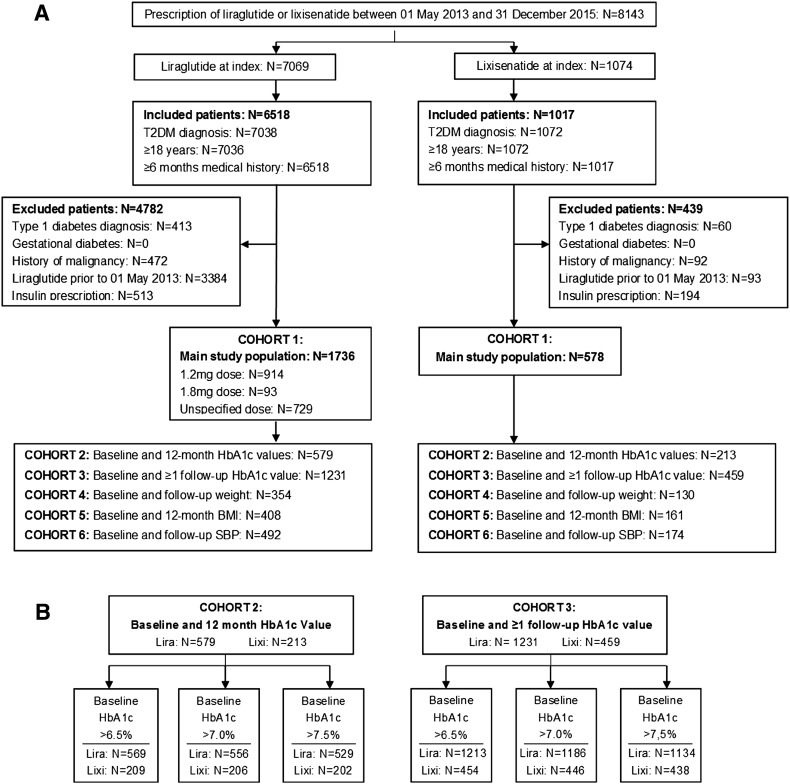
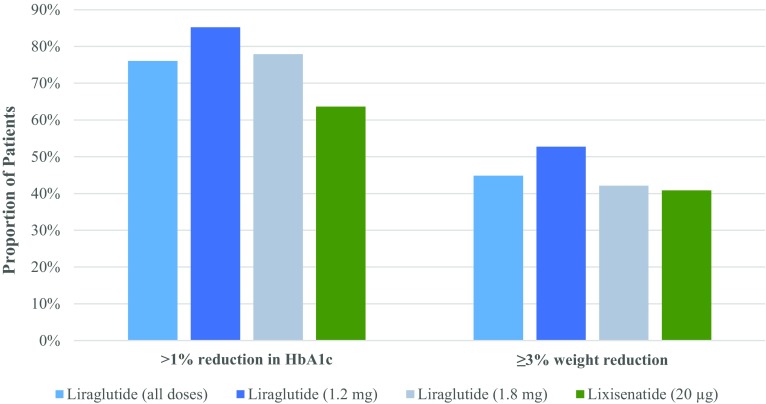
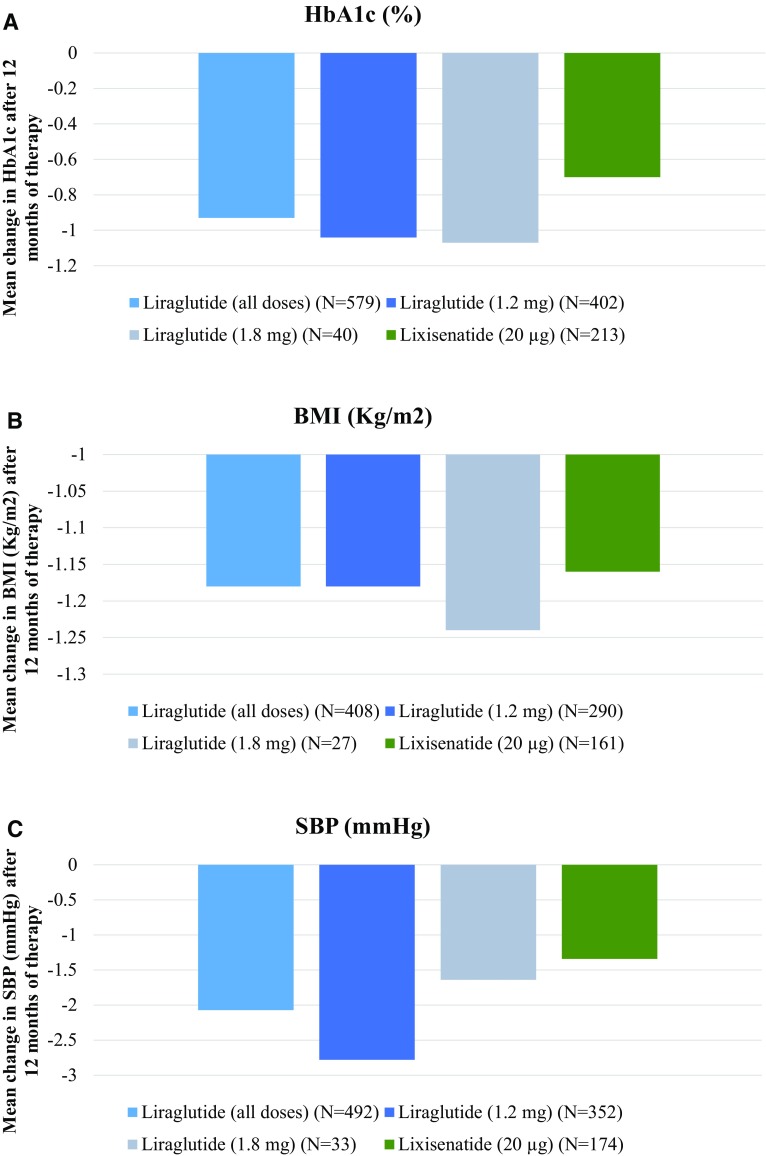
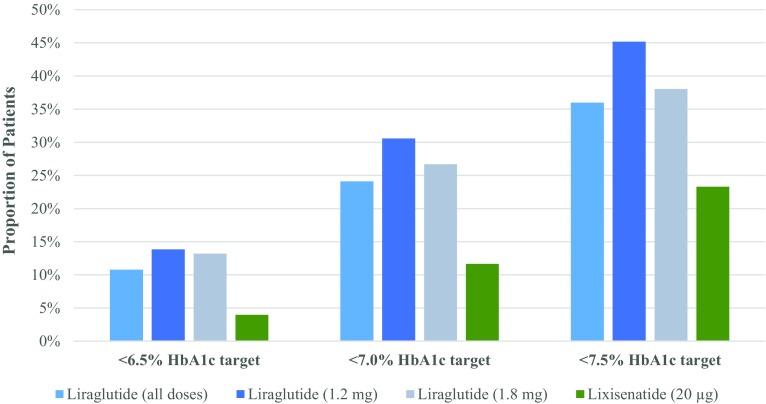
Electronic medical records from The Health Improvement Network (THIN) UK primary care database were analyzed. Patients aged ≥18 years, diagnosed with T2DM, and prescribed liraglutide or lixisenatide between 01 May 2013 and 31 December 2015 were included in the study. Adjusted linear regression models compared the difference in mean change in HbA1c, body mass index (BMI), and systolic blood pressure (SBP) after 12-month follow-up. The proportion of patients achieving glycemic control (HbA1c <6.5%, <7.0%, <7.5%); HbA1c reduction >1%; and weight reduction ≥3% within 12 months were determined. Cox proportional hazards modeling was used to evaluate the effect of treatment on time to achieving HbA1c and weight reduction targets. Healthcare resource use (HCRU) (GP, secondary care, hospitalizations) was compared using analysis of covariance.
The primary outcome was assessed in 579 liraglutide and 213 lixisenatide new users. Fully adjusted linear regression indicated that liraglutide reduced HbA1c significantly more than lixisenatide (mean treatment difference -0.30; 95% CI -0.56, -0.04; p = 0.025). Compared to lixisenatide, liraglutide recipients were 2.5 times more likely to achieve HbA1c <6.5% (p = 0.0002). Liraglutide users were also more likely to achieve HbA1c <7.0% (HR 2.10; p < 0.0001), <7.5% (HR 1.65; p < 0.0001), and >1% HbA1c reduction (HR 1.29; p = 0.0002). BMI and SBP reductions were greater for the liraglutide group but results were not significant. HCRU was comparable between treatment groups.
These results from the THIN database indicate that liraglutide treatment provided better outcomes related to glycemic control.
Novo Nordisk.
胰高血糖素样肽-1受体激动剂利拉鲁肽和利司那肽在降低2型糖尿病(T2DM)患者糖化血红蛋白(HbA1c)水平方面有效。尽管利拉鲁肽在头对头临床试验中已证明具有卓越疗效,但缺乏比较有效性的真实世界证据。这项观察性研究旨在评估在英国临床实践中利拉鲁肽与利司那肽的有效性。
分析了来自英国初级医疗数据库“健康改善网络”(THIN)的电子病历。纳入研究的患者年龄≥18岁,诊断为T2DM,且在2013年5月1日至2015年12月31日期间开具了利拉鲁肽或利司那肽处方。调整后的线性回归模型比较了12个月随访后HbA1c、体重指数(BMI)和收缩压(SBP)平均变化的差异。确定了在12个月内实现血糖控制(HbA1c<6.5%、<7.0%、<7.5%);HbA1c降低>1%;以及体重减轻≥3%的患者比例。使用Cox比例风险模型评估治疗对实现HbA1c和体重减轻目标时间的影响。使用协方差分析比较医疗资源使用(HCRU)(全科医生、二级医疗、住院)情况。
对579名利拉鲁肽新使用者和213名利司那肽新使用者评估了主要结局。完全调整后的线性回归表明,利拉鲁肽降低HbA1c的幅度显著大于利司那肽(平均治疗差异-0.30;95%CI-0.56,-0.04;p=0.025)。与利司那肽相比,接受利拉鲁肽治疗的患者HbA1c<6.5%的可能性高2.5倍(p=0.0002)。利拉鲁肽使用者也更有可能实现HbA1c<7.0%(HR 2.10;p<0.0001)、<7.5%(HR 1.65;p<0.0001)以及HbA1c降低>1%(HR 1.29;p=0.0002)。利拉鲁肽组的BMI和SBP降低幅度更大,但结果不显著。治疗组之间的HCRU相当。
THIN数据库的这些结果表明,利拉鲁肽治疗在血糖控制方面提供了更好的结果。
诺和诺德公司。