Baird Janis, Jacob Chandni, Barker Mary, Fall Caroline H D, Hanson Mark, Harvey Nicholas C, Inskip Hazel M, Kumaran Kalyanaraman, Cooper Cyrus
Medical Research Council Lifecourse Epidemiology Unit, University of Southampton, Southampton SO16 6YD, UK.
Institute of Developmental Sciences, University of Southampton, Southampton S016 5YA, UK.
Healthcare (Basel). 2017 Mar 8;5(1):14. doi: 10.3390/healthcare5010014.
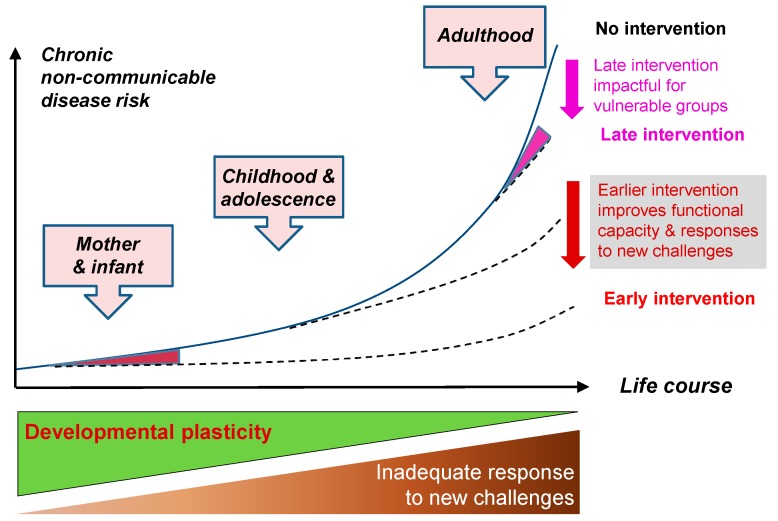
Non-communicable diseases (NCDs), such as cardiovascular disease and osteoporosis, affect individuals in all countries worldwide. Given the very high worldwide prevalence of NCDs across a range of human pathology, it is clear that traditional approaches targeting those at most risk in older adulthood will not efficiently ameliorate this growing burden. It will thus be essential to robustly identify determinants of NCDs across the entire lifecourse and, subsequently, appropriate interventions at every stage to reduce an individual's risk of developing these conditions. A lifecourse approach has the potential to prevent NCDs, from before conception through fetal life, infancy, childhood, adolescence, adulthood and into older age. In this paper, we describe the origins of the lifecourse concept, the importance of early life influences, for example during pregnancy, examine potential underlying mechanisms in both cell biology and behavior change, and finally describe current efforts to develop interventions that take a lifecourse approach to NCD prevention. Two principal approaches to improving women's nutritional status are outlined: nutritional supplementation and behavior change.
非传染性疾病(如心血管疾病和骨质疏松症)影响着全球所有国家的人群。鉴于全球范围内非传染性疾病在一系列人类病理状况中具有极高的患病率,很明显,针对老年期风险最高人群的传统方法无法有效减轻这一日益加重的负担。因此,必须强有力地确定整个生命历程中非传染性疾病的决定因素,并随后在每个阶段采取适当干预措施,以降低个体患这些疾病的风险。生命历程方法有潜力预防非传染性疾病,从受孕前直至胎儿期、婴儿期、儿童期、青春期、成年期及老年期。在本文中,我们描述了生命历程概念的起源、生命早期影响(例如孕期)的重要性,研究细胞生物学和行为改变方面潜在的基础机制,最后描述目前为开发采用生命历程方法预防非传染性疾病的干预措施所做的努力。概述了改善妇女营养状况的两种主要方法:营养补充和行为改变。