Liggins Institute, The University of Auckland, Auckland 1023, New Zealand.
School of Population Health, The University of Auckland, Auckland 1023, New Zealand.
Int J Environ Res Public Health. 2022 May 16;19(10):6024. doi: 10.3390/ijerph19106024.
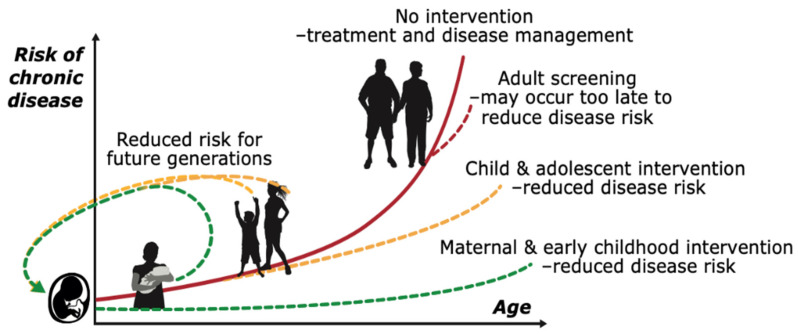
Noncommunicable diseases (NCDs), including type 2 diabetes and cardiovascular disease, represent a significant and growing global health burden. To date, a primary focus has been on treatment approaches to NCDs once manifested rather than strategies aimed at prevention. In this context, there is clear evidence that a range of adverse early life exposures can predispose individuals towards a greater risk of developing NCDs across the lifecourse. These risk factors can be passed to future generations, thus perpetuating a cycle of disease. This concept, preferentially termed "developmental programming", forms the basis of the Developmental Origins of Health and Disease (DOHaD) framework. To date, DOHaD has focused on preconception, pregnancy, lactation and, more recently, paternal health at the time of conception. However, it is becoming increasingly clear that investment in the window of adolescence is perhaps the most critical developmental window. Adolescence is a period where lifestyle behaviours become entrained. Therefore, a focus on adolescent behaviours, health literacy and emotional development may afford the best opportunity to break the cycle of NCDs. As the next generation of parents, adolescents should therefore be considered a priority group in advancing appropriate and informed actions aimed at reducing NCD risk factors across the lifecourse. This advancement requires a more comprehensive community understanding and uptake of DOHaD knowledge and concepts. NCD prevention strategies have typically entailed siloed (and often disease-specific) approaches with limited efficacy in curbing NCD prevalence and breaking the transgenerational transmission of disease traits. Recent findings across various disciplines have highlighted that a lifecourse systems approach is required to establish a comprehensive and sustainable framework for NCD intervention. A whole community approach with a particular focus on adolescents as potential agents of change is necessary to break the disease cycle.
非传染性疾病(NCDs),包括 2 型糖尿病和心血管疾病,是全球日益严重的健康负担。迄今为止,人们主要关注的是 NCD 出现后的治疗方法,而不是预防策略。在这种情况下,有明确的证据表明,一系列不良的早期生活暴露会使个体在整个生命过程中更容易患上 NCD。这些风险因素可以传递给后代,从而使疾病持续存在。这个概念,优先称为“发育编程”,是健康与疾病的发育起源(DOHaD)框架的基础。迄今为止,DOHaD 主要关注受孕前、怀孕期、哺乳期,以及最近的父亲在受孕时的健康状况。然而,越来越明显的是,投资于青春期窗口期可能是最关键的发育窗口。青春期是生活方式行为形成的时期。因此,关注青少年的行为、健康素养和情绪发展可能是打破 NCD 循环的最佳机会。由于青少年是下一代的父母,因此应该将他们视为在整个生命过程中减少 NCD 风险因素方面采取适当和知情行动的优先群体。这一进展需要更全面的社区理解和接受 DOHaD 知识和概念。NCD 预防策略通常涉及孤立(且通常是特定疾病)的方法,这些方法在遏制 NCD 患病率和打破疾病特征的代际传播方面效果有限。最近在各个学科的研究结果表明,需要采取生命历程系统方法,为 NCD 干预建立一个全面和可持续的框架。需要采取一种全社区的方法,特别关注青少年作为潜在的变革推动者,以打破疾病循环。