Thomas Shalu, Ravishankaran Sangamithra, Justin N A Johnson Amala, Asokan Aswin, Mathai Manu Thomas, Valecha Neena, Montgomery Jacqui, Thomas Matthew B, Eapen Alex
IDVC Field Unit, National Institute of Malaria Research (ICMR), NIE Campus, 2nd Main Road, TNHB, Ayapakkam, Chennai, 600 077, India.
Department of Zoology, Madras Christian College, Tambaram, Chennai, 600 059, India.
Malar J. 2017 Mar 10;16(1):111. doi: 10.1186/s12936-017-1764-5.
The Indian city of Chennai is endemic for malaria and the known local malaria vector is Anopheles stephensi. Plasmodium vivax is the predominant malaria parasite species, though Plasmodium falciparum is present at low levels. The urban ecotype of malaria prevails in Chennai with perennial transmission despite vector surveillance by the Urban Malaria Scheme (UMS) of the National Vector Borne Disease Control Programme (NVBDCP). Understanding the feeding and resting preferences, together with the transmission potential of adult vectors in the area is essential in effective planning and execution of improved vector control measures.
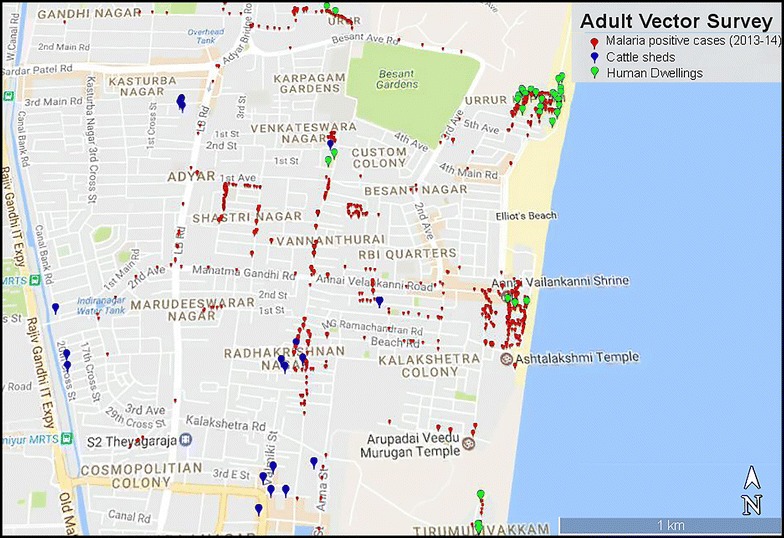
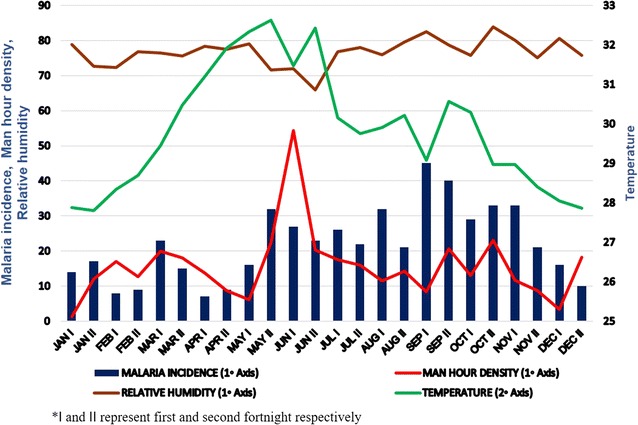
A yearlong survey was carried out in cattle sheds and human dwellings to check the resting, feeding preferences and transmission potential of An. stephensi. The gonotrophic status, age structure, resting and host seeking preferences were studied. The infection rate in An. stephensi and Anopheles subpictus were analysed by circumsporozoite ELISA (CS-ELISA).
Adult vectors were found more frequently and at higher densities in cattle sheds than human dwellings. The overall Human Blood Index (HBI) was 0.009 indicating the vectors to be strongly zoophilic. Among the vectors collected from human dwellings, 94.2% were from thatched structures and the remaining 5.8% from tiled and asbestos structures. 57.75% of the dissected vectors were nulliparous whereas, 35.83% were monoparous and the rest 6.42% biparous. Sporozoite positivity rate was 0.55% (4/720) and 1.92% (1/52) for An. stephensi collected from cattle sheds and human dwellings, respectively. One adult An. subpictus (1/155) was also found to be infected with P. falciparum.
Control of the adult vector populations can be successful only by understanding the resting and feeding preferences. The present study indicates that adult vectors predominantly feed on cattle and cattle sheds are the preferred resting place, possibly due to easy availability of blood meal source and lack of any insecticide or repellent pressure. Hence targeting these resting sites with cost effective, socially acceptable intervention tools, together with effective larval source management to reduce vector breeding, could provide an improved integrated vector management strategy to help drive down malaria transmission and assist in India's plan to eliminate malaria by 2030.
印度金奈市疟疾流行,已知当地疟疾传播媒介为斯氏按蚊。间日疟原虫是主要的疟原虫种类,不过恶性疟原虫也有少量存在。尽管国家媒介传播疾病控制项目(NVBDCP)的城市疟疾防治计划(UMS)对媒介进行了监测,但金奈市疟疾的城市生态型仍常年传播。了解该地区成年媒介的摄食和栖息偏好以及传播潜力,对于有效规划和实施改进的媒介控制措施至关重要。
在牛棚和人类住所进行了为期一年的调查,以检查斯氏按蚊的栖息、摄食偏好和传播潜力。研究了其生殖营养状态、年龄结构、栖息和宿主寻找偏好。通过环子孢子酶联免疫吸附测定(CS-ELISA)分析斯氏按蚊和伪杂鳞库蚊的感染率。
在牛棚中发现成年媒介的频率更高、密度更大,相比之下人类住所中较少。总体人类血液指数(HBI)为0.009,表明这些媒介具有强烈的嗜动物性。在从人类住所收集的媒介中,94.2%来自茅草屋,其余5.8%来自瓦房和石棉瓦结构房屋。解剖的媒介中有57.75%为未产卵的,35.83%为产过一次卵的,其余6.42%为产过两次卵的。从牛棚和人类住所收集的斯氏按蚊的子孢子阳性率分别为0.55%(4/720)和1.92%(1/52)。还发现一只成年伪杂鳞库蚊(1/155)感染了恶性疟原虫。
只有了解栖息和摄食偏好才能成功控制成年媒介种群。本研究表明,成年媒介主要以牛为食,牛棚是其首选的栖息场所,这可能是由于血餐来源容易获得且缺乏任何杀虫剂或驱避剂压力。因此,用具有成本效益、社会可接受的干预工具针对这些栖息场所,同时进行有效的幼虫源管理以减少媒介繁殖,可以提供一种改进的综合媒介管理策略,有助于降低疟疾传播,并助力印度在2030年消除疟疾的计划。