Thomas S Justin, Booth John N, Bromfield Samantha G, Seals Samantha R, Spruill Tanya M, Ogedegbe Gbenga, Kidambi Srividya, Shimbo Daichi, Calhoun David, Muntner Paul
Department of Epidemiology, University of Alabama at Birmingham, Birmingham, AL, USA.
Department of Epidemiology, University of Alabama at Birmingham, Birmingham, AL, USA.
J Am Soc Hypertens. 2017 Apr;11(4):204-212.e5. doi: 10.1016/j.jash.2017.02.001. Epub 2017 Feb 16.
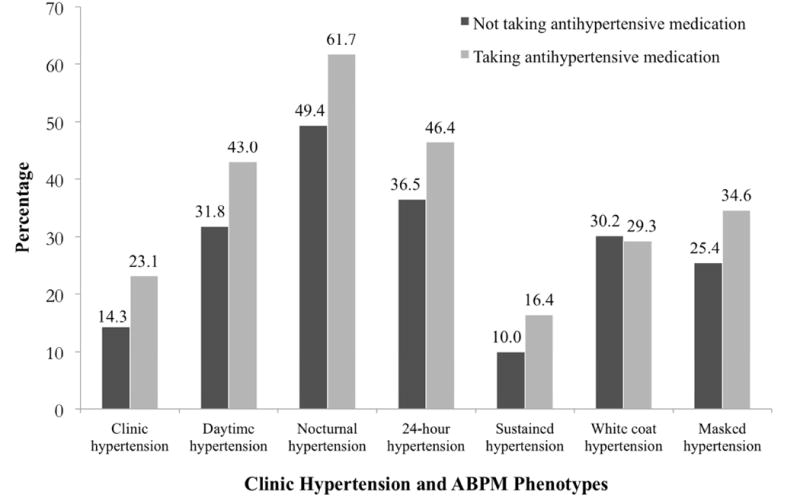
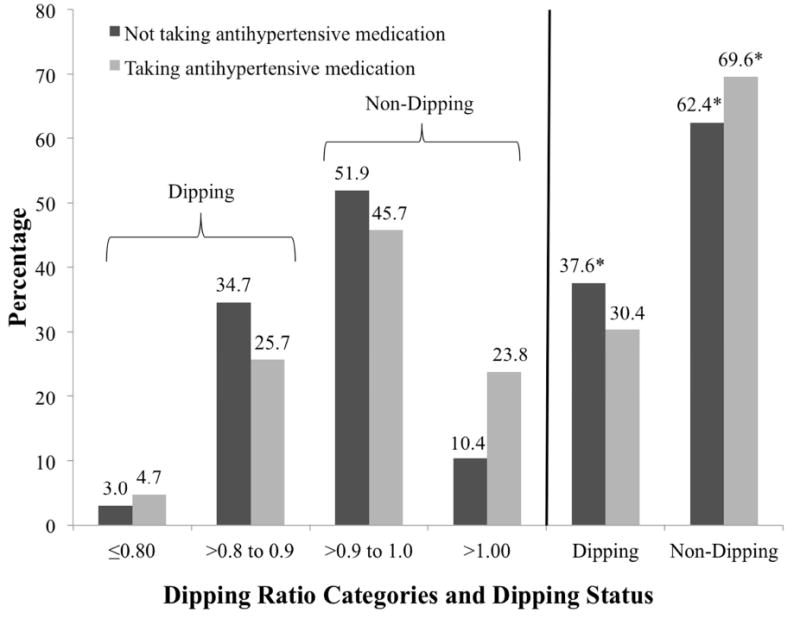
Blood pressure (BP) can differ substantially when measured in the clinic versus outside of the clinic setting. Few population-based studies with ambulatory blood pressure monitoring (ABPM) include African Americans. We calculated the prevalence of clinic hypertension and ABPM phenotypes among 1016 participants in the population-based Jackson Heart Study, an exclusively African-American cohort. Mean daytime systolic BP was higher than mean clinic systolic BP among participants not taking antihypertensive medication (127.1[standard deviation 12.8] vs. 124.5[15.7] mm Hg, respectively) and taking antihypertensive medication (131.2[13.6] vs. 130.0[15.6] mm Hg, respectively). Mean daytime diastolic BP was higher than clinic diastolic BP among participants not taking antihypertensive medication (78.2[standard deviation 8.9] vs. 74.6[8.4] mm Hg, respectively) and taking antihypertensive medication (77.6[9.4] vs. 74.3[8.5] mm Hg, respectively). The prevalence of daytime hypertension was higher than clinic hypertension for participants not taking antihypertensive medication (31.8% vs. 14.3%) and taking antihypertensive medication (43.0% vs. 23.1%). A high percentage of participants not taking and taking antihypertensive medication had nocturnal hypertension (49.4% and 61.7%, respectively), white-coat hypertension (30.2% and 29.3%, respectively), masked hypertension (25.4% and 34.6%, respectively), and a nondipping BP pattern (62.4% and 69.6%, respectively). In conclusion, these data suggest hypertension may be misdiagnosed among African Americans without using ABPM.
在诊所测量的血压与在诊所外测量的血压可能存在显著差异。很少有基于人群的动态血压监测(ABPM)研究纳入非裔美国人。我们在基于人群的杰克逊心脏研究中,对1016名参与者(一个全为非裔美国人的队列)计算了诊所高血压患病率和ABPM表型。在未服用抗高血压药物的参与者中,日间平均收缩压高于诊所平均收缩压(分别为127.1[标准差12.8]与124.5[15.7]毫米汞柱)以及服用抗高血压药物的参与者(分别为131.2[13.6]与130.0[15.6]毫米汞柱)。在未服用抗高血压药物的参与者中,日间平均舒张压高于诊所舒张压(分别为78.2[标准差8.9]与74.6[8.4]毫米汞柱)以及服用抗高血压药物的参与者(分别为77.6[9.4]与74.3[8.5]毫米汞柱)。未服用抗高血压药物的参与者(31.8%对14.3%)和服用抗高血压药物的参与者(43.0%对23.1%)中,日间高血压患病率高于诊所高血压患病率。未服用和服用抗高血压药物的参与者中有很高比例患有夜间高血压(分别为49.4%和61.7%)、白大衣高血压(分别为30.2%和29.3%)、隐匿性高血压(分别为25.4%和34.6%)以及非勺型血压模式(分别为62.4%和69.6%)。总之,这些数据表明,在非裔美国人中,如果不使用ABPM,高血压可能会被误诊。