Division of Gastroenterology, Hepatology, and Nutrition, Department of Pediatrics, University of California, San Diego School of Medicine, La Jolla, California; Department of Gastroenterology, Rady Children's Hospital San Diego, San Diego, California.
Division of Gastroenterology, Hepatology, and Nutrition, Department of Pediatrics, University of California, San Diego School of Medicine, La Jolla, California; Department of Pathology, Sharp Memorial Hospital, San Diego, California.
Clin Gastroenterol Hepatol. 2018 Mar;16(3):438-446.e1. doi: 10.1016/j.cgh.2017.02.030. Epub 2017 Mar 7.
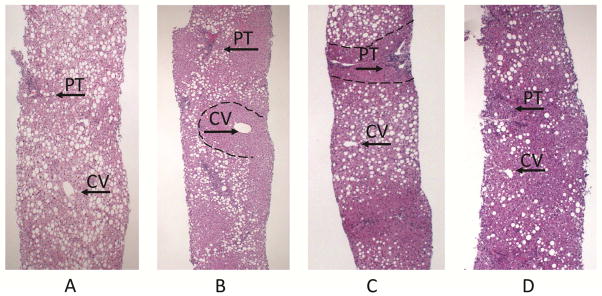
BACKGROUND & AIMS: Focal zone 1 steatosis, although rare in adults with nonalcoholic fatty liver disease (NAFLD), does occur in children with NAFLD. We investigated whether focal zone 1 steatosis and focal zone 3 steatosis are distinct subphenotypes of pediatric NAFLD. We aimed to determine associations between the zonality of steatosis and demographic, clinical, and histologic features in children with NAFLD.
We performed a cross-sectional study of baseline data from 813 children (age <18 years; mean age, 12.8 ± 2.7 years). The subjects had biopsy-proven NAFLD and were enrolled in the Nonalcoholic Steatohepatitis Clinical Research Network. Liver histology was reviewed using the Nonalcoholic Steatohepatitis Clinical Research Network scoring system.
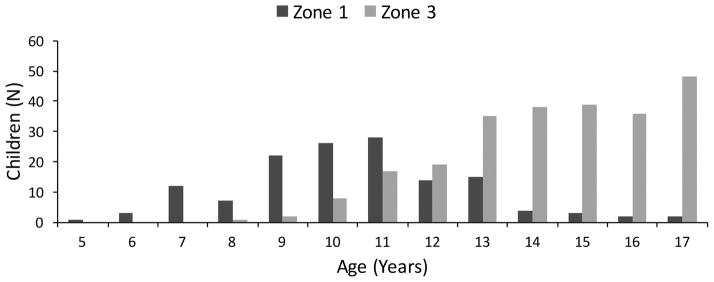
Zone 1 steatosis was present in 18% of children with NAFLD (n = 146) and zone 3 steatosis was present in 32% (n = 244). Children with zone 1 steatosis were significantly younger (10 vs 14 years; P < .001) and a significantly higher proportion had any fibrosis (81% vs 51%; P < .001) or advanced fibrosis (13% vs 5%; P < .001) compared with children with zone 3 steatosis. In contrast, children with zone 3 steatosis were significantly more likely to have steatohepatitis (30% vs 6% in children with zone 1 steatosis; P < .001).
Children with zone 1 or zone 3 distribution of steatosis have an important subphenotype of pediatric NAFLD. Children with zone 1 steatosis are more likely to have advanced fibrosis and children with zone 3 steatosis are more likely to have steatohepatitis. To achieve a comprehensive understanding of pediatric NAFLD, studies of pathophysiology, natural history, and response to treatment should account for the zonality of steatosis.
虽然非酒精性脂肪性肝病(NAFLD)成人患者中罕见出现局灶性 1 区脂肪变性,但在儿童 NAFLD 患者中确实存在。我们研究了局灶性 1 区脂肪变性和局灶性 3 区脂肪变性是否为儿童 NAFLD 的不同亚表型。我们旨在确定儿童 NAFLD 患者脂肪变性的区域性与人口统计学、临床和组织学特征之间的相关性。
我们对 813 名(年龄<18 岁;平均年龄 12.8±2.7 岁)经活检证实的 NAFLD 患儿的基线数据进行了横断面研究。这些患儿均来自非酒精性脂肪性肝炎临床研究网络(Nonalcoholic Steatohepatitis Clinical Research Network,NASH CRN),并接受了肝组织学检查,使用 NASH CRN 评分系统进行评分。
18%(n=146)的 NAFLD 患儿存在 1 区脂肪变性,32%(n=244)的患儿存在 3 区脂肪变性。与存在 3 区脂肪变性的患儿相比,存在 1 区脂肪变性的患儿更年轻(10 岁 vs 14 岁;P<0.001),且任何纤维化(81% vs 51%;P<0.001)或进展性纤维化(13% vs 5%;P<0.001)的比例更高。相比之下,存在 3 区脂肪变性的患儿发生脂肪性肝炎的可能性显著更高(30% vs 1 区脂肪变性患儿的 6%;P<0.001)。
存在 1 区或 3 区脂肪变性分布的患儿具有儿童 NAFLD 的重要亚表型。存在 1 区脂肪变性的患儿更可能发生进展性纤维化,而存在 3 区脂肪变性的患儿更可能发生脂肪性肝炎。为了全面了解儿童 NAFLD,对其发病机制、自然病史和治疗反应的研究应考虑脂肪变性的区域性。