Jarosiewicz Beata, Sarma Anish A, Saab Jad, Franco Brian, Cash Sydney S, Eskandar Emad N, Hochberg Leigh R
Neuroscience, Brown University, Providence, RI 02912, United States; Center for Neurorestoration and Neurotechnology, Rehabilitation R&D Service, Veterans Affairs Medical Center, Providence, RI 02908, United States; Brown Institute for Brain Science, Brown University, Providence, RI 02912, United States.
Center for Neurorestoration and Neurotechnology, Rehabilitation R&D Service, Veterans Affairs Medical Center, Providence, RI 02908, United States; Brown Institute for Brain Science, Brown University, Providence, RI 02912, United States; School of Engineering, Brown University, Providence, RI 02912, United States.
J Physiol Paris. 2016 Nov;110(4 Pt A):382-391. doi: 10.1016/j.jphysparis.2017.03.001. Epub 2017 Mar 8.
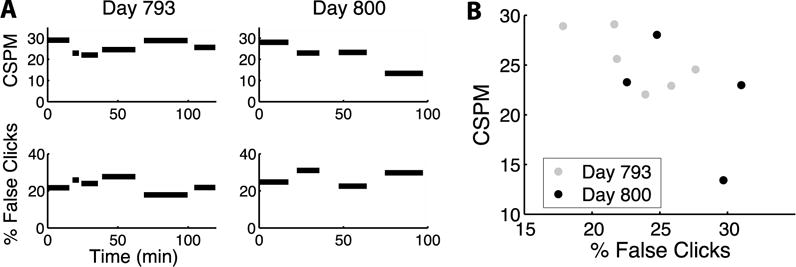
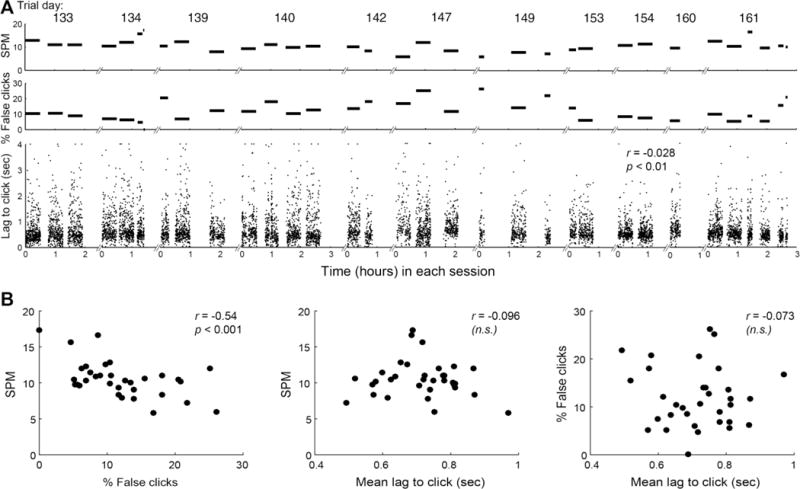
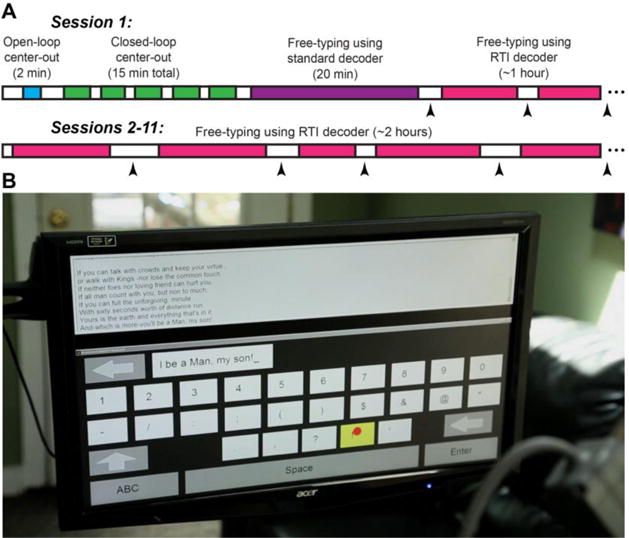
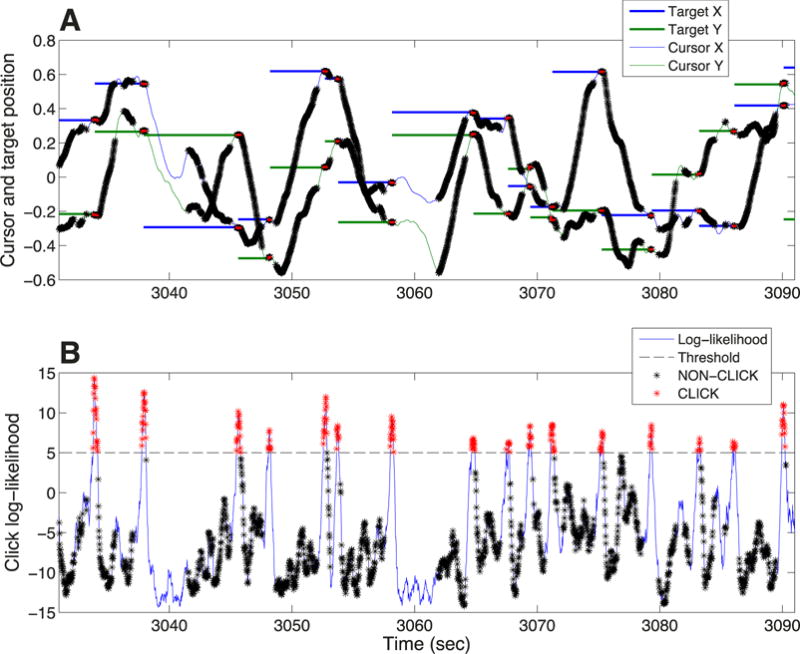
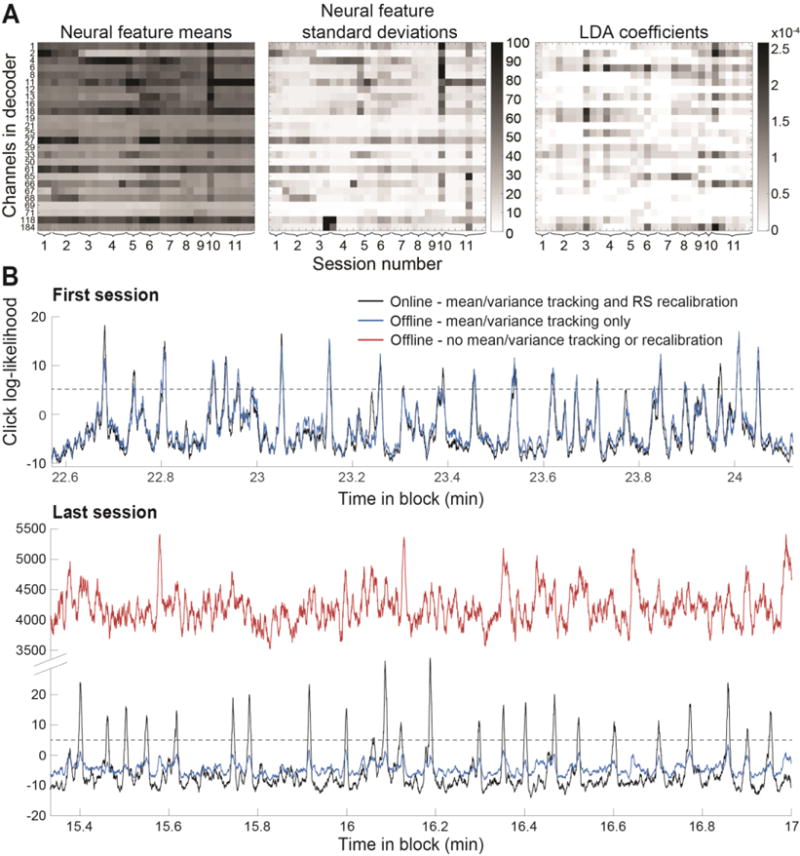
Brain-computer interfaces (BCIs) aim to restore independence to people with severe motor disabilities by allowing control of acursor on a computer screen or other effectors with neural activity. However, physiological and/or recording-related nonstationarities in neural signals can limit long-term decoding stability, and it would be tedious for users to pause use of the BCI whenever neural control degrades to perform decoder recalibration routines. We recently demonstrated that a kinematic decoder (i.e. a decoder that controls cursor movement) can be recalibrated using data acquired during practical point-and-click control of the BCI by retrospectively inferring users' intended movement directions based on their subsequent selections. Here, we extend these methods to allow the click decoder to also be recalibrated using data acquired during practical BCI use. We retrospectively labeled neural data patterns as corresponding to "click" during all time bins in which the click log-likelihood (decoded using linear discriminant analysis, or LDA) had been above the click threshold that was used during real-time neural control. We labeled as "non-click" those periods that the kinematic decoder's retrospective target inference (RTI) heuristics determined to be consistent with intended cursor movement. Once these neural activity patterns were labeled, the click decoder was calibrated using standard supervised classifier training methods. Combined with real-time bias correction and baseline firing rate tracking, this set of "retrospectively labeled" decoder calibration methods enabled a BrainGate participant with amyotrophic lateral sclerosis (T9) to type freely across 11 research sessions spanning 29days, maintaining high-performance neural control over cursor movement and click without needing to interrupt virtual keyboard use for explicit calibration tasks. By eliminating the need for tedious calibration tasks with prescribed targets and pre-specified click times, this approach advances the potential clinical utility of intracortical BCIs for individuals with severe motor disability.
脑机接口(BCIs)旨在通过利用神经活动来控制计算机屏幕上的光标或其他效应器,从而恢复严重运动功能障碍患者的自理能力。然而,神经信号中的生理和/或记录相关的非平稳性会限制长期解码稳定性,并且每当神经控制能力下降时用户都要暂停使用BCI来执行解码器重新校准程序,这会很繁琐。我们最近证明,运动解码器(即控制光标移动的解码器)可以通过回顾性地根据用户随后的选择推断其预期的运动方向,使用在BCI实际点击控制过程中获取的数据来重新校准。在此,我们扩展这些方法,使点击解码器也能使用在BCI实际使用过程中获取的数据进行重新校准。我们回顾性地将神经数据模式标记为在所有时间间隔内对应于“点击”,在这些时间间隔内,点击对数似然值(使用线性判别分析或LDA解码)高于实时神经控制期间使用的点击阈值。我们将运动解码器的回顾性目标推断(RTI)启发式方法确定为与预期光标移动一致的那些时间段标记为“非点击”。一旦这些神经活动模式被标记,点击解码器就使用标准的监督分类器训练方法进行校准。结合实时偏差校正和基线放电率跟踪,这组“回顾性标记”的解码器校准方法使一名患有肌萎缩侧索硬化症(T9)的BrainGate参与者能够在跨越29天的11次研究 sessions中自由打字,在无需中断虚拟键盘使用以进行明确校准任务的情况下,对光标移动和点击保持高性能的神经控制。通过消除对具有规定目标和预先指定点击时间的繁琐校准任务的需求,这种方法提高了皮层内BCIs对严重运动功能障碍个体的潜在临床效用。