Fong Yao, Wu Chang-Yi, Chang Kuo-Feng, Chen Bing-Hung, Chou Wan-Ju, Tseng Chih-Hua, Chen Yen-Chun, Wang Hui-Min David, Chen Yeh-Long, Chiu Chien-Chih
Department of Thoracic Surgery, Chi-Mei Medical Center, Tainan, 710 Taiwan.
Department of Biological Sciences, National Sun Yat-sen University, Kaohsiung, 804 Taiwan.
Cancer Cell Int. 2017 Mar 7;17:37. doi: 10.1186/s12935-017-0403-0. eCollection 2017.
2,9-Bis[2-(pyrrolidin-1-yl)ethoxy]-6-{4-[2-(pyrrolidin-1-yl)ethoxy] phenyl}-11-indeno[1,2-]quinoline-11-one (BPIQ), is a synthetic quinoline analog. A previous study showed the anti-cancer potential of BPIQ through modulating mitochondrial-mediated apoptosis. However, the effect of BPIQ on cell migration, an index of cancer metastasis, has not yet been examined. Furthermore, among signal pathways involved in stresses, the members of the mitogen-activated protein kinase (MAPK) family are crucial for regulating the survival and migration of cells. In this study, the aim was to explore further the role of MAPK members, including JNK, p38 and extracellular signal-regulated kinase (ERK) in BPIQ-induced apoptosis and anti-migration of human non-small cell lung cancer (NSCLC) cells.
Western Blot assay was performed for detecting the activation of MAPK members in NSCLC H1299 cells following BPIQ administration. Cellular proliferation was determined using a trypan blue exclusion assay. Cellular apoptosis was detected using flow cytometer-based Annexin V/propidium iodide dual staining. Cellular migration was determined using wound-healing assay and Boyden's chamber assay. Zymography assay was performed for examining MMP-2 and -9 activities. The assessment of MAPK inhibition was performed for further validating the role of JNK, p38, and ERK in BPIQ-induced growth inhibition, apoptosis, and migration of NSCLC cells.
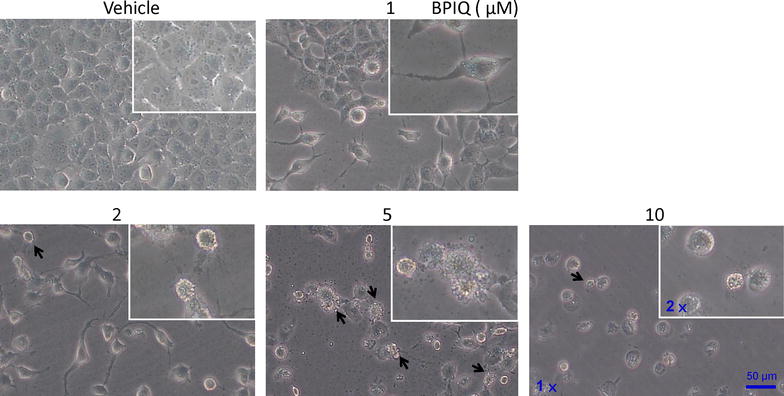
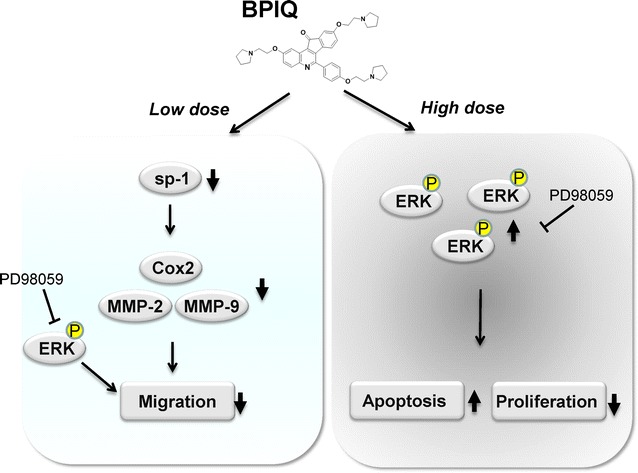
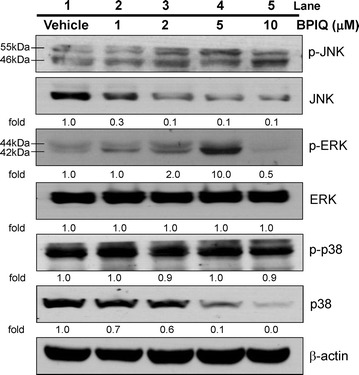
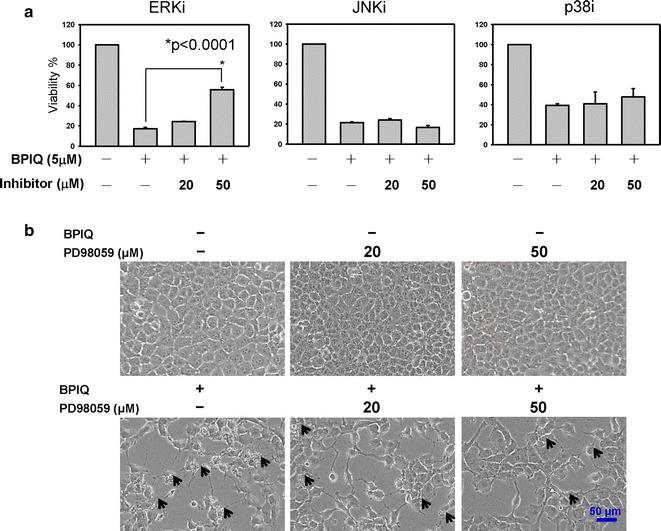
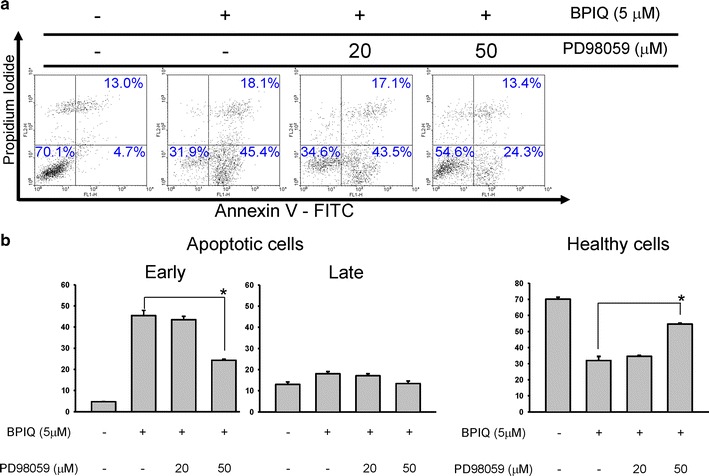
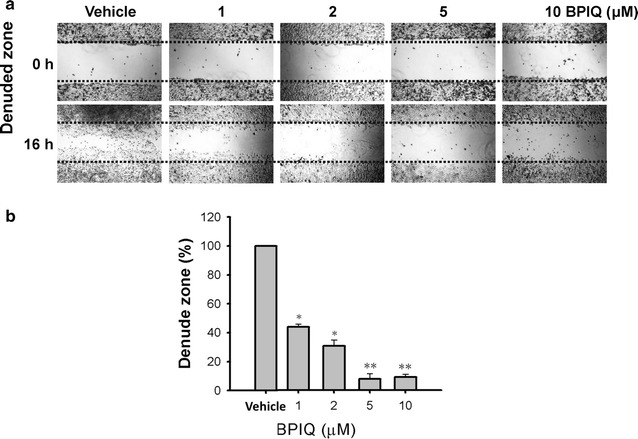
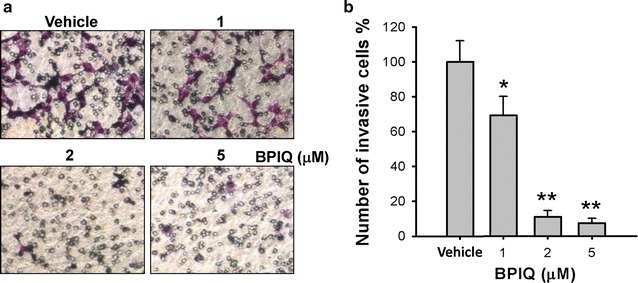
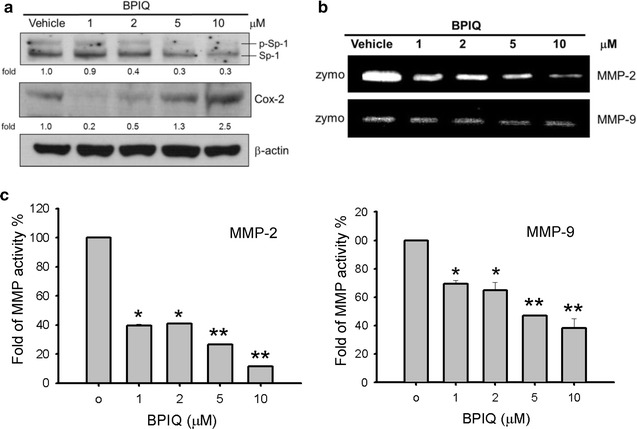
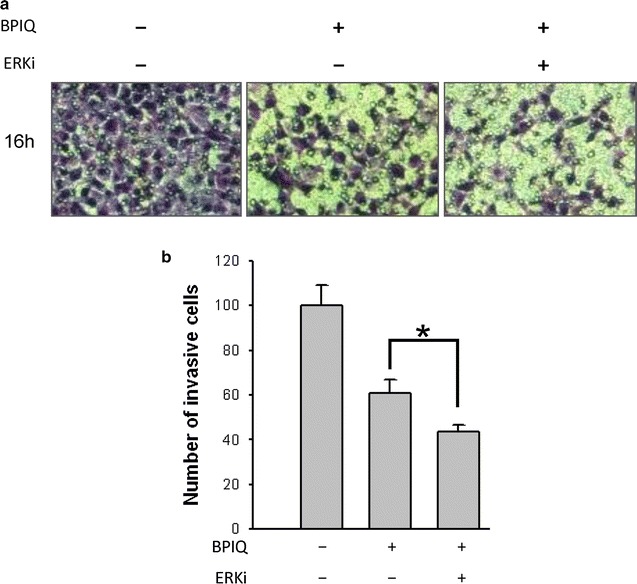
Western Blot assay showed that BPIQ treatment upregulates the phosphorylated levels of both MAPK proteins JNK and ERK. However, only ERK inhibitor rescues BPIQ-induced growth inhibition of NSCLC H1299 cells. The results of Annexin V assay further confirmed the pro-apoptotic role of ERK in BPIQ-induced cell death of H1299 cells. The results of wound healing and Boyden chamber assays showed that sub-IC (sub-lethal) concentrations of BPIQ cause a significant inhibition of migration in H1299 cells accompanied with downregulating the activity of MMP-2 and -9, the motility index of cancer cells. Inhibition of ERK significantly enhances BPIQ-induced anti-migration of H1299 cells.
Our results suggest ERK may play dual roles in BPIQ-induced apoptosis and anti-migration, and it would be worthwhile further developing strategies for treating chemoresistant lung cancers through modulating ERK activity.
2,9-双[2-(吡咯烷-1-基)乙氧基]-6-{4-[2-(吡咯烷-1-基)乙氧基]苯基}-11-茚并[1,2-]喹啉-11-酮(BPIQ)是一种合成喹啉类似物。先前的一项研究表明BPIQ通过调节线粒体介导的凋亡具有抗癌潜力。然而,BPIQ对作为癌症转移指标的细胞迁移的影响尚未得到研究。此外,在参与应激的信号通路中,丝裂原活化蛋白激酶(MAPK)家族成员对于调节细胞的存活和迁移至关重要。在本研究中,目的是进一步探讨MAPK成员,包括JNK、p38和细胞外信号调节激酶(ERK)在BPIQ诱导的人非小细胞肺癌(NSCLC)细胞凋亡和抗迁移中的作用。
进行蛋白质免疫印迹分析以检测给予BPIQ后NSCLC H1299细胞中MAPK成员的激活情况。使用台盼蓝排斥试验测定细胞增殖。使用基于流式细胞仪的膜联蛋白V/碘化丙啶双重染色检测细胞凋亡。使用伤口愈合试验和博伊登小室试验测定细胞迁移。进行酶谱分析以检测MMP-2和-9的活性。进行MAPK抑制评估以进一步验证JNK、p38和ERK在BPIQ诱导的NSCLC细胞生长抑制、凋亡和迁移中的作用。
蛋白质免疫印迹分析表明,BPIQ处理上调了MAPK蛋白JNK和ERK的磷酸化水平。然而,只有ERK抑制剂能挽救BPIQ诱导的NSCLC H1299细胞生长抑制。膜联蛋白V试验结果进一步证实了ERK在BPIQ诱导的H1299细胞死亡中的促凋亡作用。伤口愈合试验和博伊登小室试验结果表明,亚致死浓度的BPIQ可显著抑制H1299细胞的迁移,并伴随MMP-2和-9活性的下调,MMP-2和-9是癌细胞的运动指标。抑制ERK可显著增强BPIQ诱导的H1299细胞抗迁移能力。
我们的结果表明ERK可能在BPIQ诱导的凋亡和抗迁移中发挥双重作用,通过调节ERK活性进一步开发治疗化疗耐药肺癌的策略将是值得的。