Wobst Heike J, Wesolowski Steven S, Chadchankar Jayashree, Delsing Louise, Jacobsen Steven, Mukherjee Jayanta, Deeb Tarek Z, Dunlop John, Brandon Nicholas J, Moss Stephen J
AstraZeneca-Tufts Laboratory for Basic and Translational Neuroscience, Department of Neuroscience, Tufts University School of Medicine, Boston MA, USA.
IMED Biotech Unit, AstraZeneca Neuroscience IMED, AstraZeneca, Cambridge MA, USA.
Front Mol Neurosci. 2017 Feb 24;10:46. doi: 10.3389/fnmol.2017.00046. eCollection 2017.
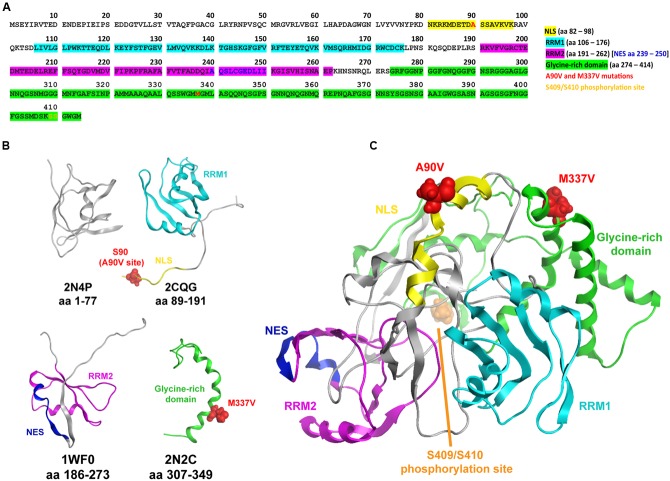
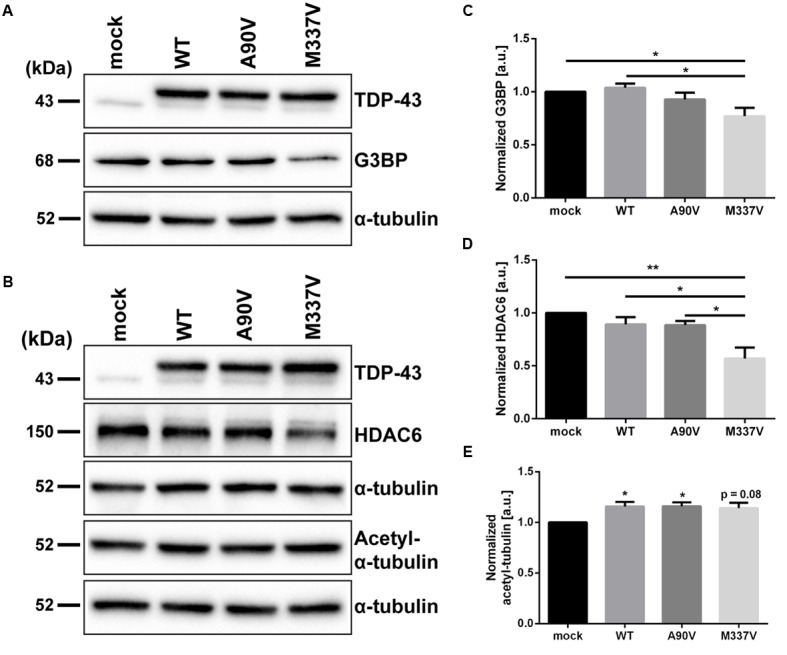
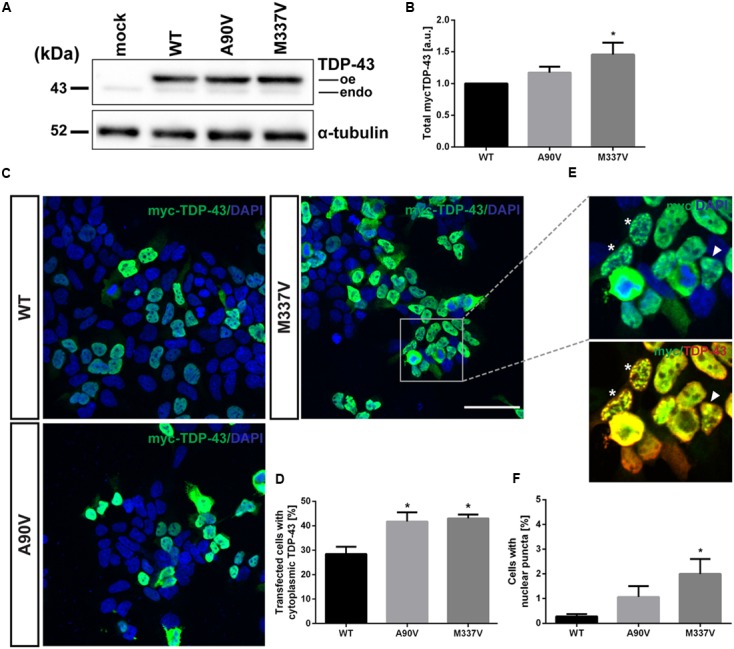
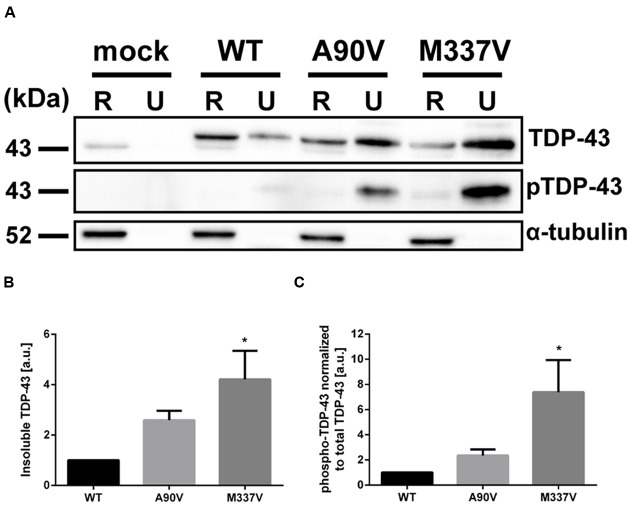
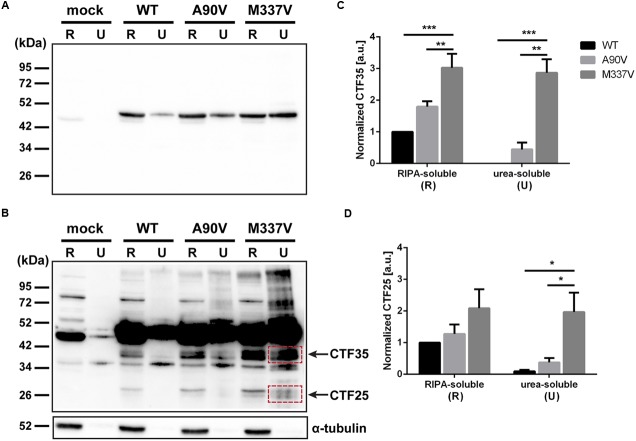
Mutations in the gene , which encodes TAR DNA-binding protein 43 (TDP-43), are a rare cause of familial forms of amyotrophic lateral sclerosis (ALS) and frontotemporal dementia (FTD). While the majority of mutations are found in the C-terminal glycine-rich domain, an alanine to valine amino acid change at position 90 (A90V) in the bipartite nuclear localization signal (NLS) of TDP-43 has been described. This sequence variant has previously been shown to cause cytoplasmic mislocalization of TDP-43 and decrease protein solubility, leading to the formation of insoluble aggregates. Since the A90V mutation has been described both in patients as well as healthy controls, its pathogenic potential in ALS and FTD remains unclear. Here we compare properties of overexpressed A90V to the highly pathogenic M337V mutation. Though both mutations drive mislocalization of the protein to the cytoplasm to the same extent, M337V produces more significant damage in terms of protein solubility, levels of pathogenic phosphorylation, and formation of C-terminal truncated protein species. Furthermore, the M337V, but not the A90V mutant, leads to a downregulation of histone deacetylase 6 and Ras GTPase-activating protein-binding protein. We conclude that in the absence of another genetic or environmental 'hit' the A90V variant is not sufficient to cause the deleterious phenotypes associated with ALS and FTD, despite prominent cytoplasmic protein relocalization of TDP-43.
编码TAR DNA结合蛋白43(TDP - 43)的基因突变是家族性肌萎缩侧索硬化症(ALS)和额颞叶痴呆(FTD)的罕见病因。虽然大多数突变发生在富含甘氨酸的C末端结构域,但已发现TDP - 43的双分核定位信号(NLS)中第90位氨基酸由丙氨酸变为缬氨酸(A90V)。此前已表明该序列变异会导致TDP - 43在细胞质中错误定位并降低蛋白质溶解度,从而导致不溶性聚集体的形成。由于A90V突变在患者和健康对照中均有报道,其在ALS和FTD中的致病潜力仍不清楚。在此,我们将过表达的A90V与高致病性的M337V突变的特性进行比较。尽管两种突变都在相同程度上促使蛋白质错误定位到细胞质中,但就蛋白质溶解度、致病性磷酸化水平和C末端截短蛋白物种的形成而言,M337V造成的损害更为显著。此外,M337V突变体而非A90V突变体导致组蛋白脱乙酰酶6和Ras GTP酶激活蛋白结合蛋白下调。我们得出结论,在没有其他遗传或环境“打击”的情况下,尽管TDP - 43在细胞质中蛋白重新定位明显,但A90V变异不足以导致与ALS和FTD相关的有害表型。