Oliveira Pedro, Ribeiro Joana, Donato Helena, Madeira Nuno
Psychiatry Department, Coimbra Hospital University Centre, Praceta Mota Pinto, 3000-075 Coimbra, Portugal.
Documentation Department, Coimbra Hospital University Centre, Coimbra, Portugal.
Ann Gen Psychiatry. 2017 Mar 6;16:17. doi: 10.1186/s12991-017-0140-8. eCollection 2017.
Despite an increasingly recognized relationship between depression and smoking, little is known about how smoking influences antidepressant response and treatment outcomes. The aim of this study was to systematically review the evidence of the impact of smoking on new-generation antidepressants with an emphasis on the pharmacokinetic perspective.
We present a systematic review of clinical trials comparing the serum levels of new-generation antidepressants in smokers and nonsmokers. Data were obtained from MEDLINE/PubMed, Embase, and other sources. Risk of bias was assessed for selection, performance, detection, attrition, and reporting of individual studies.
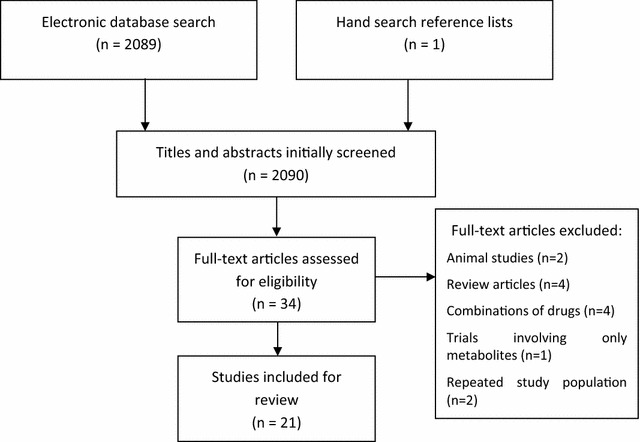
Twenty-one studies met inclusion criteria; seven involved fluvoxamine, two evaluated fluoxetine, sertraline, venlafaxine, duloxetine or mirtazapine, and escitalopram, citalopram, trazodone and bupropion were the subject of a single study. No trials were found involving other common antidepressants such as paroxetine or agomelatine. Serum levels of fluvoxamine, duloxetine, mirtazapine and trazodone were significantly higher in nonsmokers compared with smokers.
There is evidence showing a reduction in the concentration of serum levels of fluvoxamine, duloxetine, mirtazapine and trazodone in smoking patients as compared to nonsmokers. The evidence regarding other commonly used antidepressants is scarce. Nonetheless, smoking status should be considered when choosing an antidepressant treatment, given the risk of pharmacokinetic interactions.
尽管抑郁症与吸烟之间的关系日益受到认可,但对于吸烟如何影响抗抑郁反应和治疗结果却知之甚少。本研究的目的是从药代动力学角度系统回顾吸烟对新一代抗抑郁药影响的证据。
我们对比较吸烟者和非吸烟者新一代抗抑郁药血清水平的临床试验进行了系统回顾。数据来自MEDLINE/PubMed、Embase和其他来源。对个体研究的选择、实施、检测、失访和报告的偏倚风险进行了评估。
21项研究符合纳入标准;7项涉及氟伏沙明,2项评估了氟西汀、舍曲林、文拉法辛、度洛西汀或米氮平,而艾司西酞普兰、西酞普兰、曲唑酮和安非他酮则是单项研究的主题。未发现涉及其他常见抗抑郁药如帕罗西汀或阿戈美拉汀的试验。与吸烟者相比,非吸烟者的氟伏沙明、度洛西汀、米氮平和曲唑酮血清水平显著更高。
有证据表明,与非吸烟者相比,吸烟患者体内氟伏沙明、度洛西汀、米氮平和曲唑酮的血清水平浓度降低。关于其他常用抗抑郁药的证据很少。尽管如此,鉴于药代动力学相互作用的风险,在选择抗抑郁治疗时应考虑吸烟状况。