Zhang Shaocun, Cao Xiaocang, Huang He
Department of Biochemical Engineering, School of Chemical Engineering and Technology, Tianjin UniversityTianjin, China; Key Laboratory of Systems Bioengineering, Ministry of Education, Tianjin UniversityTianjin, China; Collaborative Innovation Center of Chemical Science and EngineeringTianjin, China.
Department of Gastroenterology and Hepatology, Tianjin Medical University General Hospital; Tianjin Medical University Tianjin, China.
Front Cell Infect Microbiol. 2017 Feb 24;7:51. doi: 10.3389/fcimb.2017.00051. eCollection 2017.
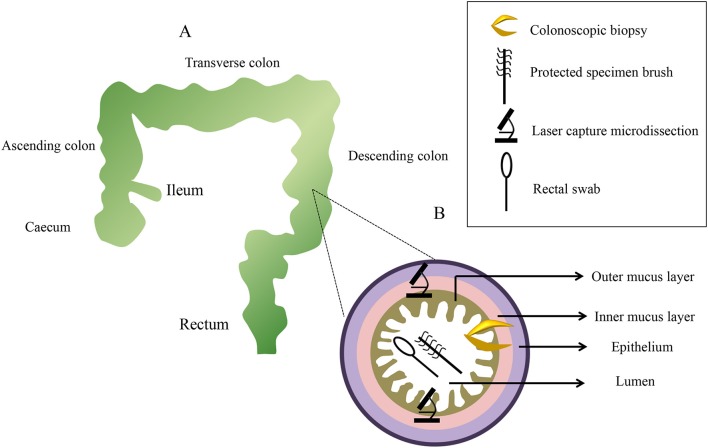
Identifying intestinal microbiota is arguably an important task that is performed to determine the pathogenesis of inflammatory bowel diseases (IBD); thus, it is crucial to collect and analyze intestinally-associated microbiota. Analyzing a single niche to categorize individuals does not enable researchers to comprehensively study the spatial variations of the microbiota. Therefore, characterizing the spatial community structures of the inflammatory bowel disease microbiome is critical for advancing our understanding of the inflammatory landscape of IBD. However, at present there is no universally accepted consensus regarding the use of specific sampling strategies in different biogeographic locations. In this review, we discuss the spatial distribution when screening sample collections in IBD microbiota research. Here, we propose a novel model, a three-dimensional spatial community structure, which encompasses the x-, y-, and z-axis distributions; it can be used in some sampling sites, such as feces, colonoscopic biopsy, the mucus gel layer, and oral cavity. On the basis of this spatial model, this article also summarizes various sampling and processing strategies prior to and after DNA extraction and recommends guidelines for practical application in future research.
识别肠道微生物群可以说是一项重要任务,其目的是确定炎症性肠病(IBD)的发病机制;因此,收集和分析肠道相关微生物群至关重要。仅分析单一生态位来对个体进行分类,无法使研究人员全面研究微生物群的空间变化。因此,表征炎症性肠病微生物组的空间群落结构对于加深我们对IBD炎症格局的理解至关重要。然而,目前对于在不同生物地理区域使用特定采样策略尚无普遍接受的共识。在本综述中,我们讨论了IBD微生物群研究中筛选样本采集时的空间分布。在此,我们提出了一种新模型,即三维空间群落结构,它涵盖了x、y和z轴分布;该模型可用于一些采样部位,如粪便、结肠镜活检、黏液凝胶层和口腔。基于此空间模型,本文还总结了DNA提取前后的各种采样和处理策略,并推荐了未来研究实际应用的指南。