Bi X, Henry C J
Clinical Nutrition Research Centre (CNRC), Singapore Institute for Clinical Sciences (SICS), Agency for Science, Technology and Research (A*STAR), Singapore, Singapore.
Department of Biochemistry, Yong Loo Lin School of Medicine, National University of Singapore, Singapore, Singapore.
Nutr Diabetes. 2017 Mar 13;7(3):e249. doi: 10.1038/nutd.2016.55.
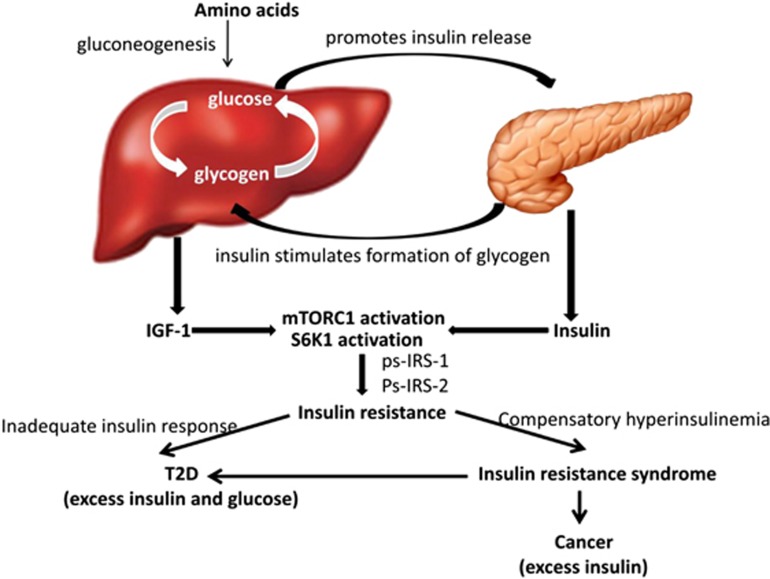
Type 2 diabetes (T2D) and cancers are two major causes of morbidity and mortality worldwide. Nowadays, there is convincing evidence of positive associations between T2D and the incidence or prognosis of a wide spectrum of cancers, for example, breast, colon, liver and pancreas. Many observational studies suggest that certain medications used to treat hyperglycemia (or T2D) may affect cancer cells directly or indirectly. The potential mechanisms of the direct T2D cancer links have been hypothesized to be hyperinsulinemia, hyperglycemia and chronic inflammation; however, the metabolic pathways that lead to T2D and cancers still remain elusive. Plasma-free amino acid (PFAA) profiles have been highlighted in their associations with the risks of developing T2D and cancers in individuals with different ethnic groups and degree of obesity. The alterations of PFAAs might be predominately caused by the metabolic shift resulted from insulin resistance. The underlying mechanisms have not been fully elucidated, in particular whether the amino acids are contributing to these diseases development in a causal manner. This review addresses the molecular and clinical associations between PFAA alterations and both T2D and cancers, and interprets possible mechanisms involved. Revealing these interactions and mechanisms may improve our understanding of the complex pathogenesis of diabetes and cancers and improve their treatment strategies.
2型糖尿病(T2D)和癌症是全球发病和死亡的两大主要原因。如今,有令人信服的证据表明T2D与多种癌症的发病率或预后之间存在正相关,例如乳腺癌、结肠癌、肝癌和胰腺癌。许多观察性研究表明,某些用于治疗高血糖(或T2D)的药物可能直接或间接影响癌细胞。T2D与癌症直接关联的潜在机制据推测为高胰岛素血症、高血糖和慢性炎症;然而,导致T2D和癌症的代谢途径仍然不明。游离氨基酸(PFAA)谱在不同种族和肥胖程度个体中与发生T2D和癌症的风险之间的关联方面受到关注。PFAA的改变可能主要由胰岛素抵抗导致的代谢转变引起。其潜在机制尚未完全阐明,尤其是氨基酸是否以因果方式促成这些疾病的发展。本综述探讨了PFAA改变与T2D和癌症之间的分子和临床关联,并解释了其中可能涉及的机制。揭示这些相互作用和机制可能会增进我们对糖尿病和癌症复杂发病机制的理解,并改善其治疗策略。