Federman Alex D, Kil Natalie, Kannry Joseph, Andreopolous Evie, Toribio Wilma, Lyons Joanne, Singer Mark, Yartel Anthony, Smith Bryce D, Rein David B, Krauskopf Katherine
*Division of General Internal Medicine, Icahn School of Medicine at Mount Sinai †Mount Sinai Health System, New York, NY ‡Centers for Disease Control and Prevention, Atlanta, GA §NORC at the University of Chicago, Chicago, IL ∥Department of Health Evidence and Policy, Icahn School of Medicine at Mount Sinai, New York, NY ¶Valley Medical Group, Greenfield, MA.
Med Care. 2017 Jun;55(6):590-597. doi: 10.1097/MLR.0000000000000715.
The Centers for Disease Control and Prevention (CDC) recommends one-time hepatitis C virus (HCV) antibody testing for "Birth Cohort" adults born during 1945-1965.
To examine the impact of an electronic health record (EHR)-embedded best practice alert (BPA) for HCV testing among Birth Cohort adults.
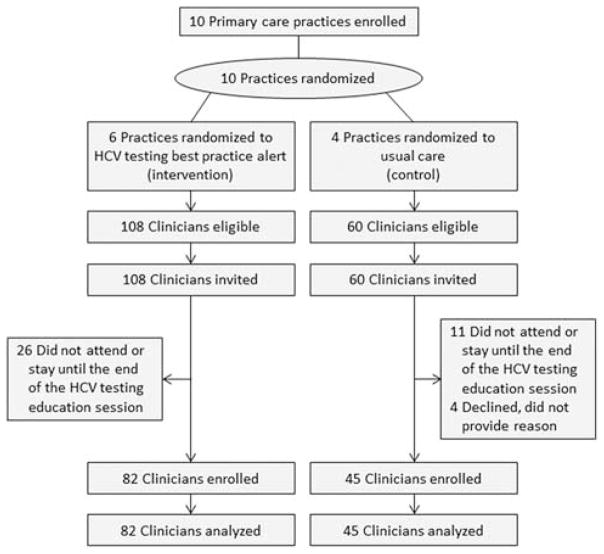
Cluster-randomized trial was conducted from April 29, 2013 to March 29, 2014.
Ten community and hospital-based primary care practices. Participants were attending physicians and medical residents during 25,620 study-eligible visits.
Physicians in all practices received a brief introduction to the CDC testing recommendations. At visits for eligible patients at intervention sites, physicians received a BPA through the EHR to order HCV testing or medical assistants were prompted to post a testing order for the physician. Physicians in control sites did not receive the BPA.
HCV testing; the incidence of HCV antibody positive tests was a secondary outcome.
Testing rates were greater among Birth Cohort patients in intervention sites (20.2% vs. 1.8%, P<0.0001) and the odds of testing were greater in intervention sites after controlling for imbalances of patient and visit characteristics between comparison groups [odds ratio (OR), 9.0; 95% confidence interval, 7.6-10.7). The adjusted OR of identifying HCV antibody positive patients was also greater in intervention sites (OR, 2.1; 95% confidence interval, 1.3-11.2).
An EHR-embedded BPA markedly increased HCV testing among Birth Cohort patients, but the majority of eligible patients did not receive testing indicating a need for more effective methods to promote uptake.
疾病控制与预防中心(CDC)建议对1945年至1965年出生的“出生队列”成年人进行一次性丙型肝炎病毒(HCV)抗体检测。
探讨电子健康记录(EHR)嵌入的最佳实践警报(BPA)对出生队列成年人HCV检测的影响。
于2013年4月29日至2014年3月29日进行整群随机试验。
10个社区和医院基层医疗实践机构。参与者为25620次符合研究条件的就诊期间的主治医生和住院医师。
所有医疗机构的医生都接受了CDC检测建议的简要介绍。在干预地点对符合条件的患者进行就诊时,医生通过电子健康记录收到BPA以开具HCV检测医嘱,或者医疗助理被提示为医生张贴检测医嘱。对照地点的医生未收到BPA。
HCV检测;HCV抗体阳性检测的发生率为次要结局。
干预地点出生队列患者的检测率更高(20.2%对1.8%,P<0.0001),在控制了比较组之间患者和就诊特征的不平衡后,干预地点的检测几率更高[优势比(OR),9.0;95%置信区间,7.6 - 10.7]。干预地点识别HCV抗体阳性患者的调整后OR也更高(OR,2.1;95%置信区间,1.3 - 11.2)。
电子健康记录嵌入的BPA显著增加了出生队列患者的HCV检测,但大多数符合条件的患者未接受检测,表明需要更有效的方法来促进检测的接受度。