Hsu Jun-Te, Liao Jian-Ann, Chuang Huei-Chieh, Chen Tai-Di, Chen Tsung-Hsing, Kuo Chia-Jung, Lin Chun-Jung, Chou Wen-Chi, Yeh Ta-Sen, Jan Yi-Yin
Department of Surgery, Chang Gung Memorial Hospital at Linkou, Chang Gung University College of Medicine, #5, Fushing Street, Kweishan District, Taoyuan City, 333, Taiwan.
Department of Pathology, Chang Gung Memorial Hospital at Linkou, Chang Gung University College of Medicine, Taoyuan City, 333, Taiwan.
BMC Palliat Care. 2017 Mar 14;16(1):19. doi: 10.1186/s12904-017-0192-1.
Salvage chemotherapy is the mainstay of treatment for metastatic gastric cancer (mGC). This study aimed to clarify the effects of palliative gastrectomy (PG) and identify prognostic factors in mGC patients undergoing PG.
This was a retrospective review of 333 mGC patients receiving PG or a non-resection procedure (NR) between 2000 and 2010. Clinicopathological factors affecting the prognosis of these patients were collected prospectively and analyzed.
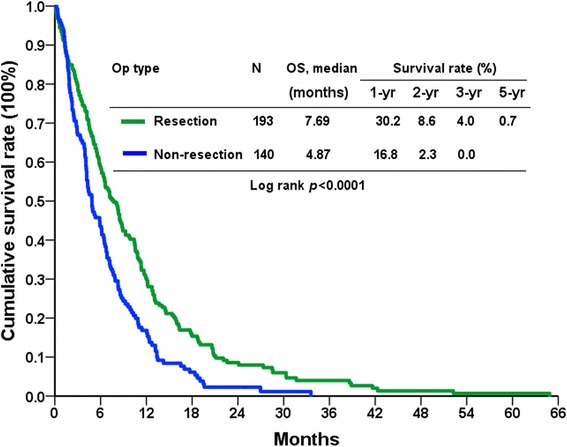
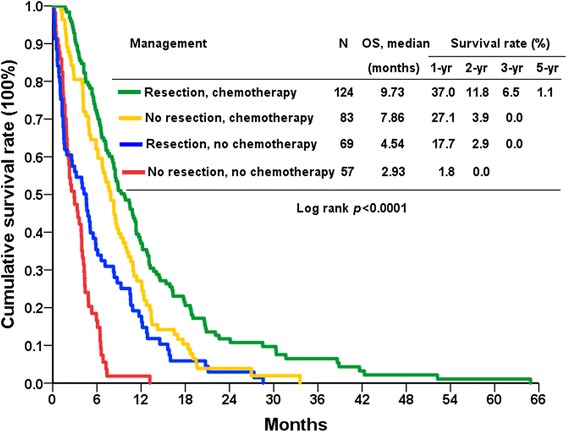
One hundred and ninety-three patients underwent PG and 140 NR. The clinicopathological characteristics were comparable between the two groups except for metastatic pattern. There were no significant differences in postoperative morbidity and mortality between the two groups. The PG group had a significantly longer median overall survival compared with the NR group (7.7 months vs. 4.9 months). In the PG group, age ≤58 years, preoperative albumin level >3 g/dL, ratio of metastatic to examined lymph nodes ≤0.58, and administration of chemotherapy were independent prognostic factors in multivariate analysis.
Patients undergoing PG had better outcomes than those undergoing NR. Among the patients undergoing resection, age ≤58 years, a better preoperative nutritional status, less nodal involvement and postoperative chemotherapy independently affected patient survival.
挽救性化疗是转移性胃癌(mGC)治疗的主要手段。本研究旨在阐明姑息性胃切除术(PG)的疗效,并确定接受PG的mGC患者的预后因素。
这是一项对2000年至2010年间接受PG或非切除手术(NR)的333例mGC患者的回顾性研究。前瞻性收集并分析影响这些患者预后的临床病理因素。
193例患者接受了PG,140例接受了NR。除转移模式外,两组的临床病理特征具有可比性。两组术后发病率和死亡率无显著差异。与NR组相比,PG组的中位总生存期显著更长(7.7个月对4.9个月)。在PG组中,年龄≤58岁、术前白蛋白水平>3g/dL、转移淋巴结与检查淋巴结的比例≤0.58以及化疗的使用是多因素分析中的独立预后因素。
接受PG的患者比接受NR的患者预后更好。在接受切除术的患者中,年龄≤58岁、术前营养状况较好、淋巴结受累较少以及术后化疗独立影响患者生存。