Ward Phillip G D, Fan Audrey P, Raniga Parnesh, Barnes David G, Dowe David L, Ng Amanda C L, Egan Gary F
Monash Biomedical Imaging, Monash UniversityClayton, VIC, Australia; Faculty of Information Technology, Monash UniversityClayton, VIC, Australia.
Department of Radiology, Lucas Center for Imaging, Stanford University Stanford, CA, USA.
Front Neurosci. 2017 Feb 27;11:89. doi: 10.3389/fnins.2017.00089. eCollection 2017.
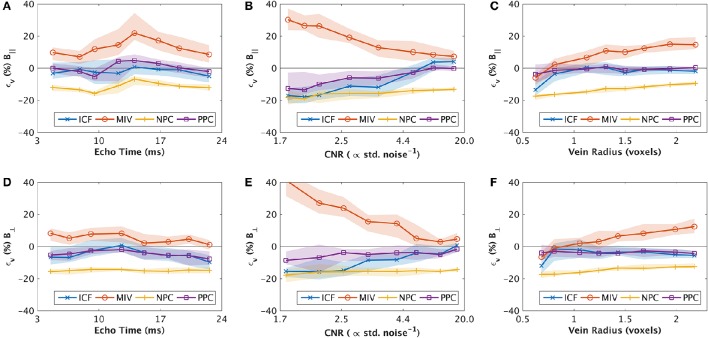
Quantitative susceptibility mapping (QSM) enables cerebral venous characterization and physiological measurements, such as oxygen extraction fraction (OEF). The exquisite sensitivity of QSM to deoxygenated blood makes it possible to image small veins; however partial volume effects must be addressed for accurate quantification. We present a new method, Iterative Cylindrical Fitting (ICF), to estimate voxel-based partial volume effects for susceptibility maps and use it to improve OEF quantification of small veins with diameters between 1.5 and 4 voxels. Simulated QSM maps were generated to assess the performance of the ICF method over a range of vein geometries with varying echo times and noise levels. The ICF method was also applied to human brain data to assess the feasibility and behavior of OEF measurements compared to the maximum intensity voxel (MIV) method. Improved quantification of OEF measurements was achieved for vessels with contrast to noise greater than 3.0 and vein radii greater than 0.75 voxels. The ICF method produced improved quantitative accuracy of OEF measurement compared to the MIV approach (mean OEF error 7.7 vs. 12.4%). The ICF method provided estimates of vein radius (mean error <27%) and partial volume maps (root mean-squared error <13%). results demonstrated consistent estimates of OEF along vein segments. OEF quantification in small veins (1.5-4 voxels in diameter) had lower error when using partial volume estimates from the ICF method.
定量磁化率成像(QSM)能够对脑静脉进行特征描述并进行生理测量,比如氧摄取分数(OEF)。QSM对脱氧血液的极高敏感性使得对小静脉成像成为可能;然而,为了进行准确量化,必须解决部分容积效应问题。我们提出了一种新方法,即迭代圆柱拟合(ICF),用于估计基于体素的磁化率图的部分容积效应,并将其用于改善直径在1.5至4个体素之间的小静脉的OEF量化。生成了模拟QSM图,以评估ICF方法在一系列具有不同回波时间和噪声水平的静脉几何形状上的性能。ICF方法还应用于人类脑数据,以评估与最大强度体素(MIV)方法相比OEF测量的可行性和表现。对于对比度噪声大于3.0且静脉半径大于0.75个体素的血管,实现了OEF测量的改进量化。与MIV方法相比,ICF方法在OEF测量上产生了更高的定量准确性(平均OEF误差分别为7.7%和12.4%)。ICF方法提供了静脉半径估计值(平均误差<27%)和部分容积图(均方根误差<13%)。结果表明沿静脉段的OEF估计值具有一致性。使用ICF方法的部分容积估计值时,小静脉(直径1.5 - 4个体素)中的OEF量化误差更低。