Lee Joon-Youn, Yoon Kyungjae, Yi Youbin, Park Chul-Hyun, Lee Jung-Sang, Seo Kyoung-Ho, Park Young Sook, Lee Yong-Taek
Department of Physical and Rehabilitation Medicine, Kangbuk Samsung Hospital, Sungkyunkwan University School of Medicine, Seoul, Korea.
Department of Physical Medicine and Rehabilitation, Dongtan Sacred Heart Hospital, Hallym University College of Medicine, Hwaseong, Korea.
Ann Rehabil Med. 2017 Feb;41(1):42-50. doi: 10.5535/arm.2017.41.1.42. Epub 2017 Feb 28.
To investigate the factors affecting prognosis of extracorporeal shockwave therapy (ESWT) for chronic refractory Achilles tendinopathy (AT).
Thirty-six patients (48 consecutive feet) with chronic AT (>6 months) and who underwent ESWT for 'poor' or 'fair' grade in Roles-Maudsley Score (RMS) after unsuccessful conservative treatment were included in the present study. A maximum of 12 sessions of ESWT were conducted until treatment success: RMS reached 'good' or 'excellent'. Termination of ESWT for no response, or 'poor' or 'fair' grade was regarded as treatment failure. Immediate outcome, long-term outcome (telephone interview after mean 26 months), and factors affecting treatment success were analyzed.
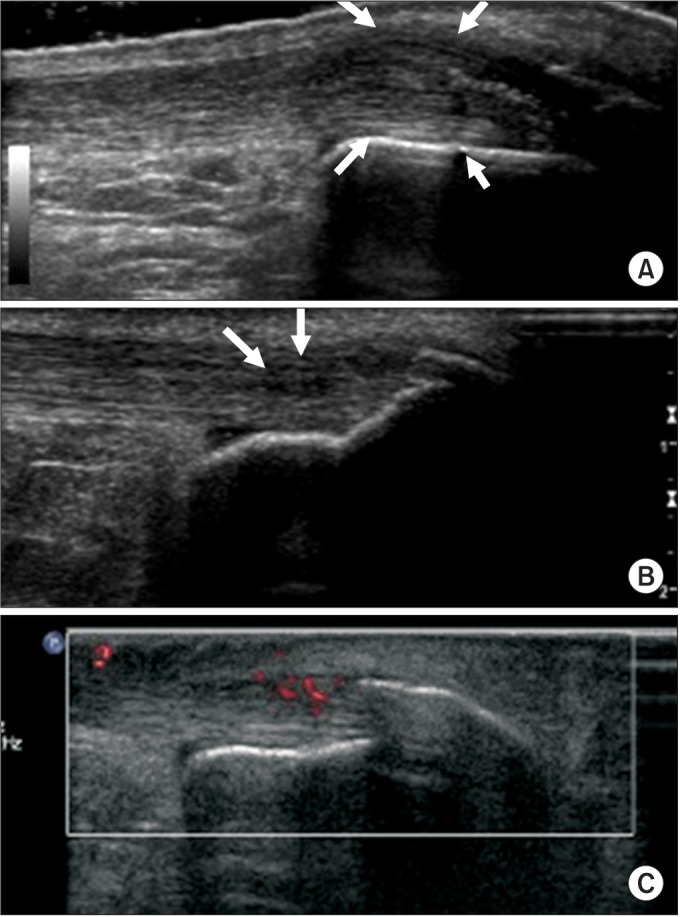
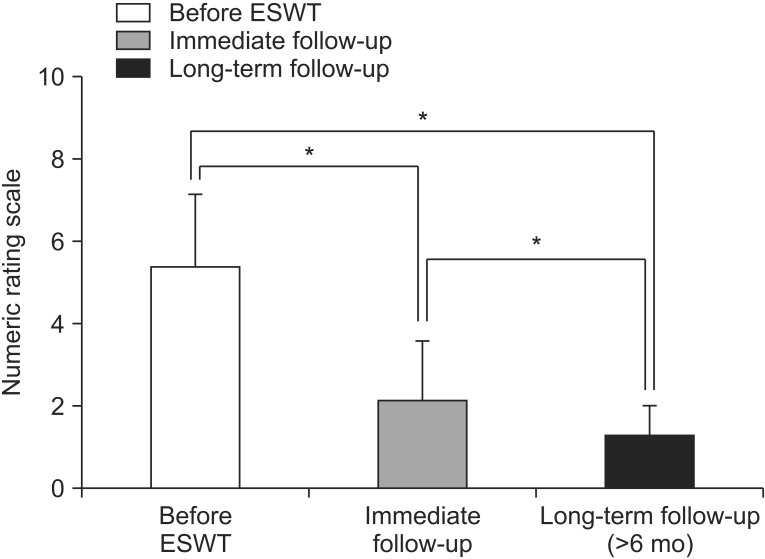
Numeric Rating Scale was significantly decreased at immediate and long-term follow-up. Success rate was 71.1% and 90.3%, respectively. Univariate logistic regression identified that immediate treatment success was associated with retrocalcaneal enthesophyte on X-ray (odds ratio [OR], 0.06; 95% confidence interval [CI], 0.01-0.28), pretreatment abnormal ultrasonography echogenicity within Achilles tendon (OR, 18.89; 95% CI, 2.08-171.96), mean duration of 'post-treatment soreness' (OR, 0.55; 95% CI, 0.33-0.94), and duration of 'post-treatment soreness after first ESWT' (OR, 0.06; 95% CI, 0.01-0.34). The duration of 'post-treatment soreness after first ESWT' was found to be the only factor associated with long-term success (OR, 0.32; 95% CI, 0.10-0.99).
ESWT appears to be effective in achieving long-term success in chronic refractory AT. Immediate success was associated with absence of retrocalcaneal enthesophyte on X-ray, presence of pretreatment abnormal ultrasonography echogenicity, shorter mean duration of 'post-treatment soreness', and shorter duration of 'post-treatment soreness after first ESWT'. The shorter duration of 'post-treatment soreness after first ESWT' was identified as the only positive prognostic parameter in achieving long-term success.
探讨影响体外冲击波疗法(ESWT)治疗慢性难治性跟腱病(AT)预后的因素。
本研究纳入36例(48侧足)慢性AT(病程>6个月)患者,这些患者在保守治疗失败后,根据Roles-Maudsley评分(RMS)为“差”或“中等”而接受ESWT治疗。ESWT最多进行12次,直至治疗成功,即RMS达到“好”或“优秀”。因无反应或RMS为“差”或“中等”而终止ESWT被视为治疗失败。分析即时疗效、长期疗效(平均26个月后的电话随访)以及影响治疗成功的因素。
数字评分量表在即时和长期随访时均显著降低。成功率分别为71.1%和90.3%。单因素逻辑回归分析显示,即时治疗成功与X线片上跟腱后结节骨赘(优势比[OR],0.06;95%置信区间[CI],0.01 - 0.28)、治疗前跟腱内超声回声异常(OR,18.89;95%CI,2.08 - 171.96)、“治疗后疼痛”的平均持续时间(OR,0.55;95%CI,0.33 - 0.94)以及“首次ESWT后治疗后疼痛”的持续时间(OR,0.06;95%CI,0.01 - 0.34)有关。发现“首次ESWT后治疗后疼痛”的持续时间是与长期成功相关的唯一因素(OR,0.32;95%CI,0.10 - 0.99)。
ESWT似乎能有效实现慢性难治性AT的长期成功治疗。即时成功与X线片上无跟腱后结节骨赘、治疗前超声回声异常、“治疗后疼痛”的平均持续时间较短以及“首次ESWT后治疗后疼痛”的持续时间较短有关。“首次ESWT后治疗后疼痛”的持续时间较短被确定为实现长期成功的唯一积极预后参数。