Gan J, Zhong M, Fan J, Liu W, Niu C, Cai S, Zou L, Wang Ya, Wang Yi, Tan C, Chan R C K, Zhu X
Medical Psychological Center, the Second Xiangya Hospital, Central South University, Changsha, Hunan, China.
Medical Psychological Institute of Central South University, Changsha, Hunan, China.
Transl Psychiatry. 2017 Mar 14;7(3):e1062. doi: 10.1038/tp.2017.22.
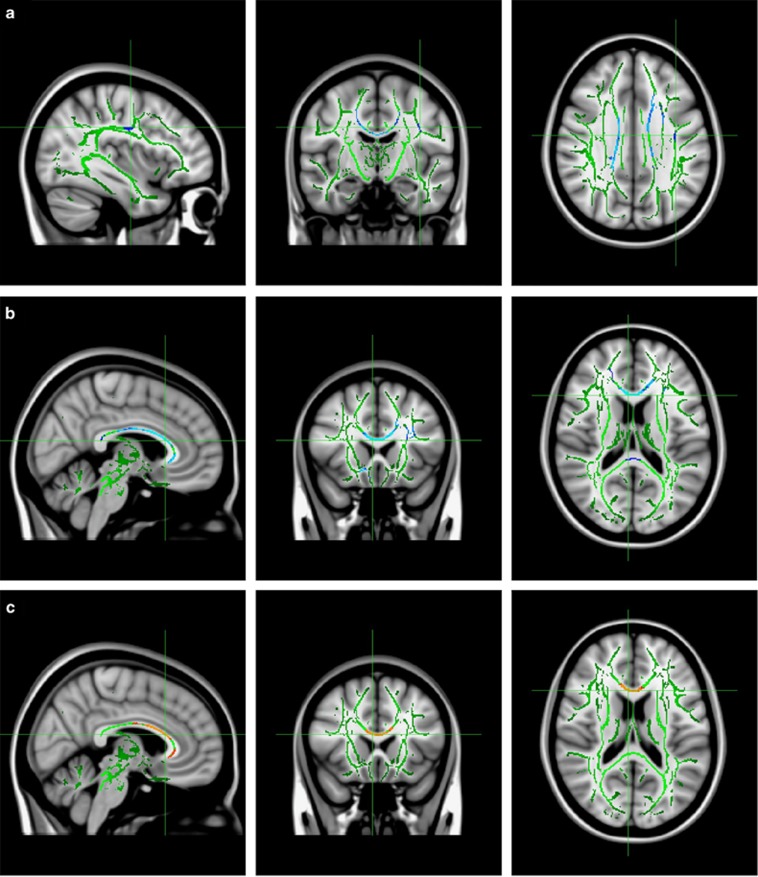
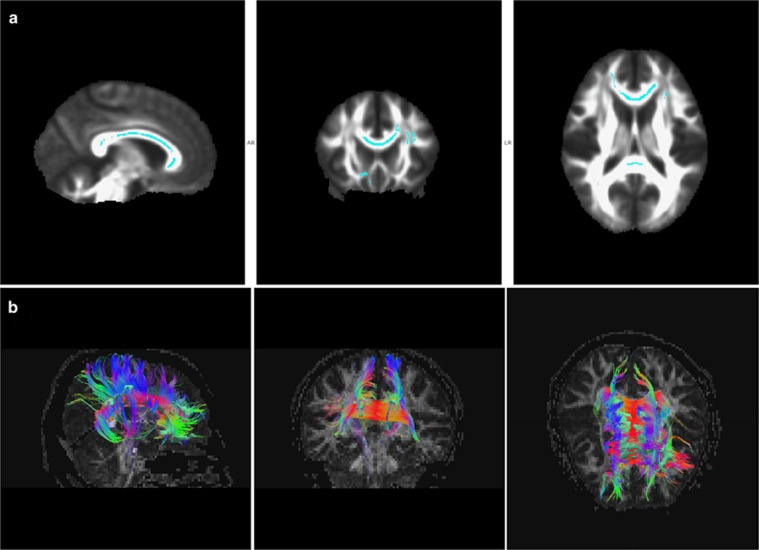
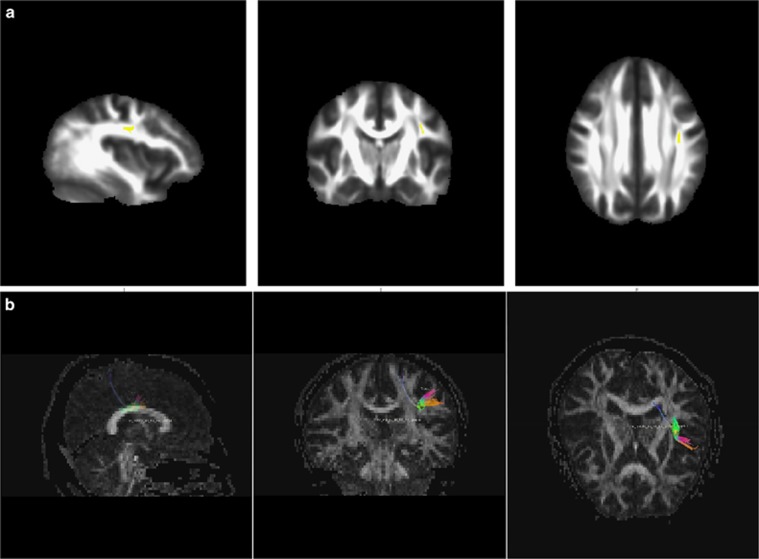
Obsessive-compulsive disorder (OCD) is a complex and severe psychiatric disorder whose pathogenesis is not fully understood. Recent studies have shown white matter (WM) alterations in adults with OCD, but the results have been inconsistent. The present study investigated WM structure in OCD patients with the hypothesis that large-scale brain networks may be disrupted in OCD. A total of 24 patients with OCD and 23 healthy controls (HCs) were scanned with diffusion tensor imaging. A tract-based spatial statistics (TBSS) approach was used to detect differences across the whole brain in patients with OCD vs HCs; post hoc fiber tractography was applied to characterize developmental differences between the two groups. Relative to HCs, patients with OCD had lower fractional anisotropy (FA) values in the corpus callosum (CC), left anterior corona radiata (ACR), left superior corona radiata (SCR) and left superior longitudinal fasciculus (SLF), and higher radial diffusivity in the genu and body of CC. Among the TBSS de-projected region of interest results, compared with HCs, patients with OCD showed lower of the mean FA values of fiber bundles passing though the SLF, and shorter lengths of ACR, SCR and CC. In conclusion, this study provides novel evidence of widespread microstructural alterations in OCD and suggests that OCD may involve abnormalities affecting a broader network of regions than commonly believed.
强迫症(OCD)是一种复杂且严重的精神疾病,其发病机制尚未完全明确。近期研究显示,成年强迫症患者存在白质(WM)改变,但结果并不一致。本研究探讨了强迫症患者的白质结构,假设强迫症可能会破坏大规模脑网络。共有24名强迫症患者和23名健康对照者(HCs)接受了扩散张量成像扫描。采用基于纤维束的空间统计学(TBSS)方法检测强迫症患者与健康对照者全脑的差异;事后纤维束成像用于描述两组之间的发育差异。与健康对照者相比,强迫症患者胼胝体(CC)、左侧前放射冠(ACR)、左侧上放射冠(SCR)和左侧上纵束(SLF)的分数各向异性(FA)值较低,CC膝部和体部的径向扩散率较高。在TBSS反投影感兴趣区域结果中,与健康对照者相比,强迫症患者穿过SLF的纤维束平均FA值较低,ACR、SCR和CC的长度较短。总之,本研究为强迫症广泛的微观结构改变提供了新证据,并表明强迫症可能涉及比通常认为的更广泛区域网络的异常。