Fan Siyan, van den Heuvel Odile A, Cath Danielle C, van der Werf Ysbrand D, de Wit Stella J, de Vries Froukje E, Veltman Dick J, Pouwels Petra J W
Department of Anatomy and Neurosciences, VU University Medical CenterAmsterdam, Netherlands; Department of Psychiatry, VU University Medical CenterAmsterdam, Netherlands; Department of Social and Behavioural Science, Utrecht UniversityUtrecht, Netherlands.
Department of Anatomy and Neurosciences, VU University Medical CenterAmsterdam, Netherlands; Department of Psychiatry, VU University Medical CenterAmsterdam, Netherlands; Neuroscience Campus Amsterdam, VU/VU University Medical CenterAmsterdam, Netherlands; The OCD Team, Haukeland University HospitalBergen, Norway.
Front Neurosci. 2016 Jan 11;9:495. doi: 10.3389/fnins.2015.00495. eCollection 2015.
Obsessive-compulsive disorder (OCD) is a common neuropsychiatric disorder with moderate genetic influences and white matter abnormalities in frontal-striatal and limbic regions. Inconsistencies in reported white matter results from diffusion tensor imaging (DTI) studies can be explained, at least partly, by medication use and between-group differences in disease profile and stage. We used a family design aiming to establish whether white matter abnormalities, if present in un-medicated OCD patients, also exist in their unaffected siblings.
Forty-four OCD patients, un-medicated for at least the past 4 weeks, 15 of their unaffected siblings, and 37 healthy controls (HC) underwent DTI using a 3-Tesla MRI-scanner. Data analysis was done using tract-based spatial statistics (TBSS). Fractional anisotropy (FA), axial diffusivity (AD), radial diffusivity (RD), and mean diffusivity (MD) values were compared within seven skeletonised regions of interest (ROIs), i.e., corpus callosum, bilateral cingulum bundle, bilateral inferior longitudinal fasciculus/frontal-occipital fasciculus (ILF/FOF) and bilateral superior longitudinal fasciculus (SLF).
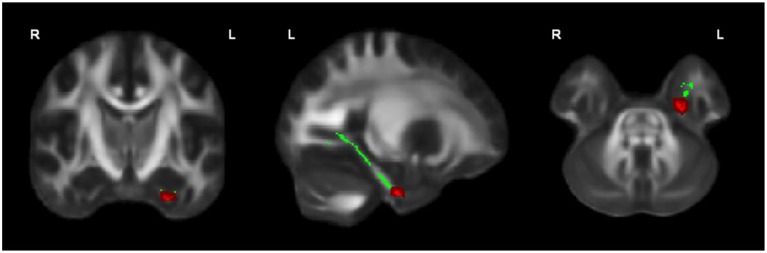
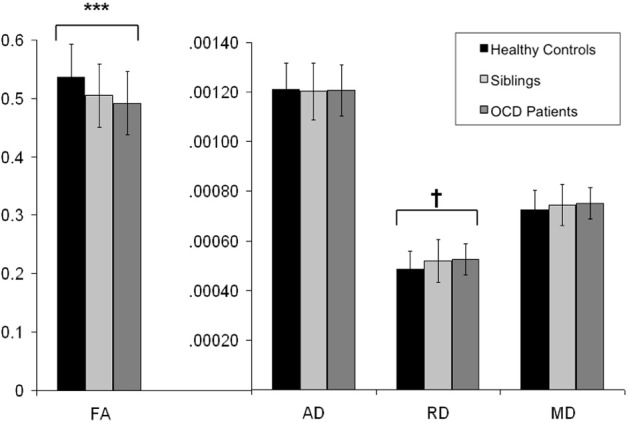
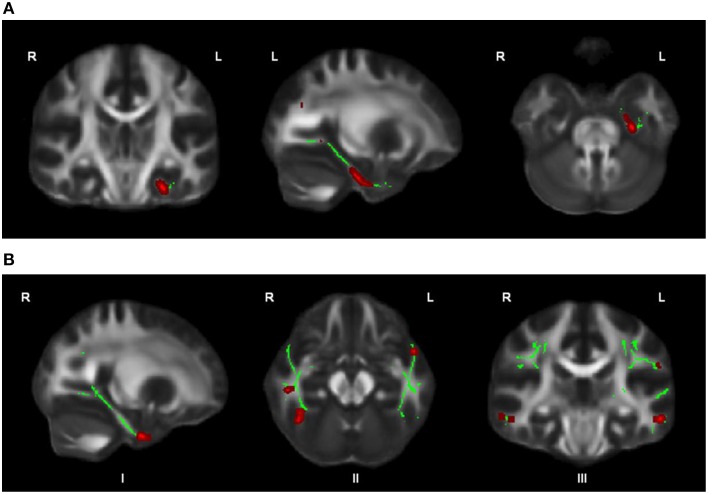
Un-medicated OCD patients, compared with HC, had significantly lower FA in the left cingulum bundle. FA was trend-significantly lower in all other ROIs, except for the corpus callosum. Significant three-group differences in FA (and in RD at trend-significant level) were observed in the left cingulum bundle, with the unaffected siblings representing an intermediate group between OCD patients and HC.
OCD patients showed lower FA in the left cingulum bundle, partly driven by trend-significantly higher values in RD. Since the unaffected siblings were found to be an intermediate group between OCD patients and HC, this white matter alteration may be considered an endophenotype for OCD.
强迫症(OCD)是一种常见的神经精神疾病,受中等程度的遗传影响,且额叶 - 纹状体和边缘区域存在白质异常。弥散张量成像(DTI)研究报告的白质结果不一致,至少部分原因可归因于药物使用以及疾病特征和阶段的组间差异。我们采用家族设计,旨在确定未用药的强迫症患者中若存在白质异常,其未患病的兄弟姐妹是否也存在该异常。
44名至少在过去4周未用药的强迫症患者、15名其未患病的兄弟姐妹以及37名健康对照(HC)使用3特斯拉磁共振成像扫描仪进行DTI检查。数据分析采用基于纤维束的空间统计学(TBSS)。在七个骨骼化感兴趣区域(ROI)内比较分数各向异性(FA)、轴向扩散率(AD)、径向扩散率(RD)和平均扩散率(MD)值,这七个区域即胼胝体、双侧扣带束、双侧下纵束/额枕束(ILF/FOF)和双侧上纵束(SLF)。
与HC相比,未用药的强迫症患者左侧扣带束的FA显著降低。除胼胝体外,所有其他ROI的FA均有降低趋势且具有统计学意义。在左侧扣带束观察到FA(以及在具有统计学意义趋势水平的RD)存在显著的三组差异,未患病的兄弟姐妹代表强迫症患者和HC之间的中间组。
强迫症患者左侧扣带束的FA较低,部分原因是RD值有统计学意义的升高趋势。由于发现未患病的兄弟姐妹是强迫症患者和HC之间的中间组,这种白质改变可能被视为强迫症的一种内表型。