Kellermeier Markus, Herbolzheimer Jens, Kreppner Stephan, Lotter Michael, Strnad Vratislav, Bert Christoph
Department of Radiation Oncology, Universitätsklinikum Erlangen, Friedrich-Alexander-Universität Erlangen-Nürnberg, Universitätsstraße 27, 91054, Erlangen, Germany.
J Appl Clin Med Phys. 2017 Jan;18(1):211-222. doi: 10.1002/acm2.12021.
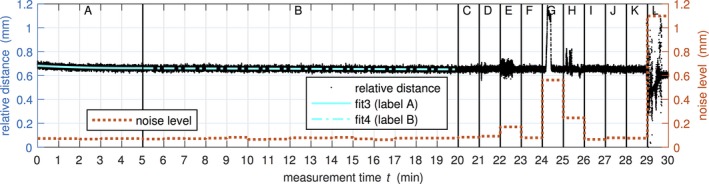
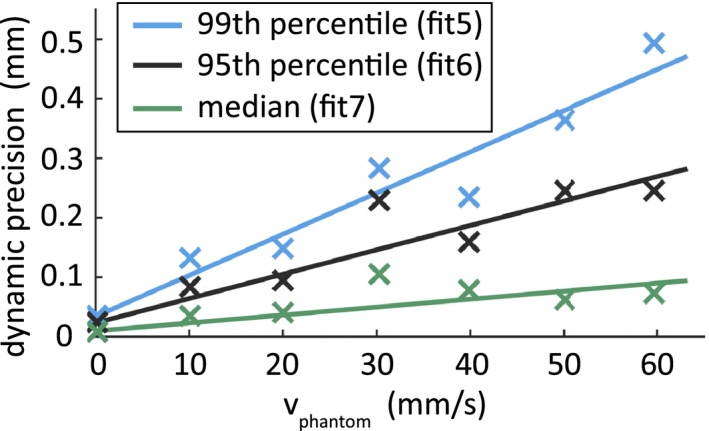
Electromagnetic Tracking (EMT) is a novel technique for error detection and quality assurance (QA) in interstitial high dose rate brachytherapy (HDR-iBT). The purpose of this study is to provide a concept for data acquisition developed as part of a clinical evaluation study on the use of EMT during interstitial treatment of breast cancer patients. The stability, accuracy, and precision of EMT-determined dwell positions were quantified. Dwell position reconstruction based on EMT was investigated on CT table, HDR table and PDR bed to examine the influence on precision and accuracy in a typical clinical workflow. All investigations were performed using a precise PMMA phantom. The track of catheters inserted in that phantom was measured by manually inserting a 5 degree of freedom (DoF) sensor while recording the position of three 6DoF fiducial sensors on the phantom surface to correct motion influences. From the corrected data, dwell positions were reconstructed along the catheter's track. The accuracy of the EMT-determined dwell positions was quantified by the residual distances to reference dwell positions after using a rigid registration. Precision and accuracy were investigated for different phantom-table and sensor-field generator (FG) distances. The measured precision of the EMT-determined dwell positions was ≤ 0.28 mm (95th percentile). Stability tests showed a drift of 0.03 mm in the first 20 min of use. Sudden shaking of the FG or (large) metallic objects close to the FG degrade the precision. The accuracy with respect to the reference dwell positions was on all clinical tables < 1 mm at 200 mm FG distance and 120 mm phantom-table distance. Phantom measurements showed that EMT-determined localization of dwell positions in HDR-iBT is stable, precise, and sufficiently accurate for clinical assessment. The presented method may be viable for clinical applications in HDR-iBT, like implant definition, error detection or quantification of uncertainties. Further clinical investigations are needed.
电磁跟踪(EMT)是一种用于间质高剂量率近距离放射治疗(HDR-iBT)中误差检测和质量保证(QA)的新技术。本研究的目的是提供一种数据采集概念,该概念是作为乳腺癌患者间质治疗期间使用EMT的临床评估研究的一部分而开发的。对EMT确定的驻留位置的稳定性、准确性和精确性进行了量化。在CT检查床、HDR检查床和PDR治疗床上研究了基于EMT的驻留位置重建,以检查在典型临床工作流程中对精确性和准确性的影响。所有研究均使用精确的聚甲基丙烯酸甲酯(PMMA)体模进行。通过手动插入一个5自由度(DoF)传感器来测量插入该体模中的导管轨迹,同时记录体模表面上三个6自由度基准传感器的位置,以校正运动影响。根据校正后的数据,沿导管轨迹重建驻留位置。在使用刚性配准后,通过与参考驻留位置的残余距离来量化EMT确定的驻留位置的准确性。研究了不同体模-检查床和传感器-场发生器(FG)距离下的精确性和准确性。EMT确定的驻留位置的测量精度≤0.28毫米(第95百分位数)。稳定性测试表明,在使用的前20分钟内漂移为0.03毫米。FG的突然晃动或靠近FG的(大)金属物体都会降低精度。在FG距离为200毫米且体模-检查床距离为120毫米时,所有临床检查床上相对于参考驻留位置的准确性均<1毫米。体模测量表明,EMT确定的HDR-iBT中驻留位置的定位对于临床评估是稳定、精确且足够准确的。所提出的方法对于HDR-iBT的临床应用可能是可行的,如植入物定义、误差检测或不确定性量化。还需要进一步的临床研究。