Biron Vincent L, O'Connell Daniel A, Barber Brittany, Clark Jessica M, Andrews Colin, Jeffery Caroline C, Côté David W J, Harris Jeffrey, Seikaly Hadi
Department of Surgery, Division of Otolaryngology-Head & Neck Surgery, University of Alberta, 8440-112 st, 1E4 Walter Mackenzie Centre, Edmonton, AB, T6G 2B7, Canada.
Alberta Head & Neck Centre for Oncology and Reconstruction, Edmonton, AB, Canada.
J Otolaryngol Head Neck Surg. 2017 Mar 14;46(1):20. doi: 10.1186/s40463-017-0196-0.
The resection of large oropharyngeal tumors traditionally involves a lip-splitting mandibulotomy for adequate margin visualization and free flap reconstruction of the surgical defect. Transoral robotic surgery (TORS) has emerged as a technique that can resect large and complex oropharyngeal tumors, avoiding a lip-splitting approach. The aim of this study is to compare the lip-splitting mandibulotomy approach versus TORS for the management of advanced stage oropharyngeal carcinomas.
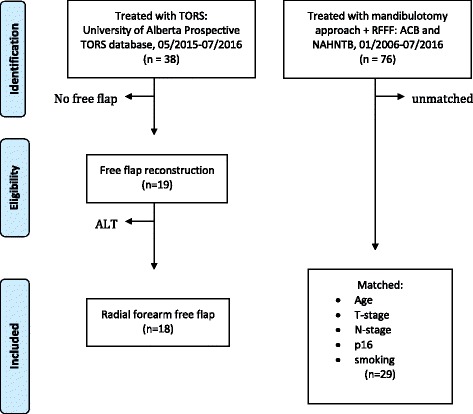
Prospectively collected data from 18 patients with advanced stage oropharyngeal squamous cell carcinoma (OPSCC) who received TORS with radial forearm free flap reconstruction (RFFF) was compared to a matched cohort of 39 patients who received a lip-splitting mandibulotomy and RFFF. Patients were matched for stage, p16 positivity, smoking, age and gender. Length of hospital stay (LOHS), tracheostomy decanulation time, operative time, surgical margin status, and post-operative complications were compared between groups.
Patients who received TORS with RFFF had a significantly lower mean LOHS, compared to patients who were treated by lip-splitting mandibulotomy and RFFF (14.4 vs 19.7 days, p = 0.03). No significant differences were seen between groups in terms of operative time, tracheostomy decannulation time, margin positivity and post-operative complications.
TORS with radial forearm free flap reconstruction is a safe, effective and cost-saving alternative to the lip-splitting mandibulotomy approach for the treatment of advanced stage OPSCC.
传统上,大型口咽肿瘤的切除需要进行唇裂下颌骨切开术,以充分暴露手术切缘,并对手术缺损进行游离皮瓣重建。经口机器人手术(TORS)已成为一种能够切除大型复杂口咽肿瘤的技术,避免了唇裂入路。本研究的目的是比较唇裂下颌骨切开术与TORS治疗晚期口咽癌的效果。
前瞻性收集18例接受TORS联合桡侧前臂游离皮瓣重建(RFFF)的晚期口咽鳞状细胞癌(OPSCC)患者的数据,并与39例接受唇裂下颌骨切开术和RFFF的匹配队列患者进行比较。患者在分期、p16阳性、吸烟、年龄和性别方面进行匹配。比较两组患者的住院时间(LOHS)、气管切开拔管时间、手术时间、手术切缘状态和术后并发症。
与接受唇裂下颌骨切开术和RFFF治疗的患者相比,接受TORS联合RFFF的患者平均LOHS显著更低(14.4天对19.7天,p = 0.03)。两组在手术时间、气管切开拔管时间、切缘阳性率和术后并发症方面无显著差异。
对于晚期OPSCC的治疗,TORS联合桡侧前臂游离皮瓣重建是一种安全、有效且节省成本的替代唇裂下颌骨切开术的方法。