Gao Xiao-Peng, Qian Dong-Wei, Xie Zhen, Hui Hao
Department of General Surgery, Xi'an Central Hospital, The Affiliated Xi'an Central Hospital of Xi'an Jiaotong University College of Medicine, Xi'an 710003, P.R. China.
Department of Operation Room, Xi'an Central Hospital, The affiliated Xi'an central hospital of Xi'an Jiaotong university College of Medicine, Xi'an 710003, P.R. China.
Iran J Basic Med Sci. 2017 Feb;20(2):131-137. doi: 10.22038/ijbms.2017.8235.
Oxidative stress has been established as a key cause of alcohol-induced hepatotoxicity. Licochalcone B, an extract of licorice root, has shown antioxidative properties. This study was to investigate the effects and mechanisms of licochalcone B in ethanol-induced hepatic injury in an study.
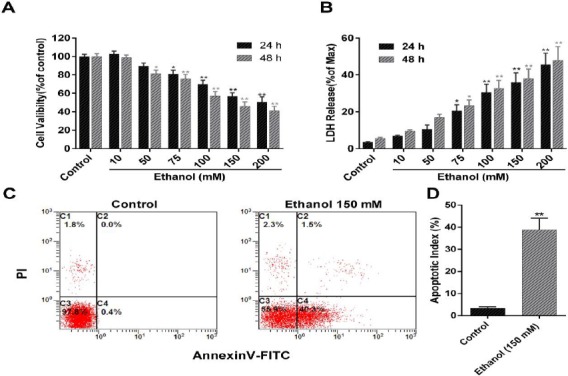
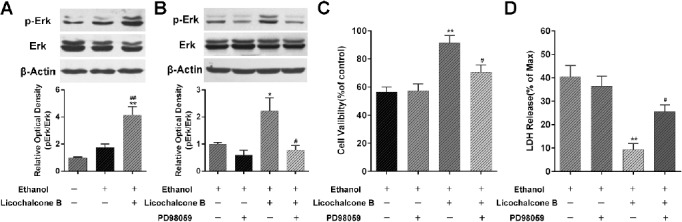
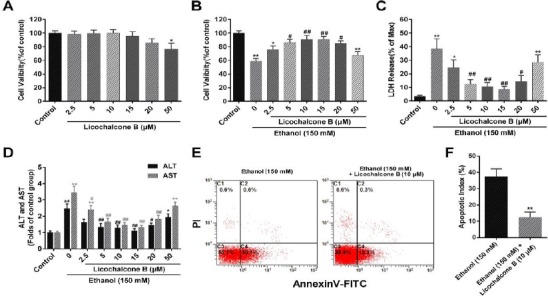
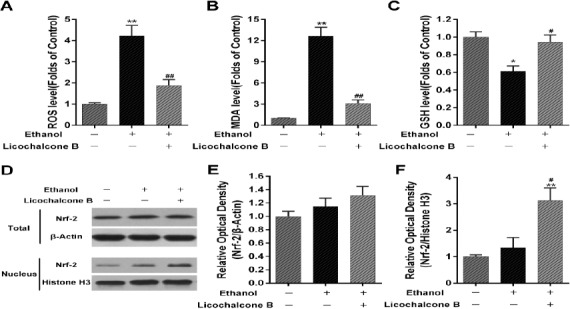
An model of Ethanol-induced cytotoxicity in BRL cells was used in this study. Cell injury was assessed using WST-1 assay and lactate dehydrogenase, alanine transaminase, and aspartate aminotransferase release assay. Cell apoptosis were quantified by flow cytometric analysis. The intracellular oxidative level was evaluated by reactive oxidative species, malondialdehyde and glutathione detection. Furthermore, the expression level of Erk, p-Erk, Nrf-2 were assessed using Western blot.
Treatment with ethanol induced marked cell injury and cell apoptosis in BRL cells. Licochalcone B significantly attenuated ethanol-induced cell injury, and inhibited cell apoptosis. Furthermore, licochalcone B significantly inhibited ethanol-induced intracellular oxidative level, upregulated the expression of p-Erk, and promoted nuclear localization of Nrf2. Additionally, this hepatoprotective role was significantly abolished by inhibition of Erk signaling. However, no apparent effects of Erk inhibition were observed on ethanol-induced hepatotoxicity.
This study demonstrates that licochalcone B protects hepatocyte from alcohol-induced cell injury, and this hepatoprotective role might be attributable to apoptosis reduction, inhibition of oxidative stress, and upregulation of Erk-Nrf2. Therefore, licochalcone B might possess potential as a novel therapeutic drug candidate for alcohol-related liver disorders.
氧化应激已被确认为酒精性肝毒性的关键成因。甘草查尔酮B是甘草根的提取物,已显示出抗氧化特性。本研究旨在探讨甘草查尔酮B在乙醇诱导的肝损伤中的作用及机制。
本研究采用乙醇诱导BRL细胞毒性的模型。使用WST-1法以及乳酸脱氢酶、丙氨酸转氨酶和天冬氨酸转氨酶释放试验评估细胞损伤。通过流式细胞术分析对细胞凋亡进行定量。通过活性氧、丙二醛和谷胱甘肽检测评估细胞内氧化水平。此外,使用蛋白质免疫印迹法评估Erk、p-Erk、Nrf-2的表达水平。
用乙醇处理可诱导BRL细胞发生明显的细胞损伤和细胞凋亡。甘草查尔酮B显著减轻乙醇诱导的细胞损伤,并抑制细胞凋亡。此外,甘草查尔酮B显著抑制乙醇诱导的细胞内氧化水平,上调p-Erk的表达,并促进Nrf2的核定位。此外,抑制Erk信号可显著消除这种肝脏保护作用。然而,未观察到Erk抑制对乙醇诱导的肝毒性有明显影响。
本研究表明,甘草查尔酮B可保护肝细胞免受酒精诱导的细胞损伤,这种肝脏保护作用可能归因于细胞凋亡减少、氧化应激抑制以及Erk-Nrf2上调。因此,甘草查尔酮B可能具有作为酒精相关肝脏疾病新型治疗药物候选物的潜力。