Peters Sanne, Clarebout Geraldine, Diemers Agnes, Delvaux Nicolas, Verburgh An, Aertgeerts Bert, Roex Ann
Academic Center for General Practice, Department of Public Health and Primary Care, KU Leuven, University of Leuven, Leuven, Belgium.
School of Health Professions Education, Maastricht University, Maastricht, The Netherlands.
Perspect Med Educ. 2017 Jun;6(3):148-157. doi: 10.1007/s40037-017-0338-0.
Although medical students are increasingly exposed to clinical experiences as part of their training, these often occur parallel with, rather than connected to, their classroom-based learning experiences. Additionally, students seem to struggle with spontaneously making the connection between these spheres of their training themselves. Therefore, this systematic review synthesized the existing evidence about educational interventions that aim to enhance the connection between learning in the classroom and its application in the workplace.
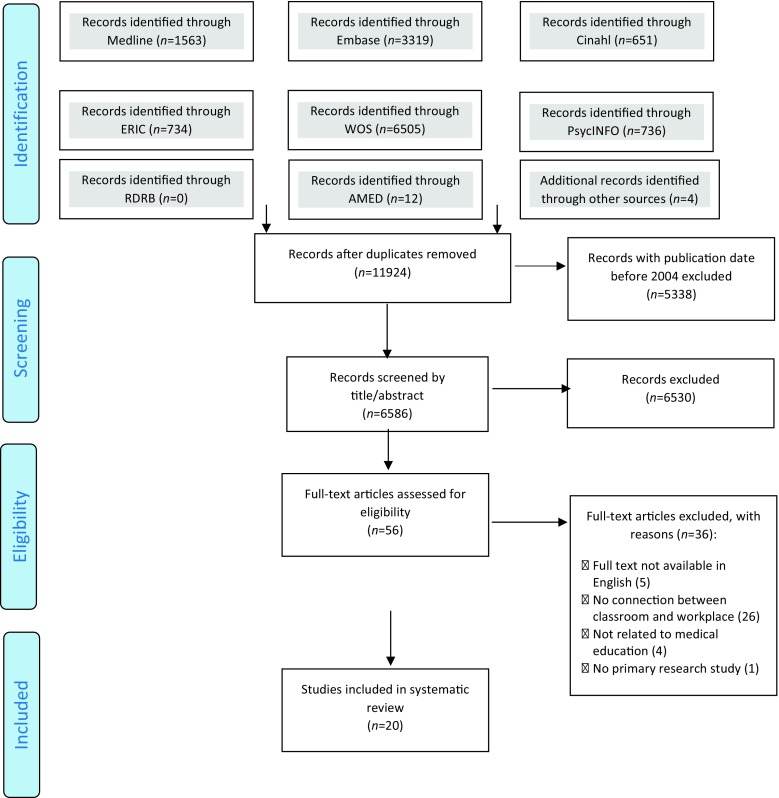
Electronic databases (AMED, CINAHL, EMBASE, ERIC, Medline, RDRB, PsycINFO and WoS) were screened for quantitative and qualitative studies investigating educational interventions that referenced a connection between the classroom and workplace-based experiences within undergraduate, graduate or postgraduate medical education.
Three types of interventions were identified: classroom to workplace interventions, workplace to classroom interventions, and interventions involving multiple connections between the two settings. Most interventions involved a tool (e. g. video, flow chart) or a specific process (e. g. linking patient cases with classroom-based learning content, reflecting on differences between what was learned and how it works in practice) which aimed to enhance the connection between the two settings.
Small-scale interventions can bring classroom learning and workplace practice into closer alignment. Such interventions appear to be the necessary accompaniments to curricular structures, helping bridge the gap between classroom learning and workplace experience. This paper documents examples that may serve to assist medical educators in connecting the classroom and the workplace.
尽管医学生在培训过程中越来越多地接触到临床经验,但这些经验往往与他们基于课堂的学习经验并行,而非相互关联。此外,学生似乎难以自发地在这些培训领域之间建立联系。因此,本系统综述综合了现有关于教育干预措施的证据,这些措施旨在加强课堂学习与其在工作场所应用之间的联系。
对电子数据库(AMED、CINAHL、EMBASE、ERIC、Medline、RDRB、PsycINFO和WoS)进行筛选,以查找调查教育干预措施的定量和定性研究,这些干预措施涉及本科、研究生或研究生医学教育中课堂与基于工作场所的经验之间的联系。
确定了三种类型的干预措施:从课堂到工作场所的干预措施、从工作场所到课堂的干预措施,以及涉及两种环境之间多重联系的干预措施。大多数干预措施涉及一种工具(如视频、流程图)或一个特定过程(如将患者病例与基于课堂的学习内容相联系,反思所学内容与实际应用之间的差异),旨在加强两种环境之间的联系。
小规模干预措施可以使课堂学习与工作场所实践更紧密地结合。此类干预措施似乎是课程结构的必要补充,有助于弥合课堂学习与工作场所经验之间的差距。本文记录了一些实例,可能有助于医学教育工作者将课堂与工作场所联系起来。