De Craene Johan-Owen, Bertazzi Dimitri L, Bär Séverine, Friant Sylvie
Department of Molecular and Cellular Genetics, Université de Strasbourg, CNRS, GMGM UMR 7156, F-67000 Strasbourg, France.
Int J Mol Sci. 2017 Mar 15;18(3):634. doi: 10.3390/ijms18030634.
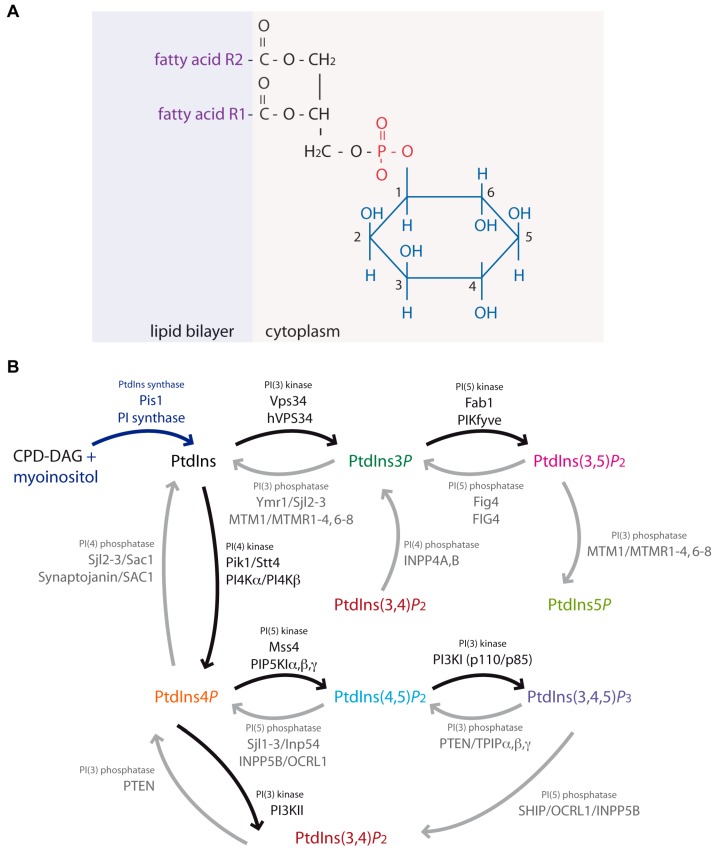
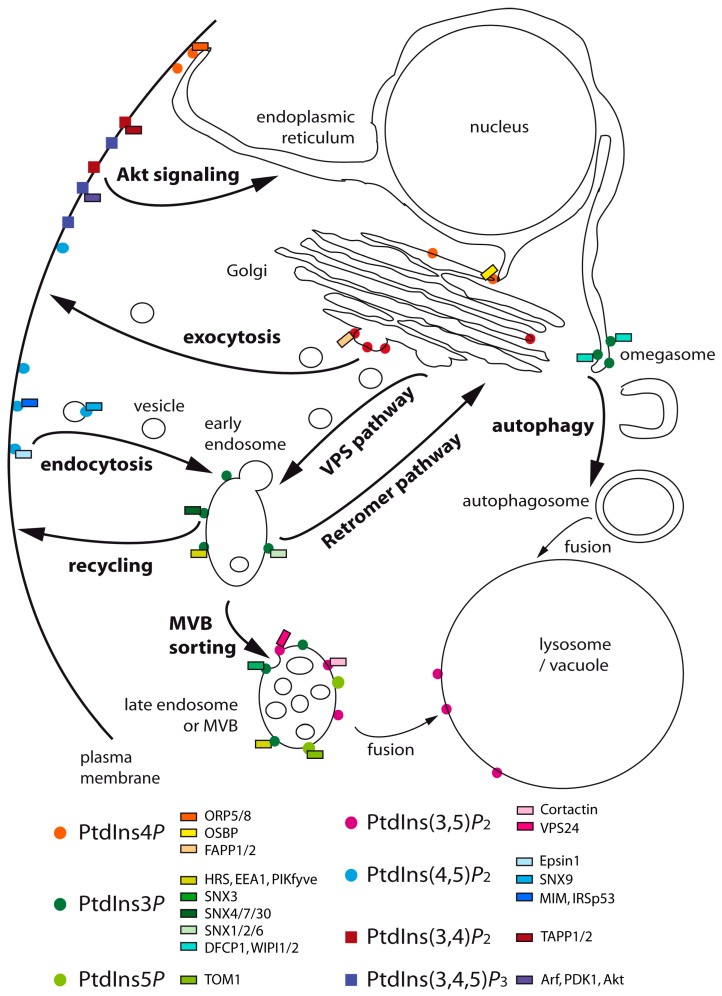
Phosphoinositides are lipids involved in the vesicular transport of proteins and lipids between the different compartments of eukaryotic cells. They act by recruiting and/or activating effector proteins and thus are involved in regulating various cellular functions, such as vesicular budding, membrane fusion and cytoskeleton dynamics. Although detected in small concentrations in membranes, their role is essential to cell function, since imbalance in their concentrations is a hallmark of many cancers. Their synthesis involves phosphorylating/dephosphorylating positions D3, D4 and/or D5 of their inositol ring by specific lipid kinases and phosphatases. This process is tightly regulated and specific to the different intracellular membranes. Most enzymes involved in phosphoinositide synthesis are conserved between yeast and human, and their loss of function leads to severe diseases (cancer, myopathy, neuropathy and ciliopathy).
磷酸肌醇是一类脂质,参与真核细胞不同区室之间蛋白质和脂质的囊泡运输。它们通过招募和/或激活效应蛋白发挥作用,从而参与调节各种细胞功能,如囊泡出芽、膜融合和细胞骨架动力学。尽管在膜中的浓度很低,但它们对细胞功能至关重要,因为其浓度失衡是许多癌症的一个标志。它们的合成涉及通过特定的脂质激酶和磷酸酶对其肌醇环的D3、D4和/或D5位进行磷酸化/去磷酸化。这个过程受到严格调控,并且特定于不同的细胞内膜。大多数参与磷酸肌醇合成的酶在酵母和人类之间是保守的,它们的功能丧失会导致严重疾病(癌症、肌病、神经病和纤毛病)。