
秋水仙碱对梗阻性肾病肾纤维化和细胞凋亡的影响。
Effects of colchicine on renal fibrosis and apoptosis in obstructed kidneys.
作者信息
Kim Sejoong, Jung Eun Sook, Lee Jeonghwan, Heo Nam Ju, Na Ki Young, Han Jin Suk
机构信息
Department of Internal Medicine, Seoul National University College of Medicine, Seoul, Korea.
Department of Internal Medicine, Seoul National University Bundang Hospital, Seongnam, Korea.
出版信息
Korean J Intern Med. 2018 May;33(3):568-576. doi: 10.3904/kjim.2016.131. Epub 2017 Mar 18.
BACKGROUND/AIMS: Colchicine is an established drug for microtubule stabilization that may reduce tissue injury. No data were available that its effects may depend on the dosage of colchicine. We investigated the anti-fibrotic and apoptotic effects of various dose of colchicine in a unilateral ureteral obstruction (UUO) model.
METHODS
Thirty-six Sprague-Dawley rats were randomly assigned into six groups. Two sham groups were divided into a vehicle-treated or colchicine-treated group (100 μg/kg/day). Four UUO groups were treated with either vehicle or three different doses of colchicine for 7 days (30, 60, and 100 μg/kg/day, intraperitoneally). All of the animals were sacrificed on day 7.
RESULTS
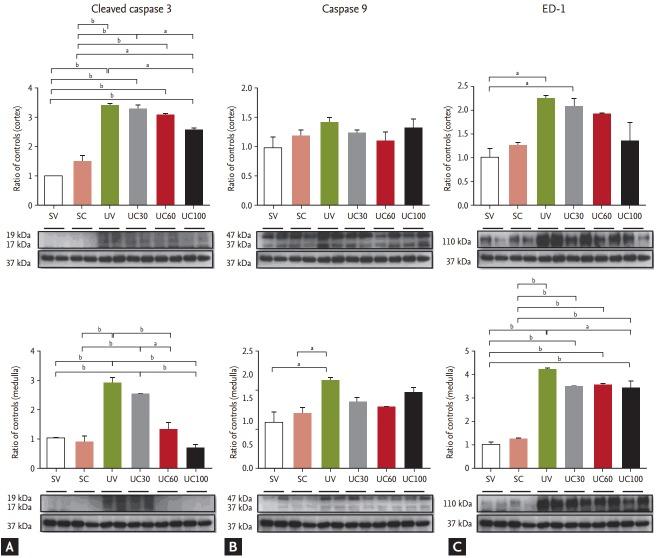
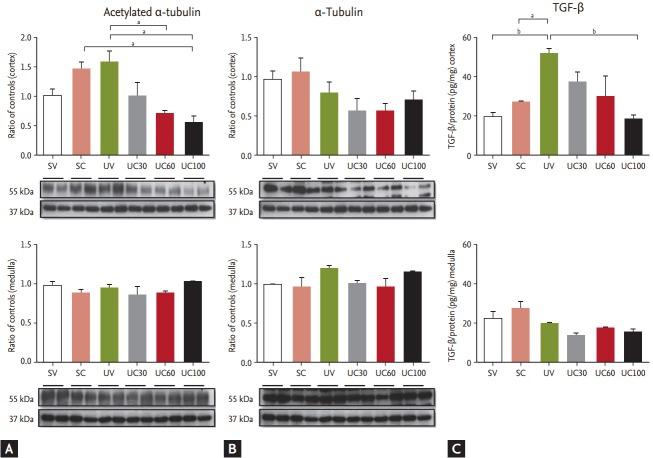
Colchicine treatment diminished acetylated α-tubulin and tumor growth factor-β immunoreactivities in the cortical area of the 7-day obstructed kidneys, which was in dose dependent manner. Colchicine attenuated tubulointerstitial damage and apoptosis in both cortical and medullary area, and beneficial effects of colchicine therapy were dramatically shown at the higher dosage of colchicine. The expression levels of cleaved caspase-3, ED-1, and fibronectin were decreased in UUO animals.
CONCLUSIONS
We found that the proper dosage of colchicine may have anti-fibrotic and anti-apoptotic effects in obstructed kidneys. For clinical applications, an optimal dose of colchicine should be evaluated to maximize the prevention of renal disease progression.
背景/目的:秋水仙碱是一种公认的可稳定微管的药物,可能减轻组织损伤。尚无数据表明其效果可能取决于秋水仙碱的剂量。我们在单侧输尿管梗阻(UUO)模型中研究了不同剂量秋水仙碱的抗纤维化和凋亡作用。
方法
将36只Sprague-Dawley大鼠随机分为6组。两个假手术组分别分为溶剂处理组或秋水仙碱处理组(100μg/kg/天)。四个UUO组分别用溶剂或三种不同剂量的秋水仙碱处理7天(30、60和100μg/kg/天,腹腔注射)。所有动物在第7天处死。
结果
秋水仙碱处理使梗阻7天的肾脏皮质区域的乙酰化α-微管蛋白和肿瘤生长因子-β免疫反应性降低,呈剂量依赖性。秋水仙碱减轻了皮质和髓质区域的肾小管间质损伤和凋亡,秋水仙碱治疗的有益效果在较高剂量时显著显现。UUO动物中裂解的半胱天冬酶-3、ED-1和纤连蛋白的表达水平降低。
结论
我们发现适当剂量的秋水仙碱可能对梗阻性肾脏具有抗纤维化和抗凋亡作用。对于临床应用,应评估秋水仙碱的最佳剂量,以最大程度地预防肾脏疾病进展。


 Zotero 插件