Doboszewska Urszula, Wlaź Piotr, Nowak Gabriel, Radziwoń-Zaleska Maria, Cui Ranji, Młyniec Katarzyna
Department of Pharmacobiology, Jagiellonian University Medical College, Medyczna 9, 30-688 Kraków, Poland; Department of Animal Physiology, Institute of Biology and Biochemistry, Faculty of Biology and Biotechnology, Maria Curie-Sklodowska University, Akademicka 19, 20-033 Lublin, Poland.
Department of Animal Physiology, Institute of Biology and Biochemistry, Faculty of Biology and Biotechnology, Maria Curie-Sklodowska University, Akademicka 19, 20-033 Lublin, Poland.
Neural Plast. 2017;2017:3682752. doi: 10.1155/2017/3682752. Epub 2017 Feb 19.
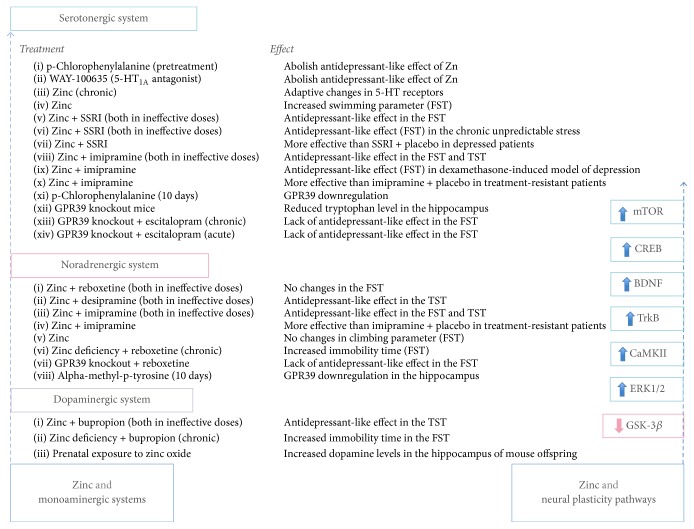
Preclinical and clinical studies have demonstrated that zinc possesses antidepressant properties and that it may augment the therapy with conventional, that is, monoamine-based, antidepressants. In this review we aim to discuss the role of zinc in the pathophysiology and treatment of depression with regard to the monoamine hypothesis of the disease. Particular attention will be paid to the recently described zinc-sensing GPR39 receptor as well as aspects of zinc deficiency. Furthermore, an attempt will be made to give a possible explanation of the mechanisms by which zinc interacts with the monoamine system in the context of depression and neural plasticity.
临床前和临床研究表明,锌具有抗抑郁特性,并且可能增强传统的(即基于单胺的)抗抑郁药的治疗效果。在本综述中,我们旨在讨论锌在抑郁症的病理生理学和治疗中的作用,这与该疾病的单胺假说有关。将特别关注最近描述的锌感应GPR39受体以及锌缺乏的方面。此外,我们将尝试对锌在抑郁症和神经可塑性背景下与单胺系统相互作用的机制给出一个可能的解释。