Milonas Daimantas, Venclovas Zilvinas, Gudinaviciene Inga, Zviniene Kristina, Matjosaitis Aivaras Jonas
Department of Urology, Lithuanian University of Health Sciences, Medical Academy, A. Mickeviciaus 9, LT-44307 Kaunas, Lithuania.
Department of Pathology, Lithuanian University of Health Sciences, Medical Academy, A. Mickeviciaus 9, LT-44307 Kaunas, Lithuania.
Biomed Res Int. 2017;2017:9858923. doi: 10.1155/2017/9858923. Epub 2017 Feb 19.
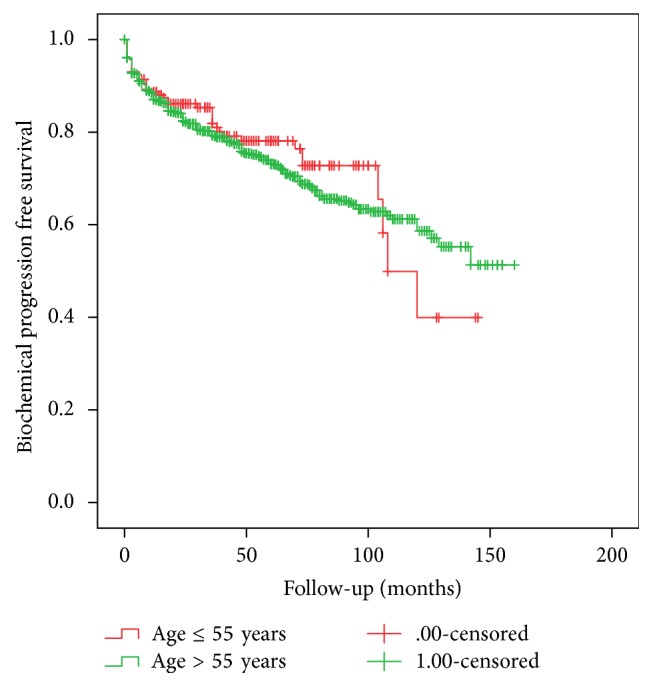
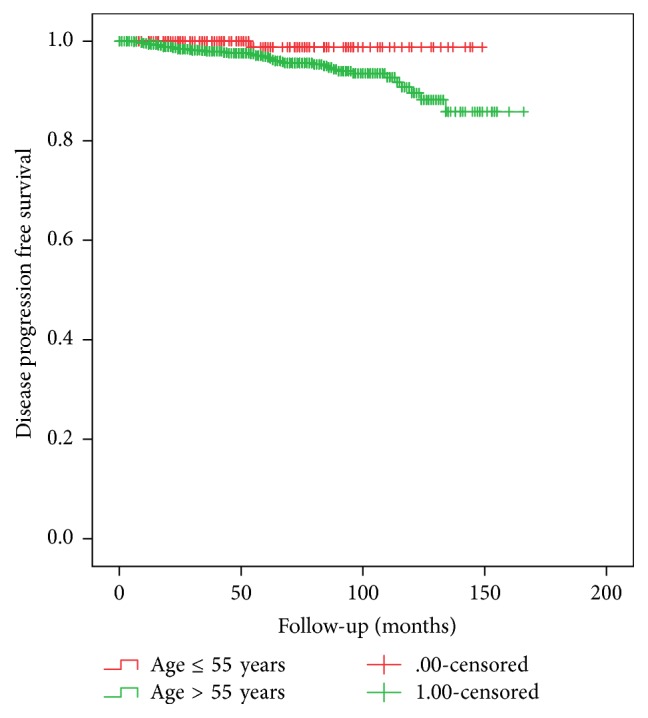
. The aim of this study was to describe PCa characteristics and long-term outcomes in young men aged ≤55 years after radical prostatectomy (RP) and to compare them with older men cohort. . Among 2,200 patients who underwent RP for clinically localized PCa at our centre between 2001 and 2015, 277 (10.3%) men aged ≤55 years were identified. All preoperative and pathological parameters were compared between groups. Biochemical progression free survival (BPFS) and disease progression free survival (DPFS) were assessed at 5 and 10 years. . Men aged ≤55 years had similar pathological tumor characteristics and biochemical recurrence rate (BCR) compared to their older counterparts. Disease progression rate 2.5% versus 0.4% was higher in older patients ( = 0.026). BPFS rate was not different in both study groups. Estimated 10-year DPFS was 98.8% in younger men compared to 89.2% in their older counterparts ( = 0.031). Multivariate Cox regression showed that Gleason score lymph-nodes and surgical margins status were significant predictors for disease progression. . In our cohort, men aged ≤55 years had similar pathological PCa characteristics and BCR rate in comparison with older men. RP can be performed with excellent long-term DPFS results in men with localized PCa at ≤55 years of age.
本研究的目的是描述年龄≤55岁的年轻男性在根治性前列腺切除术(RP)后的前列腺癌特征和长期预后,并将其与老年男性队列进行比较。在2001年至2015年间于我们中心接受临床局限性前列腺癌RP治疗的2200例患者中,确定了277例(10.3%)年龄≤55岁的男性。对两组之间的所有术前和病理参数进行了比较。在5年和10年时评估了无生化进展生存期(BPFS)和无疾病进展生存期(DPFS)。年龄≤55岁的男性与老年男性相比,具有相似的病理肿瘤特征和生化复发率(BCR)。老年患者的疾病进展率为2.5%,而老年患者为0.4%(P = 0.026)。两个研究组的BPFS率没有差异。年轻男性的估计10年DPFS为98.8%,而老年男性为89.2%(P = 0.031)。多变量Cox回归显示,Gleason评分、淋巴结和手术切缘状态是疾病进展的重要预测因素。在我们的队列中,年龄≤55岁的男性与老年男性相比,具有相似的病理前列腺癌特征和BCR率。对于年龄≤55岁的局限性前列腺癌男性,RP可以取得优异的长期DPFS结果。