Manoharan Varun, Lee Soon, Chong Shanley, Yap June, Coupe Nick, Wilson Robert, Merrett Neil, Ng Weng, Lin Michael
University of New South Wales, Liverpool Hospital, Sydney, NSW, 2170, Australia.
University of Western Sydney, Liverpool Hospital, Sydney, NSW, 2170, Australia.
Ann Nucl Med. 2017 May;31(4):315-323. doi: 10.1007/s12149-017-1159-2. Epub 2017 Mar 15.
We retrospectively evaluated the value of PET/CT in predicting survival and histopathological tumour-response in patients with distal oesophageal and gastric adenocarcinoma following neoadjuvant treatment.
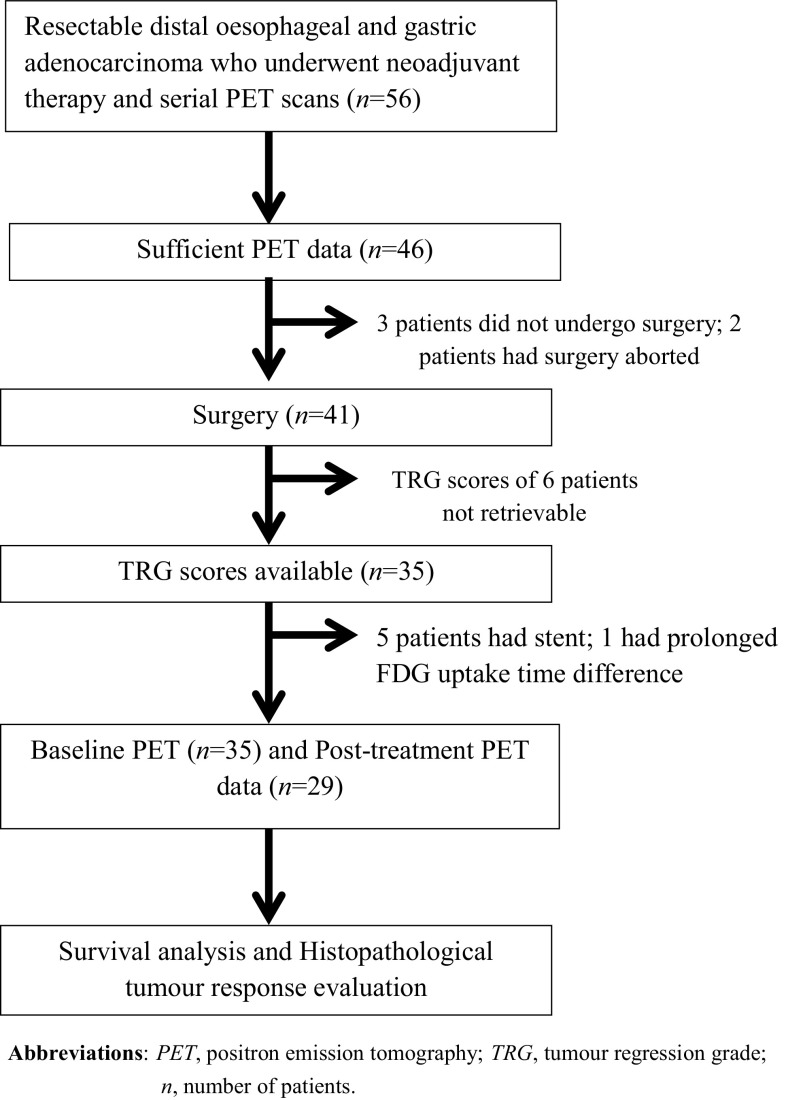
Twenty-one patients with resectable distal oesophageal adenocarcinoma and 14 with gastric adenocarcinoma between January 2002 and December 2011, who had undergone serial PET before and after neoadjuvant therapy followed by surgery, were enrolled. Maximum standard uptake value (SUVmax) and metabolic tumour volume were measured and correlated with tumour regression grade and survival.
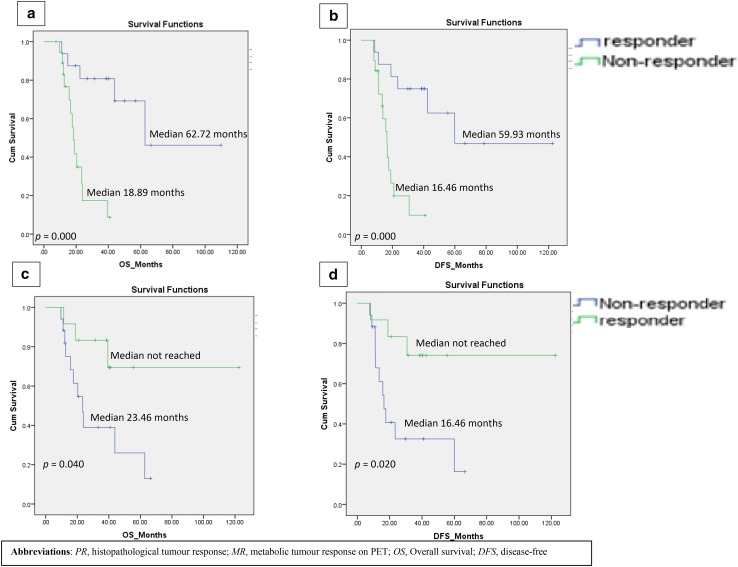
Histopathological tumour response (PR) is a stronger predictor of overall and disease-free survival compared to metabolic response. ∆%SUVmax ≥70% was the only PET metric that predicted PR (82.4% sensitivity, 61.5% specificity, p = 0.047). Histopathological non-responders had a higher risk of death (HR 8.461, p = 0.001) and recurrence (HR 6.385, p = 0.002) and similarly in metabolic non-responders for death (HR 2.956, p = 0.063) and recurrence (HR 3.614, p = 0.028). Ordinalised ∆%SUVmax showed a predictive trend for OS and DFS, but failed to achieve statistical significance.
PR was a stronger predictor of survival than metabolic response. ∆%SUVmax ≥70% was the best biomarker on PET that predicted PR and survival in oesophageal and gastric adenocarcinoma. Ordinalisation of ∆%SUVmax was not helpful in predicting primary outcomes.
我们回顾性评估了PET/CT在预测新辅助治疗后远端食管腺癌和胃腺癌患者的生存及组织病理学肿瘤反应方面的价值。
纳入2002年1月至2011年12月期间21例可切除的远端食管腺癌患者和14例胃腺癌患者,这些患者在新辅助治疗前后及手术前均接受了系列PET检查。测量最大标准摄取值(SUVmax)和代谢肿瘤体积,并将其与肿瘤退缩分级及生存情况进行关联分析。
与代谢反应相比,组织病理学肿瘤反应(PR)是总生存和无病生存的更强预测指标。∆%SUVmax≥70%是唯一能预测PR的PET指标(敏感性82.4%,特异性61.5%,p = 0.047)。组织病理学无反应者死亡风险更高(HR 8.461,p = 0.001)和复发风险更高(HR 6.385,p = 0.002),代谢无反应者的死亡(HR 2.956,p = 0.063)和复发(HR 3.614,p = 0.028)情况类似。序数化的∆%SUVmax显示出对总生存和无病生存的预测趋势,但未达到统计学显著性。
PR是比代谢反应更强的生存预测指标。∆%SUVmax≥70%是PET上预测食管和胃腺癌PR及生存的最佳生物标志物。∆%SUVmax的序数化对预测主要结局并无帮助。