Chen Li, Yan Ying, Zhu Lihua, Cong Xiliang, Li Sen, Song Shubin, Song Hongjiang, Xue Yingwei
Department of Gastrointestinal Surgery, Harbin Medical University Cancer Hospital, Harbin Medical University, Harbin, Heilongjiang.
Department of Internal Oncology, Harbin The First Hospital, Harbin, Heilongjiang.
Cancer Manag Res. 2017 Dec 14;9:849-867. doi: 10.2147/CMAR.S151026. eCollection 2017.
A novel systemic immune-inflammation index named SII (SII=N×P/L), which is based on neutrophil (N), platelet (P) and lymphocyte (L) counts, has emerged and reflects comprehensively the balance of host inflammatory and immune status. We aimed to evaluate the potential prognostic significance of SII in patients with advanced gastric cancer who received neoadjuvant chemotherapy.
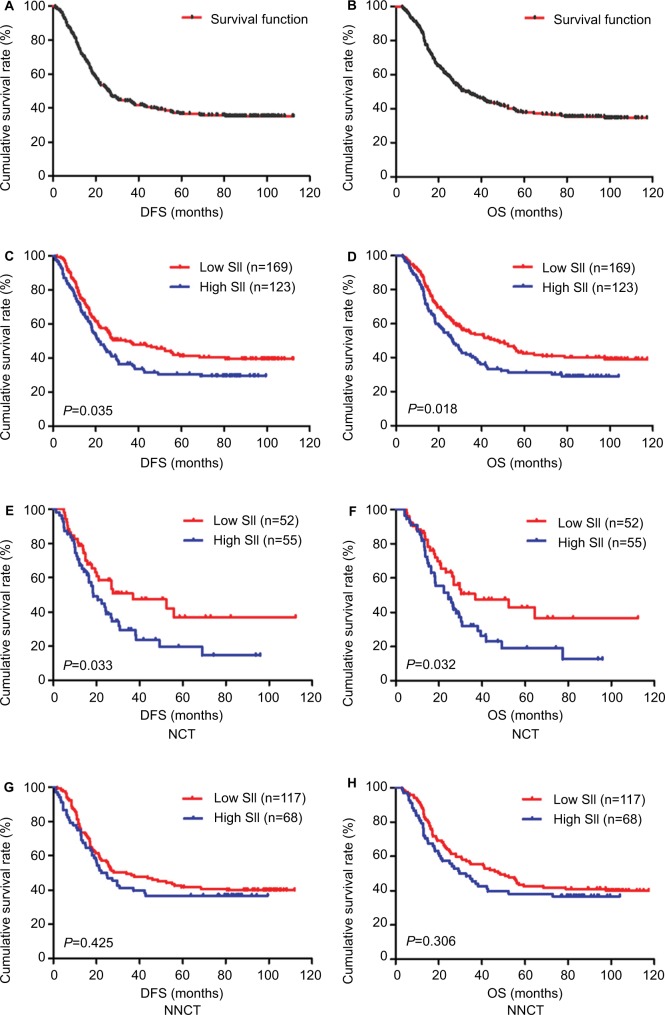
The retrospective analysis included data from 107 patients with advanced gastric cancer undergoing neoadjuvant chemotherapy and 185 patients with pathology-proven gastric cancer. The optimal cutoff value of SII by receiver operating characteristic curve stratified patients into low SII (<600×10/L) and high SII (SII ≥600×10/L) groups. The clinical outcomes of disease-free survival (DFS) and overall survival (OS) were calculated by Kaplan-Meier survival curves and compared using log-rank test. Univariate and multivariate Cox proportional hazards regression models were used to analyze the prognostic value of SII.
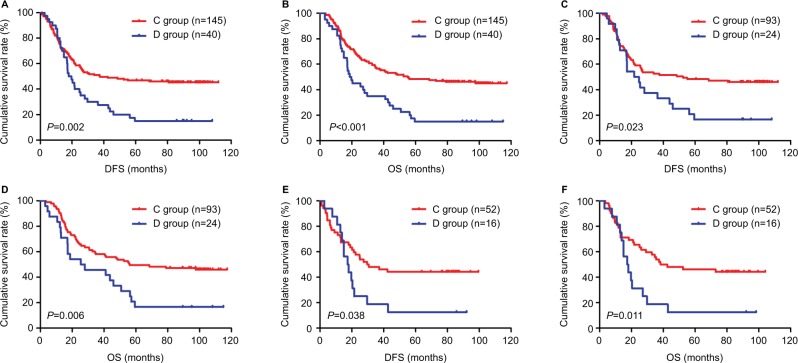
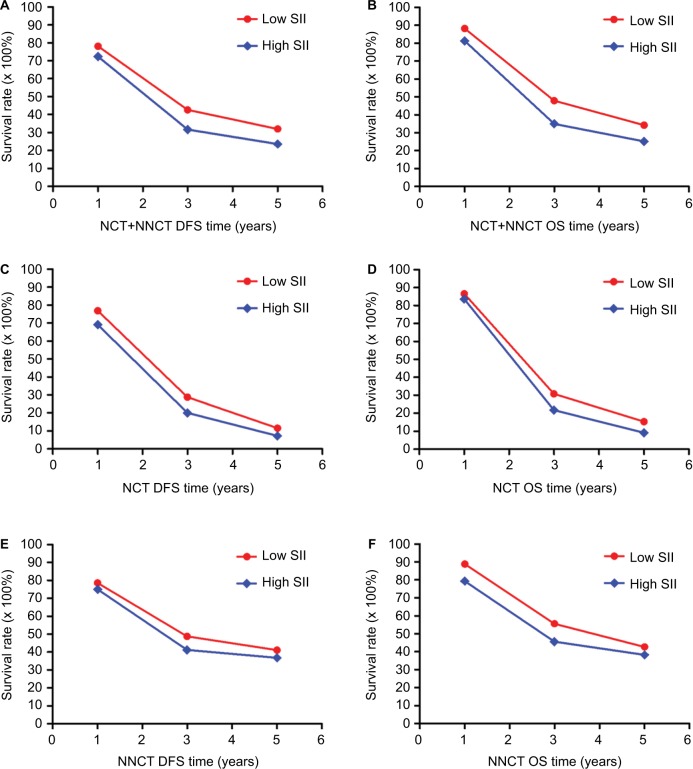
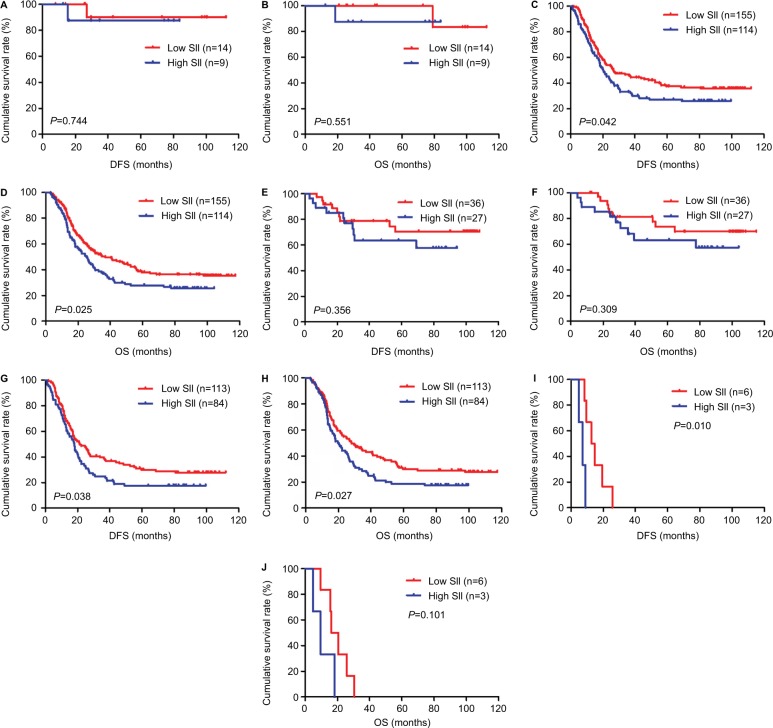
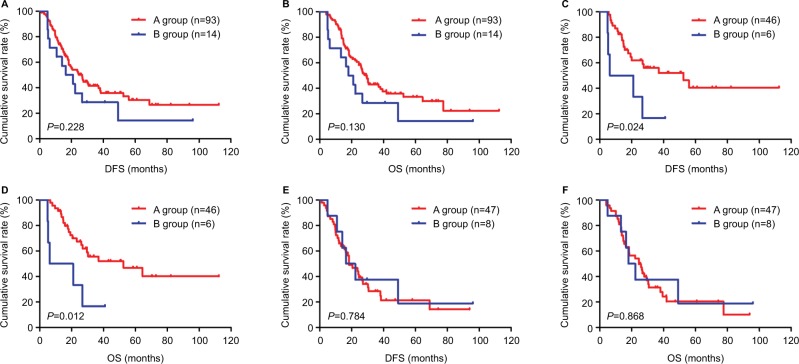
The results indicated that SII had prognostic significance using the cutoff value of 600×10/L on DFS and OS in univariate and multivariate Cox regression survival analyses. Low SII was associated with prolonged DFS and OS, and the mean DFS and OS for patients with low SII were longer than for those with high SII (57.22 vs 41.56 months and 62.25 vs 45.60 months, respectively). Furthermore, we found that patients with low SII had better 1-, 3- and 5-year rates of DFS and OS than those with high SII. In addition, patients with low SII were likely to receive DFS and OS benefits from neoadjuvant chemotherapy and postoperative chemotherapy.
SII may qualify as a noninvasive, cost-effective, convenient and reproducible prognostic indicator for patients with advanced gastric cancer undergoing neoadjuvant chemotherapy. It may help clinicians to identify those patients who will benefit from treatment strategy decisions.
一种名为SII(SII = N×P/L)的新型全身免疫炎症指数应运而生,该指数基于中性粒细胞(N)、血小板(P)和淋巴细胞(L)计数,全面反映了宿主炎症与免疫状态的平衡。我们旨在评估SII在接受新辅助化疗的晚期胃癌患者中的潜在预后意义。
回顾性分析纳入了107例接受新辅助化疗的晚期胃癌患者以及185例经病理证实的胃癌患者的数据。通过受试者工作特征曲线确定SII的最佳截断值,将患者分为低SII(<600×10/L)组和高SII(SII≥600×10/L)组。采用Kaplan-Meier生存曲线计算无病生存期(DFS)和总生存期(OS)的临床结局,并使用对数秩检验进行比较。单因素和多因素Cox比例风险回归模型用于分析SII的预后价值。
结果表明,在单因素和多因素Cox回归生存分析中,SII以600×10/L为截断值时,对DFS和OS具有预后意义。低SII与延长的DFS和OS相关,低SII患者的平均DFS和OS长于高SII患者(分别为57.22个月对41.56个月和62.25个月对45.60个月)。此外,我们发现低SII患者的1年、3年和5年DFS和OS率高于高SII患者。此外,低SII患者可能从新辅助化疗和术后化疗中获得DFS和OS益处。
SII可能是接受新辅助化疗的晚期胃癌患者的一种无创、经济有效、方便且可重复的预后指标。它可能有助于临床医生识别那些将从治疗策略决策中获益的患者。