van de Sluis Bart, Wijers Melinde, Herz Joachim
aSection of Molecular Genetics, Department of Pediatrics, University of Groningen, University Medical Center Groningen, Groningen, Netherlands bDepartments of Molecular Genetics, Neuroscience, Neurology and Neurotherapeutics, Center for Translational Neurodegeneration Research, University of Texas Southwestern Medical Center, Dallas, Texas, USA.
Curr Opin Lipidol. 2017 Jun;28(3):241-247. doi: 10.1097/MOL.0000000000000411.
Clearing of atherogenic lipoprotein particles by the liver requires hepatic low-density lipoprotein receptor (LDLR) and LDLR-related protein 1 (LRP1). This review highlights recent studies that have expanded our understanding of the molecular regulation and metabolic functions of LDLR and LRP1 in the liver.
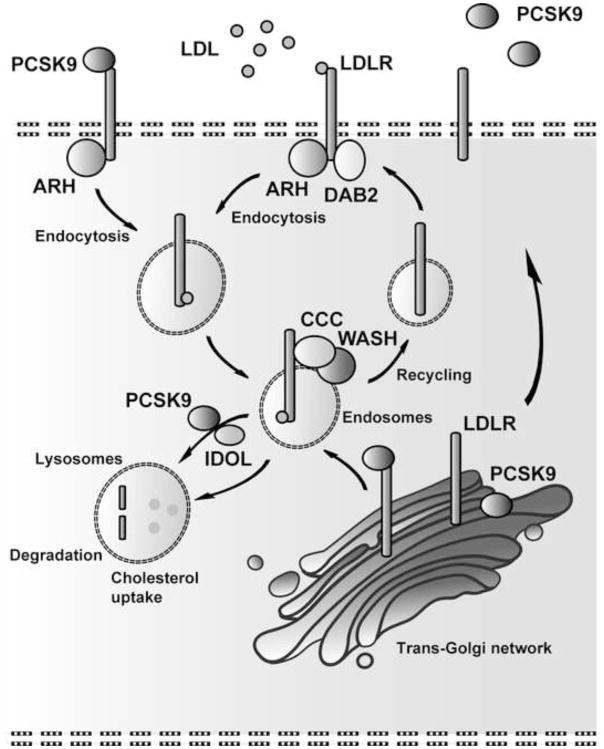
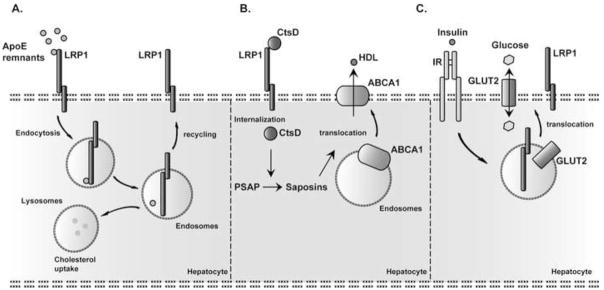
Various proteins orchestrate the intracellular trafficking of LDLR and LRP1. After internalization, the receptors are redirected via recycling endosomes to the cell surface. Several new endocytic proteins that facilitate the endosomal trafficking of LDLR and consequently the clearance of circulating LDL cholesterol have recently been reported. Mutations in some of these proteins cause hypercholesterolemia in human. In addition, LRP1 controls cellular cholesterol efflux by modulating the expression of ABCA1 and ABCG1, and hepatic LRP1 protects against diet-induced hepatic insulin resistance and steatosis through the regulation of insulin receptor trafficking.
LDLR and LRP1 have prominent roles in cellular and organismal cholesterol homeostasis. Their functioning, including their trafficking in the cell, is controlled by numerous proteins. Comprehensive studies into the molecular regulation of LDLR and LRP1 trafficking have advanced our fundamental understanding of cholesterol homeostasis, and these insights may lead to novel therapeutic strategies for atherosclerosis, hyperlipidemia and insulin resistance in the future.
肝脏清除致动脉粥样硬化脂蛋白颗粒需要肝低密度脂蛋白受体(LDLR)和LDLR相关蛋白1(LRP1)。本综述重点介绍了最近的研究,这些研究扩展了我们对肝脏中LDLR和LRP1分子调控及代谢功能的理解。
多种蛋白质协同调节LDLR和LRP1的细胞内运输。内化后,这些受体通过再循环内体重新导向细胞表面。最近报道了几种促进LDLR内体运输从而清除循环中LDL胆固醇的新的内吞蛋白。其中一些蛋白质的突变会导致人类高胆固醇血症。此外,LRP1通过调节ABCA1和ABCG1的表达来控制细胞胆固醇外流,肝脏中的LRP1通过调节胰岛素受体运输来预防饮食诱导的肝脏胰岛素抵抗和脂肪变性。
LDLR和LRP1在细胞和机体胆固醇稳态中起重要作用。它们的功能,包括在细胞内的运输,受多种蛋白质控制。对LDLR和LRP1运输分子调控的全面研究推进了我们对胆固醇稳态的基本理解,这些见解可能会在未来为动脉粥样硬化、高脂血症和胰岛素抵抗带来新的治疗策略。