Lidman Johan, Jonsson Micael, Burrows Ryan M, Bundschuh Mirco, Sponseller Ryan A
Department of Ecology and Environmental Science Umeå University Umeå Sweden.
Department of Forest Ecology and Management Swedish University of Agricultural Sciences Umeå Sweden; Australian Rivers Institute Griffith University Nathan campus Qld Australia.
Ecol Evol. 2017 Jan 22;7(4):1068-1077. doi: 10.1002/ece3.2726. eCollection 2017 Feb.
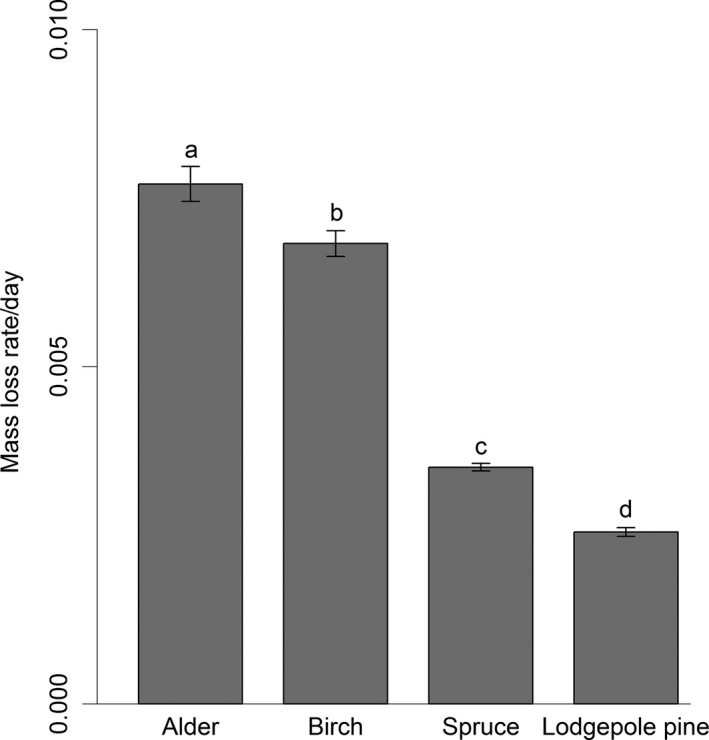
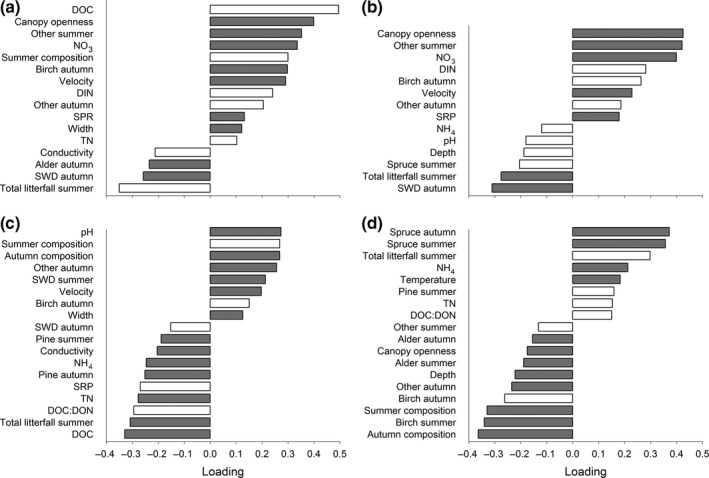
Although the importance of stream condition for leaf litter decomposition has been extensively studied, little is known about how processing rates change in response to altered riparian vegetation community composition. We investigated patterns of plant litter input and decomposition across 20 boreal headwater streams that varied in proportions of riparian deciduous and coniferous trees. We measured a suite of in-stream physical and chemical characteristics, as well as the amount and type of litter inputs from riparian vegetation, and related these to decomposition rates of native (alder, birch, and spruce) and introduced (lodgepole pine) litter species incubated in coarse- and fine-mesh bags. Total litter inputs ranged more than fivefold among sites and increased with the proportion of deciduous vegetation in the riparian zone. In line with differences in initial litter quality, mean decomposition rate was highest for alder, followed by birch, spruce, and lodgepole pine (12, 55, and 68% lower rates, respectively). Further, these rates were greater in coarse-mesh bags that allow colonization by macroinvertebrates. Variance in decomposition rate among sites for different species was best explained by different sets of environmental conditions, but litter-input composition (i.e., quality) was overall highly important. On average, native litter decomposed faster in sites with higher-quality litter input and (with the exception of spruce) higher concentrations of dissolved nutrients and open canopies. By contrast, lodgepole pine decomposed more rapidly in sites receiving lower-quality litter inputs. Birch litter decomposition rate in coarse-mesh bags was best predicted by the same environmental variables as in fine-mesh bags, with additional positive influences of macroinvertebrate species richness. Hence, to facilitate energy turnover in boreal headwaters, forest management with focus on conifer production should aim at increasing the presence of native deciduous trees along streams, as they promote conditions that favor higher decomposition rates of terrestrial plant litter.
尽管溪流状况对落叶分解的重要性已得到广泛研究,但对于处理速率如何响应河岸植被群落组成的变化却知之甚少。我们调查了20条北方源头溪流中植物凋落物输入和分解的模式,这些溪流的河岸落叶树和针叶树比例各不相同。我们测量了一系列溪流中的物理和化学特征,以及河岸植被的凋落物输入量和类型,并将这些与在粗网袋和细网袋中孵化的本地(桤木、桦树和云杉)和引入(黑松)凋落物种的分解速率相关联。各站点的总凋落物输入量相差超过五倍,并随着河岸带落叶植被比例的增加而增加。与初始凋落物质量的差异一致,桤木的平均分解速率最高,其次是桦树、云杉和黑松(分解速率分别低12%、55%和68%)。此外,在允许大型无脊椎动物定殖的粗网袋中,这些速率更高。不同物种在各站点间分解速率的差异最好由不同的环境条件集来解释,但凋落物输入组成(即质量)总体上非常重要。平均而言,在具有较高质量凋落物输入以及(云杉除外)较高溶解养分浓度和开阔树冠的站点中,本地凋落物分解得更快。相比之下,黑松在接受较低质量凋落物输入的站点中分解得更快。粗网袋中桦树凋落物的分解速率,与细网袋中一样,最好由相同的环境变量预测,大型无脊椎动物物种丰富度有额外的积极影响。因此,为了促进北方源头溪流的能量周转,以针叶树生产为重点的森林管理应旨在增加溪流沿岸本地落叶树的数量,因为它们能营造有利于陆地植物凋落物更高分解速率的条件。