Key Laboratory for Humid Subtropical Eco-Geographical Processes of the Ministry of Education, Institute of Geographical Sciences, Fujian Normal University, Fuzhou, 350007, Fujian, China.
Baisha National Forest Farm of Fujian Province, Shanghang, 364205, Fujian, China.
Sci Rep. 2023 Oct 5;13(1):16805. doi: 10.1038/s41598-023-44042-5.
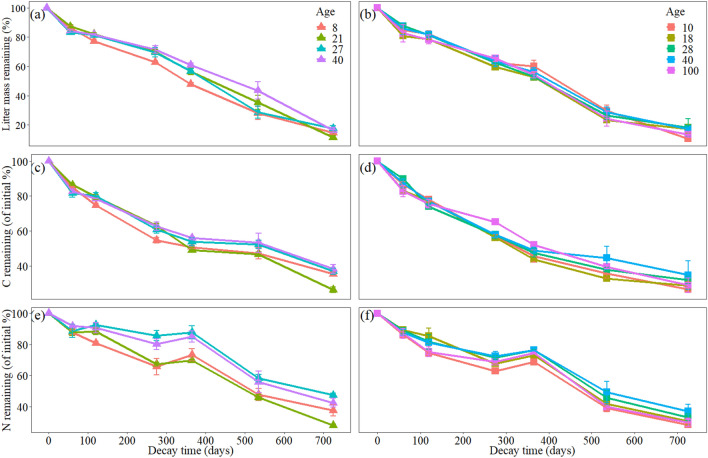
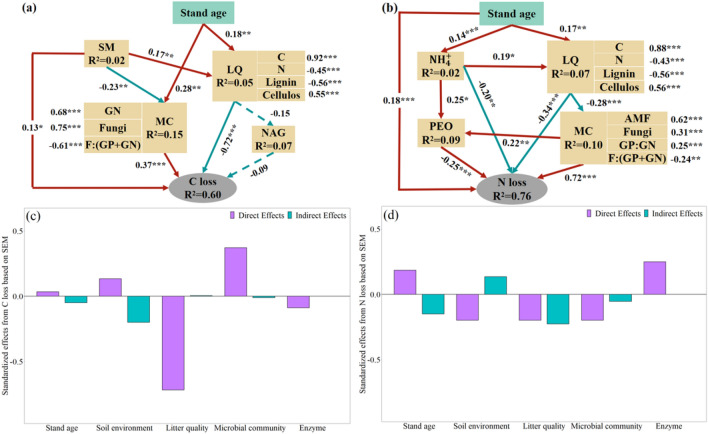
In terrestrial ecosystems, leaf litter is the main source of nutrients returning to the soil. Understanding how litter decomposition responds to stand age is critical for improving predictions of the effects of forest age structure on nutrient availability and cycling in ecosystems. However, the changes in this critical process with stand age remain poorly understood due to the complexity and diversity of litter decomposition patterns and drivers among different stand ages. In this study, we examined the effects of stand age on litter decomposition with two well-replicated age sequences of naturally occurring secondary forests and Chinese fir (Cunninghamia lanceolata) plantations in southern China. Our results showed that the litter decomposition rates in the secondary forests were significantly higher than those in the Chinese fir plantations of the same age, except for 40-year-old forests. The litter decomposition rate of the Chinese fir initially increased and then decreased with stand age, while that of secondary forests gradually decreased. The results of a structural equation model indicated that stand age, litter quality and microbial community were the primary factors driving nutrient litter loss. Overall, these findings are helpful for understanding the effects of stand age on the litter decomposition process and nutrient cycling in plantation and secondary forest ecosystems.
在陆地生态系统中,凋落物是养分返回土壤的主要来源。了解凋落物分解如何响应林龄对于提高森林年龄结构对生态系统养分有效性和循环影响的预测至关重要。然而,由于不同林龄凋落物分解模式和驱动因素的复杂性和多样性,凋落物分解这一关键过程的变化仍知之甚少。在这项研究中,我们利用中国南方两个经过良好复制的天然次生林和杉木(Cunninghamia lanceolata)人工林的年龄序列,研究了林龄对凋落物分解的影响。结果表明,除了 40 年生林分外,次生林的凋落物分解速率明显高于同龄的杉木林分。杉木林分的凋落物分解速率随林龄先增加后减少,而次生林分的凋落物分解速率则逐渐减少。结构方程模型的结果表明,林龄、凋落物质量和微生物群落是驱动养分损失的主要因素。总体而言,这些发现有助于理解林龄对人工林和次生林生态系统凋落物分解过程和养分循环的影响。