Department of Pharmacology, School of Biomedical Sciences, University of Queensland , St. Lucia, QLD 4072, Australia.
Department of Pharmacology, School of Biomedical Sciences, University of Queensland, St. Lucia, QLD 4072, Australia; Department of Nutrition, Faculty of Medicine, University of Chile, Santiago 8380453, Chile.
eNeuro. 2017 Mar 9;4(1). doi: 10.1523/ENEURO.0341-16.2017. eCollection 2017 Jan-Feb.
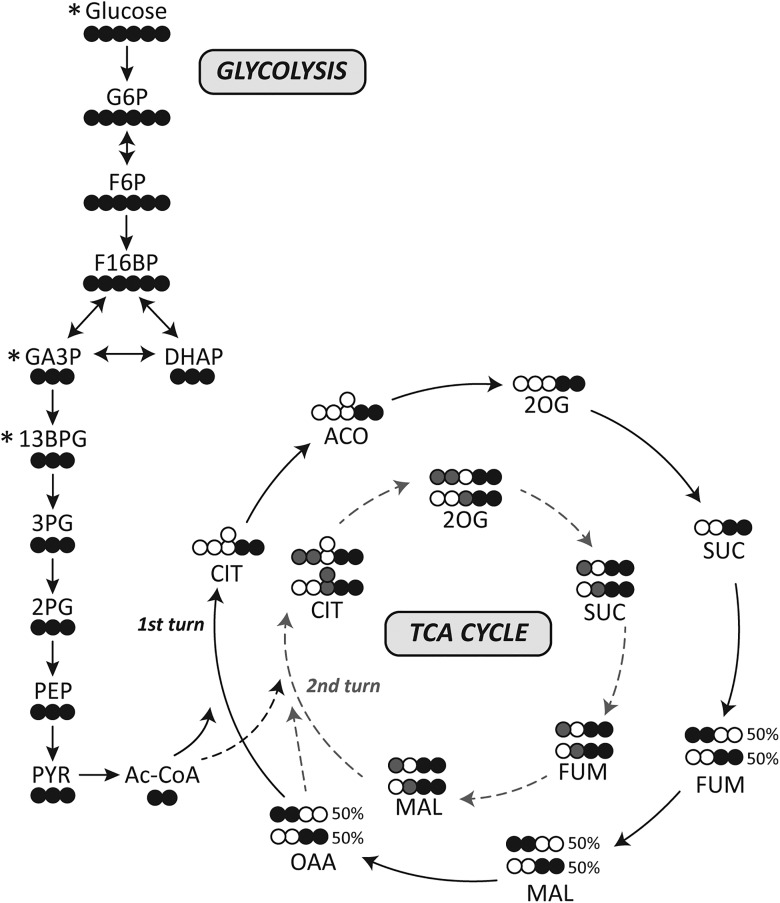
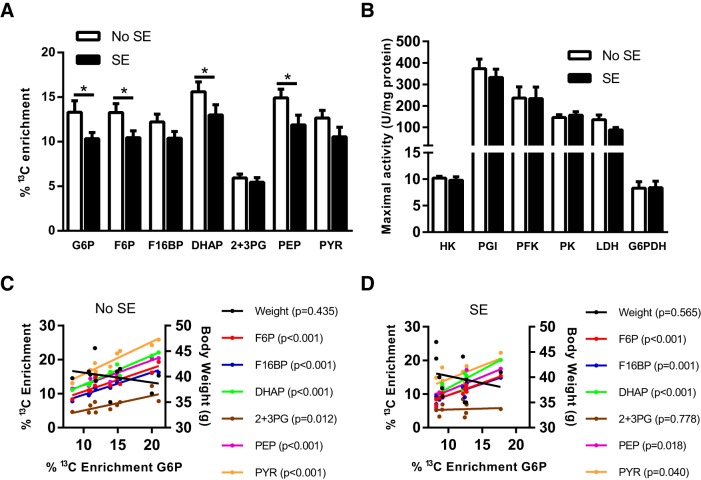
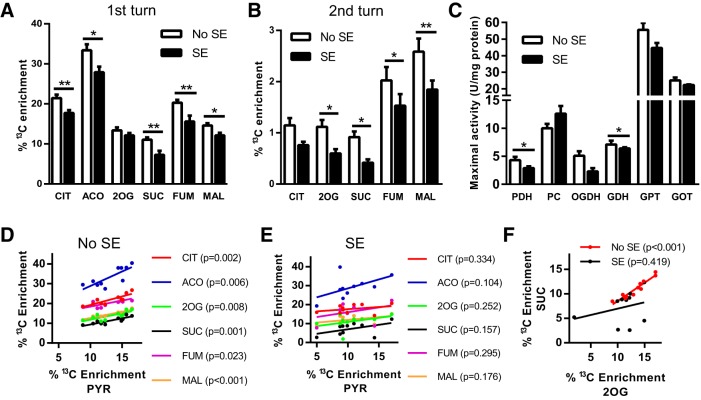
Temporal lobe epilepsy is a common form of adult epilepsy and shows high resistance to treatment. Increasing evidence has suggested that metabolic dysfunction contributes to the development of seizures, with previous studies indicating impairments in brain glucose metabolism. Here we aim to elucidate which pathways involved in glucose metabolism are impaired, by tracing the hippocampal metabolism of injected [U-C]glucose (i.p.) during the chronic stage of the pilocarpine-status epilepticus mouse model of epilepsy. The enrichment of C in the intermediates of glycolysis and the TCA cycle were quantified in hippocampal extracts using liquid chromatography-tandem mass spectroscopy, along with the measurement of the activities of enzymes in each pathway. We show that there is reduced incorporation of C in the intermediates of glycolysis, with the percentage enrichment of all downstream intermediates being highly correlated with those of glucose 6-phosphate. Furthermore, the activities of all enzymes in this pathway including hexokinase and phosphofructokinase were unaltered, suggesting that glucose uptake is reduced in this model without further impairments in glycolysis itself. The key findings were 33% and 55% losses in the activities of pyruvate dehydrogenase and 2-oxoglutarate dehydrogenase, respectively, along with reduced C enrichment in TCA cycle intermediates. This lower C enrichment is best explained in part by the reduced enrichment in glycolytic intermediates, whereas the reduction of key TCA cycle enzyme activity indicates that TCA cycling is also impaired in the hippocampal formation. Together, these data suggest that multitarget approaches may be necessary to restore metabolism in the epileptic brain.
颞叶癫痫是成人癫痫的一种常见形式,且对治疗具有较高的抗性。越来越多的证据表明代谢功能障碍有助于癫痫发作的发展,先前的研究表明脑葡萄糖代谢受损。在这里,我们旨在通过追踪匹罗卡品癫痫持续状态小鼠模型癫痫慢性期注射[U-C]葡萄糖(i.p.)后的海马代谢,阐明葡萄糖代谢中哪些途径受损。使用液相色谱-串联质谱法,在海马提取物中定量测定糖酵解和三羧酸循环中 C 在中间产物中的富集,并测量每条途径中的酶活性。我们发现糖酵解中间产物的 C 掺入减少,所有下游中间产物的富集百分比与葡萄糖 6-磷酸的高度相关。此外,该途径中所有酶的活性(包括己糖激酶和磷酸果糖激酶)均未改变,表明该模型中葡萄糖摄取减少,而糖酵解本身没有进一步受损。关键发现是丙酮酸脱氢酶和 2-氧戊二酸脱氢酶的活性分别降低了 33%和 55%,同时三羧酸循环中间产物的 C 富集减少。这种较低的 C 富集部分可以通过糖酵解中间产物的减少富集来解释,而关键三羧酸循环酶活性的降低表明三羧酸循环在海马形成中也受到损害。这些数据表明,可能需要多靶点方法来恢复癫痫大脑的代谢。