Tiffin Paul A, Paton Lewis W, Mwandigha Lazaro M, McLachlan John C, Illing Jan
Department of Health Sciences, University of York, Heslington, York, YO10 5DD, UK.
School for Medicine, Pharmacy and Health, Durham University Queen's Campus, Thornaby, TS17 6BH, UK.
BMC Med. 2017 Mar 20;15(1):66. doi: 10.1186/s12916-017-0829-1.
International medical graduates working in the UK are more likely to be censured in relation to fitness to practise compared to home graduates. Performance on the General Medical Council's (GMC's) Professional and Linguistic Assessments Board (PLAB) tests and English fluency have previously been shown to predict later educational performance in this group of doctors. It is unknown whether the PLAB system is also a valid predictor of unprofessional behaviour and malpractice. The findings would have implications for regulatory policy.
This was an observational study linking data relating to fitness to practise events (referral or censure), PLAB performance, demographic variables and English language competence, as evaluated via the International English Language Test System (IELTS). Data from 27,330 international medical graduates registered with the GMC were analysed, including 210 doctors who had been sanctioned in relation to at least one fitness to practise issue. The main outcome was risk of eventual censure (including a warning).
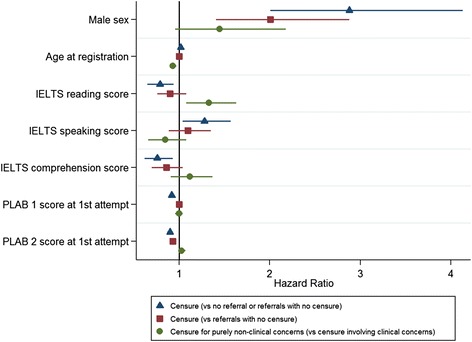
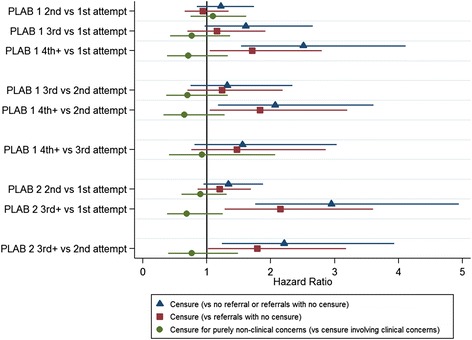
The significant univariable educational predictors of eventual censure (versus no censures or referrals) were lower PLAB part 1 (hazard ratio [HR], 0.99; 95% confidence interval, 0.98 to 1.00) and part 2 scores (HR, 0.94; 0.91 to 0.97) at first sitting, multiple attempts at both parts of the PLAB, lower IELTS reading (HR, 0.79; 0.65 to 0.94) and listening scores (HR, 0.76; 0.62 to 0.93) and higher IELTS speaking scores (HR, 1.28; 1.04 to 1.57). Multiple resits at either part of the PLAB and higher IELTS speaking score (HR, 1.49; 1.20 to 1.84) were also independent predictors of censure. We estimated that the proposed limit of four attempts at both parts of the PLAB would reduce the risk in this entire group by only approximately two censures per 5 years in this group of doctors.
Making the PLAB, or any replacement assessment, more stringent and raising the required standards of English reading and listening may result in fewer fitness to practice events in international medical graduates. However, the number of PLAB resits permitted would have to be further capped to meaningfully impact the risk of sanctions in this group of doctors.
与英国本土医学毕业生相比,在英国工作的国际医学毕业生在执业资格方面更有可能受到谴责。此前研究表明,英国医学总会(GMC)的专业及语言评估委员会(PLAB)测试成绩和英语流利程度可预测这组医生日后的教育表现。尚不清楚PLAB系统是否也是不专业行为和医疗事故的有效预测指标。研究结果将对监管政策产生影响。
这是一项观察性研究,将与执业资格事件(转介或谴责)、PLAB成绩、人口统计学变量以及通过国际英语语言测试系统(雅思)评估的英语语言能力相关的数据联系起来。对在GMC注册的27330名国际医学毕业生的数据进行了分析,其中包括210名因至少一项执业资格问题而受到制裁的医生。主要结果是最终受到谴责(包括警告)的风险。
最终受到谴责(与未受谴责或未被转介相比)的显著单变量教育预测因素包括首次参加PLAB第1部分考试时成绩较低(风险比[HR],0.99;95%置信区间,0.98至1.00)和第2部分考试成绩较低(HR,0.94;0.91至0.97)、PLAB两部分考试均多次参加、雅思阅读成绩较低(HR,0.79;0.65至0.94)和听力成绩较低(HR,0.76;0.62至0.93)以及雅思口语成绩较高(HR,1.28;1.04至1.57)。PLAB任何一部分考试多次重考以及雅思口语成绩较高(HR,1.49;1.20至1.84)也是受到谴责的独立预测因素。我们估计,提议的PLAB两部分考试均限制为四次尝试,在这组医生中,每5年只能使整个群体的风险减少约两起谴责事件。
提高PLAB或任何替代评估的严格程度,并提高英语阅读和听力的要求标准,可能会减少国际医学毕业生中与执业资格相关的事件。然而,必须进一步限制PLAB重考的次数,才能对这组医生受到制裁的风险产生有意义的影响。