Qian Fang, Sun Jiayue, Cao Di, Tuo Yanfeng, Jiang Shujuan, Mu Guangqing
School of Food Science and Technology, Dalian Polytechnic University, Dalian, 116034, P.R.China.
School of Food Science and Technology, Dalian Polytechnic University, Dalian, 116034, P.R.China; Synergetic Innovation Center of Food Safety and Nutrition, Northeast Agricultural University, Harbin, 150030, P.R.China.
Korean J Food Sci Anim Resour. 2017;37(1):44-51. doi: 10.5851/kosfa.2017.37.1.44. Epub 2017 Feb 28.
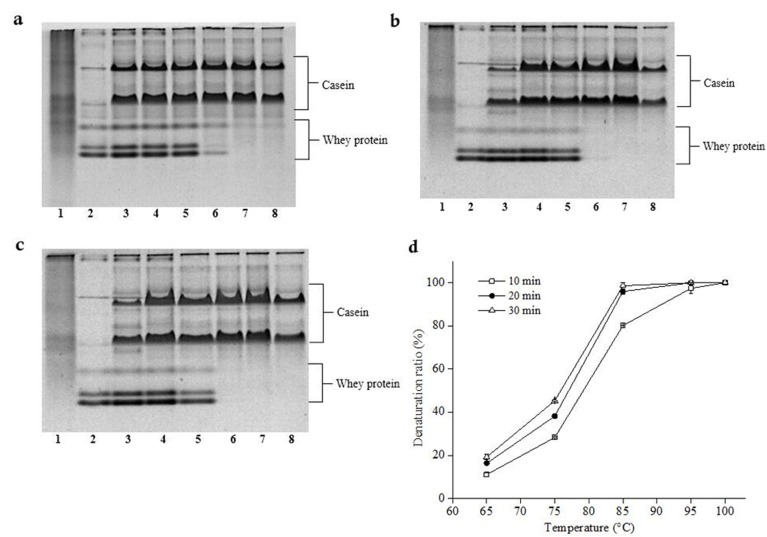
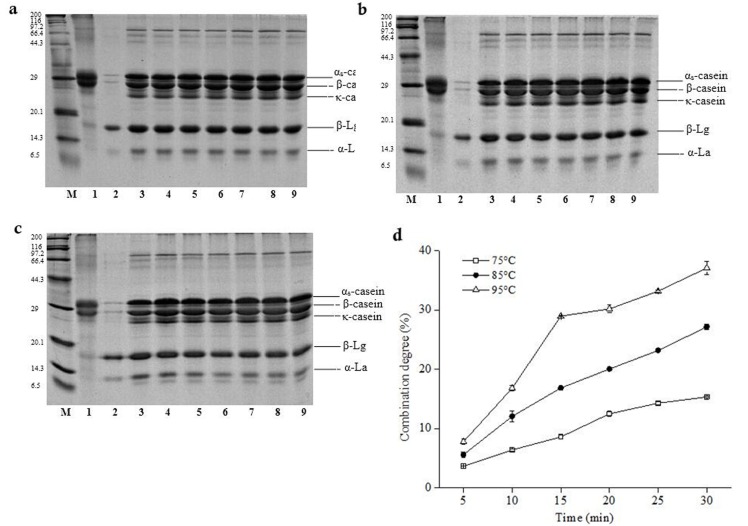
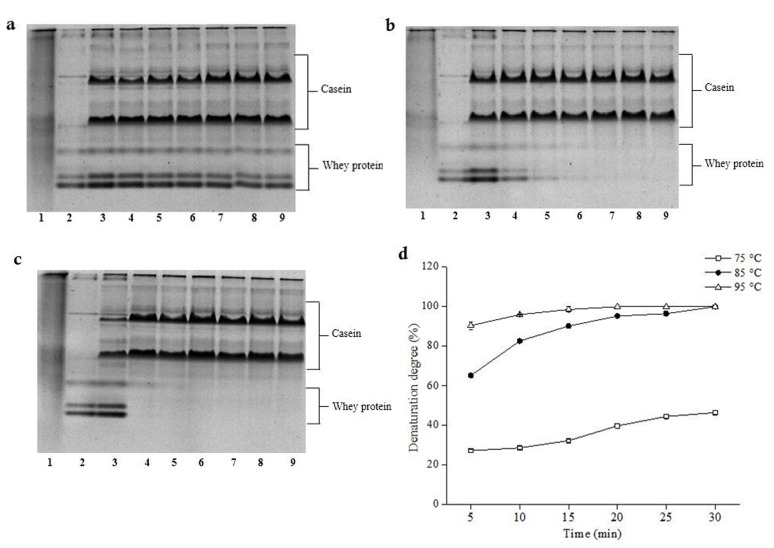
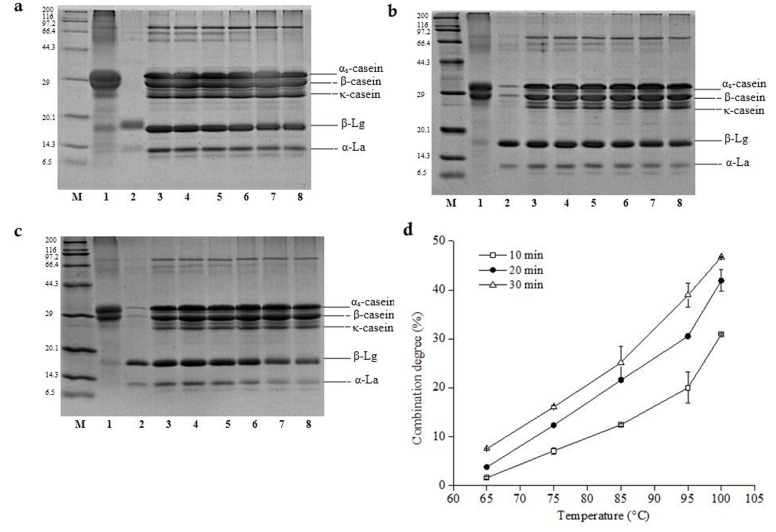
Heat treatment of milk aims to inhibit the growth of microbes, extend the shelf-life of products and improve the quality of the products. Heat treatment also leads to denaturation of whey protein and the formation of whey protein-casein polymer, which has negative effects on milk product. Hence the milk heat treatment conditions should be controlled in milk processing. In this study, the denaturation degree of whey protein and the combination degree of whey protein and casein when undergoing heat treatment were also determined by using the Native-PAGE and SDS-PAGE analysis. The results showed that the denaturation degree of whey protein and the combination degree of whey protein with casein extended with the increase of the heat-treated temperature and time. The effects of the heat-treated temperature and heat-treated time on the denaturation degree of whey protein and on the combination degree of whey protein and casein were well described using the quadratic regression equation. The analysis strategy used in this study reveals an intuitive and effective measure of the denaturation degree of whey protein, and the changes of milk protein under different heat treatment conditions efficiently and accurately in the dairy industry. It can be of great significance for dairy product proteins following processing treatments applied for dairy product manufacturing.
牛奶热处理旨在抑制微生物生长、延长产品保质期并提高产品质量。热处理还会导致乳清蛋白变性以及乳清蛋白 - 酪蛋白聚合物的形成,这对奶制品有负面影响。因此,在牛奶加工过程中应控制牛奶热处理条件。在本研究中,还通过使用非变性聚丙烯酰胺凝胶电泳(Native - PAGE)和十二烷基硫酸钠 - 聚丙烯酰胺凝胶电泳(SDS - PAGE)分析来测定热处理时乳清蛋白的变性程度以及乳清蛋白与酪蛋白的结合程度。结果表明,乳清蛋白的变性程度以及乳清蛋白与酪蛋白的结合程度随热处理温度和时间的增加而增大。使用二次回归方程很好地描述了热处理温度和热处理时间对乳清蛋白变性程度以及乳清蛋白与酪蛋白结合程度的影响。本研究中使用的分析策略揭示了一种直观有效的测定乳清蛋白变性程度的方法,以及在乳制品行业中不同热处理条件下牛奶蛋白变化的有效且准确的方法。这对于乳制品制造过程中应用的加工处理后的乳制品蛋白质可能具有重要意义。