Wolff Jason J, Swanson Meghan R, Elison Jed T, Gerig Guido, Pruett John R, Styner Martin A, Vachet Clement, Botteron Kelly N, Dager Stephen R, Estes Annette M, Hazlett Heather C, Schultz Robert T, Shen Mark D, Zwaigenbaum Lonnie, Piven Joseph
Department of Educational Psychology, University of Minnesota, Minneapolis, MN USA.
Carolina Institute for Developmental Disabilities, University of North Carolina, Chapel Hill, NC USA.
Mol Autism. 2017 Mar 4;8:8. doi: 10.1186/s13229-017-0126-z. eCollection 2017.
Restricted and repetitive behaviors are defining features of autism spectrum disorder (ASD). Under revised diagnostic criteria for ASD, this behavioral domain now includes atypical responses to sensory stimuli. To date, little is known about the neural circuitry underlying these features of ASD early in life.
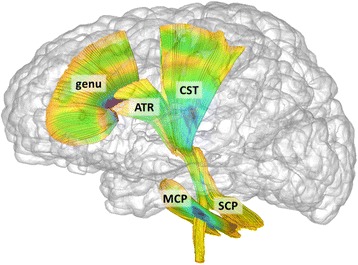
Longitudinal diffusion tensor imaging data were collected from 217 infants at high familial risk for ASD. Forty-four of these infants were diagnosed with ASD at age 2. Targeted cortical, cerebellar, and striatal white matter pathways were defined and measured at ages 6, 12, and 24 months. Dependent variables included the Repetitive Behavior Scale-Revised and the Sensory Experiences Questionnaire.
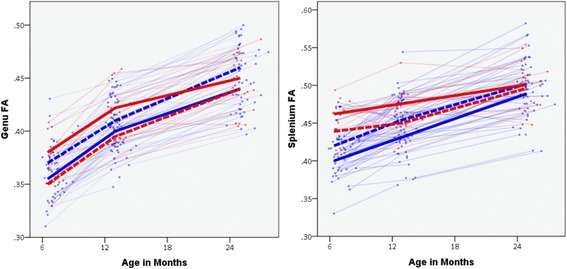
Among children diagnosed with ASD, repetitive behaviors and sensory response patterns were strongly correlated, even when accounting for developmental level or social impairment. Longitudinal analyses indicated that the genu and cerebellar pathways were significantly associated with both repetitive behaviors and sensory responsiveness but not social deficits. At age 6 months, fractional anisotropy in the genu significantly predicted repetitive behaviors and sensory responsiveness at age 2. Cerebellar pathways significantly predicted later sensory responsiveness. Exploratory analyses suggested a possible disordinal interaction based on diagnostic status for the association between fractional anisotropy and repetitive behavior.
Our findings suggest that restricted and repetitive behaviors contributing to a diagnosis of ASD at age 2 years are associated with structural properties of callosal and cerebellar white matter pathways measured during infancy and toddlerhood. We further identified that repetitive behaviors and unusual sensory response patterns co-occur and share common brain-behavior relationships. These results were strikingly specific given the absence of association between targeted pathways and social deficits.
受限及重复行为是自闭症谱系障碍(ASD)的典型特征。根据ASD的修订诊断标准,这一行为领域现在包括对感觉刺激的非典型反应。迄今为止,对于ASD这些早期特征背后的神经回路知之甚少。
收集了217名患ASD家族风险高的婴儿的纵向扩散张量成像数据。其中44名婴儿在2岁时被诊断为ASD。在6个月、12个月和24个月时确定并测量了靶向的皮质、小脑和纹状体白质通路。因变量包括修订版重复行为量表和感觉体验问卷。
在被诊断为ASD的儿童中,即使考虑到发育水平或社交障碍,重复行为和感觉反应模式也密切相关。纵向分析表明,胼胝体和小脑通路与重复行为和感觉反应性均显著相关,但与社交缺陷无关。在6个月时,胼胝体的各向异性分数显著预测了2岁时的重复行为和感觉反应性。小脑通路显著预测了后期的感觉反应性。探索性分析表明,基于各向异性分数与重复行为之间关联的诊断状态可能存在非顺序性相互作用。
我们的研究结果表明,导致2岁时被诊断为ASD的受限及重复行为与婴儿期和幼儿期测量的胼胝体和小脑白质通路的结构特性相关。我们进一步发现,重复行为和异常感觉反应模式同时出现并共享共同的脑-行为关系。鉴于靶向通路与社交缺陷之间不存在关联,这些结果具有显著的特异性。