Yale Child Study Center, Yale University School of Medicine, New Haven, Connecticut.
Centre for Applied Autism Research, Psychology Department, University of Bath, Bath, UK.
Autism Res. 2019 Oct;12(10):1472-1483. doi: 10.1002/aur.2180. Epub 2019 Jul 26.
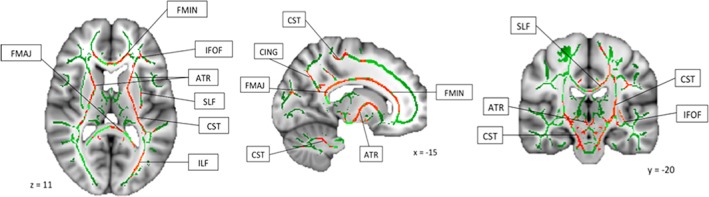
Previous studies using diffusion tensor imaging (DTI) to investigate white matter (WM) structural connectivity have suggested widespread, although inconsistent WM alterations in autism spectrum disorder (ASD), such as greater reductions in fractional anisotropy (FA). However, findings may lack generalizability because: (a) most have focused solely on the ASD male brain phenotype, and not sex-differences in WM integrity; (b) many lack stringent and transparent data quality control such as controlling for head motion in analysis. This study addressed both issues by using Tract-Based Spatial Statistics (TBSS) to separately compare WM differences in 81 ASD (56 male, 25 female; 4-21 years old) and 39 typically developing (TD; 23 males, 16 females; 5-18 years old) children and young people, carefully group-matched on sex, age, cognitive abilities, and head motion. ASD males and females were also matched on autism symptom severity. Two independent-raters completed a multistep scan quality assurance to remove images that were significantly distorted by motion artifacts before analysis. ASD females exhibited significant widespread reductions in FA compared to TD females, suggesting altered WM integrity. In contrast, no significant localized or widespread WM differences were found between ASD and TD males. This study highlights the importance of data quality control in DTI, and outlines important sex-differences in WM alterations in ASD females. Future studies can explore the extent to which neural structural differences might underlie sex-differences in ASD behavioral phenotype, and guide clinical interventions to be tailored toward the unique needs of ASD females and males. Autism Res 2019, 12: 1472-1483. © 2019 The Authors. Autism Research published by International Society for Autism Research published by Wiley Periodicals, Inc. LAY SUMMARY: Previous Diffusion Tensor Imaging (DTI) studies have found atypical brain structural connectivity in males with autism, although findings are inconclusive in females with autism. To investigate potential sex-differences, we studied males and females with and without autism who showed a similar level of head movement during their brain scan. We found that females with autism had widespread atypical neural connectivity than females without autism, although not in males, highlighting sex-differences.
先前使用弥散张量成像(DTI)研究脑白质(WM)结构连接的研究表明,自闭症谱系障碍(ASD)存在广泛的 WM 改变,尽管不一致,例如各向异性分数(FA)降低。然而,这些发现可能缺乏普遍性,因为:(a)大多数研究仅集中于 ASD 男性脑表型,而没有研究 WM 完整性的性别差异;(b)许多研究缺乏严格和透明的数据质量控制,例如在分析中控制头部运动。本研究通过使用基于束的空间统计学(TBSS),分别比较了 81 名 ASD(56 名男性,25 名女性;4-21 岁)和 39 名正常发育(TD;23 名男性,16 名女性;5-18 岁)儿童和青少年的 WM 差异,这些儿童和青少年在性别、年龄、认知能力和头部运动方面进行了仔细的分组匹配。ASD 男性和女性还根据自闭症症状严重程度进行匹配。两名独立的评分员完成了多步骤的扫描质量保证,以在分析之前去除受运动伪影显著扭曲的图像。与 TD 女性相比,ASD 女性表现出广泛的 FA 显著降低,表明 WM 完整性改变。相比之下,在 ASD 和 TD 男性之间没有发现显著的局部或广泛的 WM 差异。本研究强调了 DTI 中数据质量控制的重要性,并概述了 ASD 女性 WM 改变中的重要性别差异。未来的研究可以探索神经结构差异在多大程度上可能是 ASD 行为表型性别差异的基础,并指导针对 ASD 女性和男性独特需求的临床干预措施。自闭症研究 2019,12:1472-1483。©2019 自闭症研究协会由国际自闭症研究协会出版,由 Wiley 期刊出版公司出版。
摘要:先前的弥散张量成像(DTI)研究发现,自闭症男性的大脑结构连接存在异常,但自闭症女性的研究结果尚无定论。为了研究潜在的性别差异,我们研究了患有和不患有自闭症的男性和女性,这些患者在大脑扫描过程中表现出相似水平的头部运动。我们发现,与没有自闭症的女性相比,患有自闭症的女性存在广泛的神经连接异常,但在男性中没有发现这种异常,这突出了性别差异。