Bribiesca-Contreras Fernanda, Sellers William I
Faculty of Science and Engineering, University of Manchester , Manchester , UK.
PeerJ. 2017 Mar 15;5:e3039. doi: 10.7717/peerj.3039. eCollection 2017.
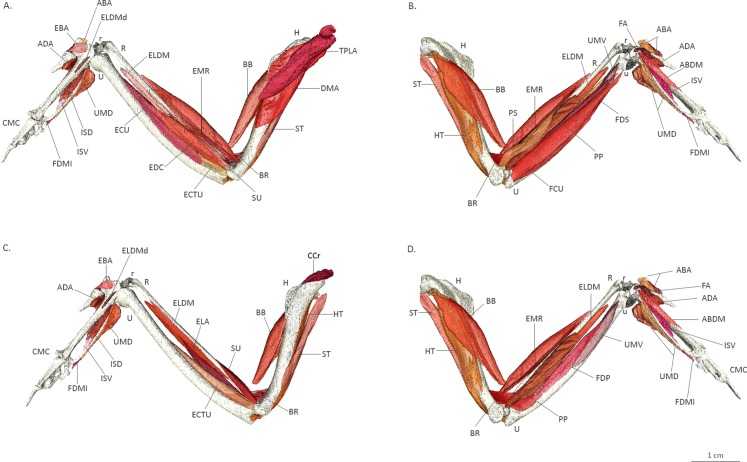
Gross dissection is a widespread method for studying animal anatomy, despite being highly destructive and time-consuming. X-ray computed tomography (CT) has been shown to be a non-destructive alternative for studying anatomical structures. However, in the past it has been limited to only being able to visualise mineralised tissues. In recent years, morphologists have started to use traditional X-ray contrast agents to allow the visualisation of soft tissue elements in the CT context. The aim of this project is to assess the ability of contrast-enhanced micro-CT (μCT) to construct a three-dimensional (3D) model of the musculoskeletal system of the bird wing and to quantify muscle geometry and any systematic changes due to shrinkage. We expect that this reconstruction can be used as an anatomical guide to the sparrowhawk wing musculature and form the basis of further biomechanical analysis of flight.
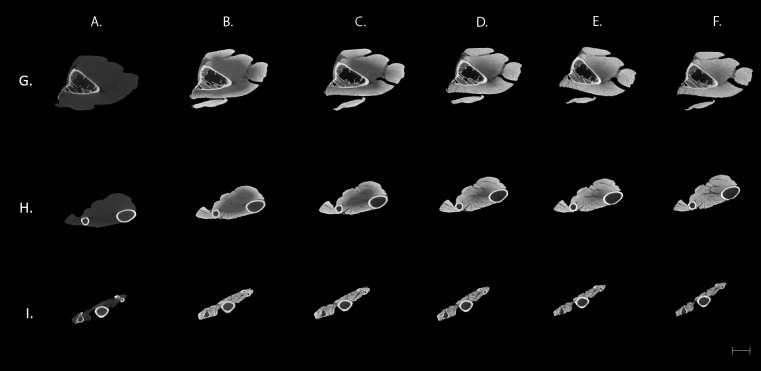
A 3% iodine-buffered formalin solution with a 25-day staining period was used to visualise the wing myology of the sparrowhawk (). μCT scans of the wing were taken over the staining period until full penetration of the forelimb musculature by iodine was reached. A 3D model was reconstructed by manually segmenting out the individual elements of the avian wing using 3D visualisation software.
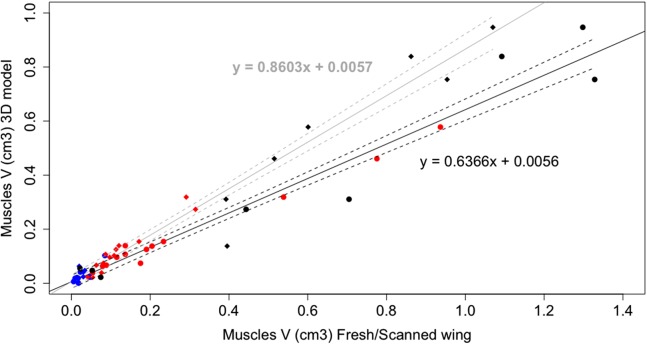
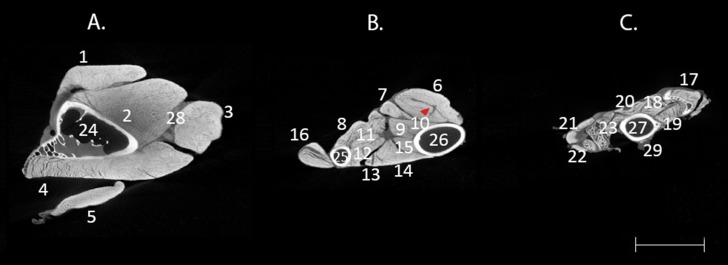
Different patterns of contrast were observed over the duration of the staining treatment with the best results occurring after 25 days of staining. Staining made it possible to visualise and identify different elements of the soft tissue of the wing. Finally, a 3D reconstruction of the musculoskeletal system of the sparrowhawk wing is presented and numerical data of muscle geometry is compared to values obtained by dissection.
Contrast-enhanced μCT allows the visualisation and identification of the wing myology of birds, including the smaller muscles in the hand, and provides a non-destructive way for quantifying muscle volume with an accuracy of 96.2%. By combining contrast-enhanced μCT with 3D visualisation techniques, it is possible to study the individual muscles of the forelimb in their original position and 3D design, which can be the basis of further biomechanical analysis. Because the stain can be washed out post analysis, this technique provides a means of obtaining quantitative muscle data from museum specimens non-destructively.
大体解剖是研究动物解剖学的一种广泛应用的方法,尽管它具有高度的破坏性且耗时。X射线计算机断层扫描(CT)已被证明是研究解剖结构的一种非破坏性替代方法。然而,过去它仅限于能够可视化矿化组织。近年来,形态学家开始使用传统的X射线造影剂,以便在CT环境中可视化软组织成分。本项目的目的是评估对比增强型显微CT(μCT)构建鸟翼肌肉骨骼系统三维(3D)模型的能力,并量化肌肉几何形状以及由于收缩引起的任何系统性变化。我们期望这种重建能够用作雀鹰翅膀肌肉组织的解剖学指南,并构成进一步飞行生物力学分析的基础。
使用3%碘缓冲福尔马林溶液,染色期为25天,以可视化雀鹰的翅膀肌肉学()。在染色期间对翅膀进行μCT扫描,直到碘完全穿透前肢肌肉组织。使用3D可视化软件手动分割出鸟类翅膀的各个元素,重建3D模型。
在染色处理过程中观察到不同的对比模式,染色25天后效果最佳。染色使得可视化和识别翅膀软组织的不同元素成为可能。最后,展示了雀鹰翅膀肌肉骨骼系统的3D重建,并将肌肉几何形状的数值数据与通过解剖获得的值进行了比较。
对比增强型μCT能够可视化和识别鸟类的翅膀肌肉学,包括手部较小的肌肉,并提供一种非破坏性的方法来量化肌肉体积,准确率为96.2%。通过将对比增强型μCT与3D可视化技术相结合,可以在其原始位置和3D设计中研究前肢的各个肌肉,这可以作为进一步生物力学分析的基础。由于染色剂可以在分析后冲洗掉,该技术提供了一种从博物馆标本中无损获取定量肌肉数据的方法。