Larsbrink Johan, Tuveng Tina R, Pope Phillip B, Bulone Vincent, Eijsink Vincent G H, Brumer Harry, McKee Lauren S
Norwegian University of Life Sciences, NMBU, Department of Chemistry, Biotechnology and Food Sciences, PO Box 5003, NO-1432 Ås, Norway; Wallenberg Wood Science Center, Division of Industrial Biotechnology, Department of Biology and Biological Engineering, Chalmers University, 412 96 Gothenburg, Sweden.
Norwegian University of Life Sciences, NMBU, Department of Chemistry, Biotechnology and Food Sciences, PO Box 5003, NO-1432 Ås, Norway.
Data Brief. 2017 Feb 17;11:484-490. doi: 10.1016/j.dib.2017.02.032. eCollection 2017 Apr.
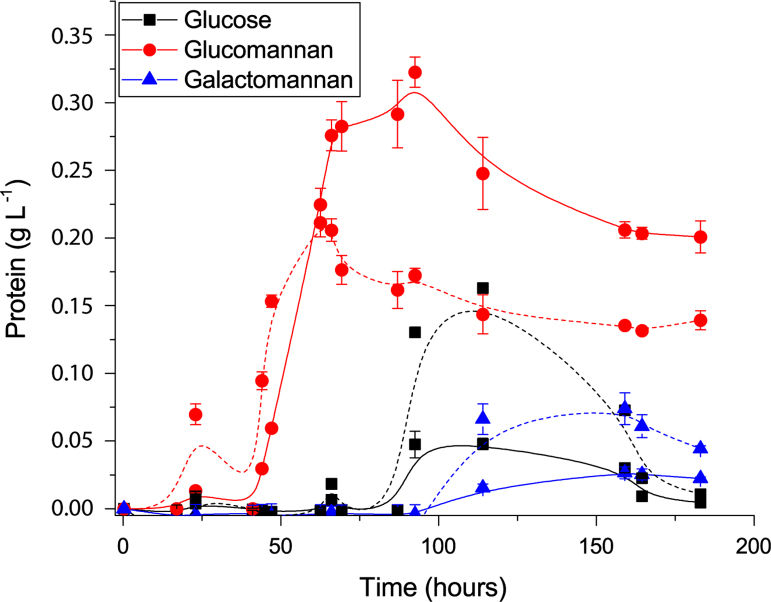
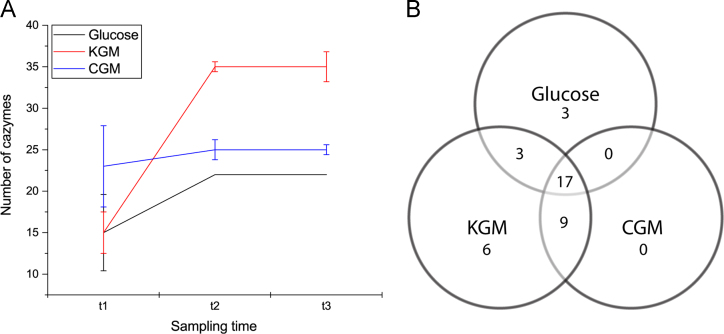
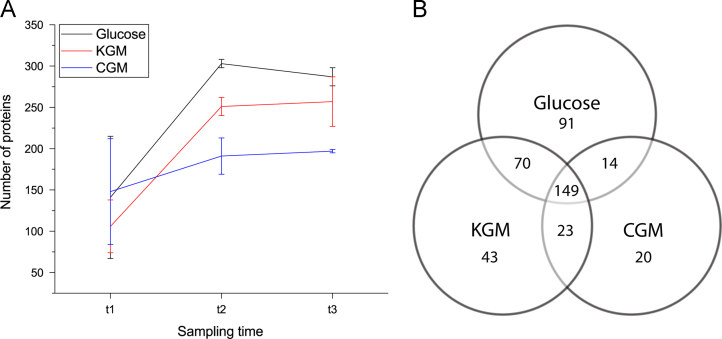
The secretion of carbohydrate-degrading enzymes by a bacterium sourced from a softwood forest environment has been investigated by mass spectrometry. The findings are discussed in full in the research article "Proteomic insights into mannan degradation and protein secretion by the forest floor bacterium " in Journal of Proteomics by Larsbrink et al. ([1], doi: 10.1016/j.jprot.2017.01.003). The bacterium was grown on three carbon sources (glucose, glucomannan, and galactomannan) which are likely to be nutrient sources or carbohydrate degradation products found in its natural habitat. The bacterium was grown on solid agarose plates to mimic the natural behaviour of growth on a solid surface. Secreted proteins were collected from the agarose following trypsin-mediated hydrolysis to peptides. The different carbon sources led to the secretion of different numbers and types of proteins. Most carbohydrate-degrading enzymes were found in the glucomannan-induced cultures. Several of these enzymes may have biotechnological potential in plant cell wall deconstruction for biofuel or biomaterial production, and several may have novel activities. A subset of carbohydrate-active enzymes (CAZymes) with predicted activities not obviously related to the growth substrates were also found in samples grown on each of the three carbohydrates. The full dataset is accessible at the PRIDE partner repository (ProteomeXchange Consortium) with the identifier PXD004305, and the full list of proteins detected is given in the supplementary material attached to this report.
通过质谱法研究了从针叶林环境中分离出的一种细菌分泌碳水化合物降解酶的情况。相关研究结果在Larsbrink等人发表于《蛋白质组学杂志》的研究论文《对森林地面细菌甘露聚糖降解和蛋白质分泌的蛋白质组学见解》([1],doi: 10.1016/j.jprot.2017.01.003)中有详细讨论。该细菌在三种碳源(葡萄糖、葡甘露聚糖和半乳甘露聚糖)上生长,这些碳源可能是其天然栖息地中存在的营养源或碳水化合物降解产物。细菌在固体琼脂平板上生长,以模拟在固体表面生长的自然行为。胰蛋白酶介导水解为肽后,从琼脂中收集分泌的蛋白质。不同的碳源导致分泌不同数量和类型的蛋白质。大多数碳水化合物降解酶在葡甘露聚糖诱导的培养物中被发现。其中几种酶在用于生物燃料或生物材料生产的植物细胞壁解构方面可能具有生物技术潜力,还有几种可能具有新的活性。在以三种碳水化合物中的每一种为碳源生长的样品中,还发现了一组预测活性与生长底物无明显关联的碳水化合物活性酶(CAZymes)。完整数据集可在PRIDE合作伙伴库(蛋白质组交换联盟)中获取,标识符为PXD004305,本报告附件中的补充材料给出了检测到的蛋白质完整列表。