Department of Integrative Biology, University of Guelph, Guelph, Ontario, Canada N1G 2W1.
Department of Biology, Bowdoin College, Brunswick, Maine 04011, USA.
Nat Commun. 2017 Mar 20;8:14812. doi: 10.1038/ncomms14812.
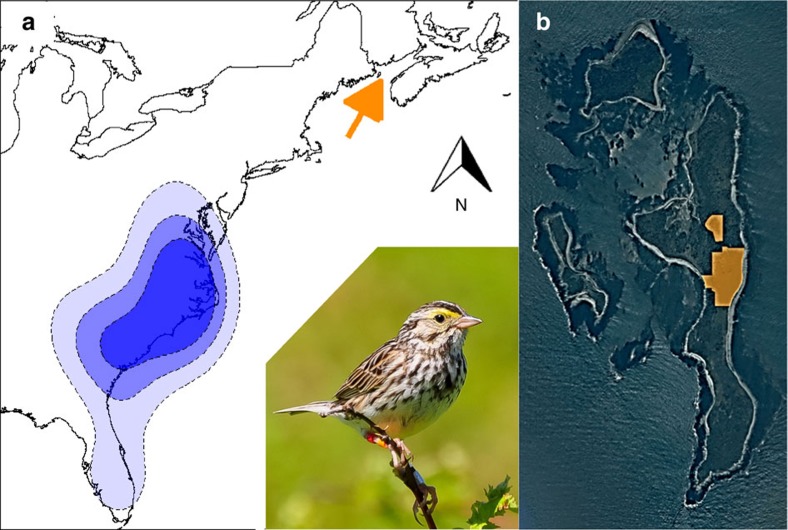
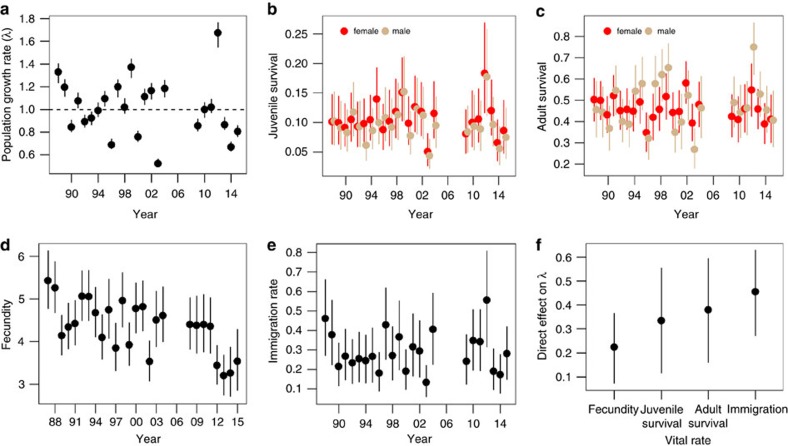
Understanding the factors that limit and regulate wildlife populations requires insight into demographic and environmental processes acting throughout the annual cycle. Here, we combine multi-year tracking data of individual birds with a 26-year demographic study of a migratory songbird to evaluate the relative effects of density and weather at the breeding and wintering grounds on population growth rate. Our results reveal clear support for opposing forces of winter temperature and breeding density driving population dynamics. Above-average temperatures at the wintering grounds lead to higher population growth, primarily through their strong positive effects on survival. However, population growth is regulated over the long term by strong negative effects of breeding density on both fecundity and adult male survival. Such knowledge of how year-round factors influence population growth, and the demographic mechanisms through which they act, will vastly improve our ability to predict species responses to environmental change and develop effective conservation strategies for migratory animals.
了解限制和调节野生动物种群的因素需要深入了解整个年度周期中起作用的人口和环境过程。在这里,我们将个体鸟类的多年跟踪数据与对一种迁徙鸣禽的 26 年人口研究相结合,以评估繁殖地和越冬地的密度和天气对种群增长率的相对影响。我们的研究结果清楚地表明,冬季温度和繁殖密度这两种对立的力量推动了种群动态。越冬地的平均温度升高会导致种群增长率上升,这主要是因为它们对存活率有很强的正向影响。然而,繁殖密度对繁殖力和成年雄性存活率的强烈负面影响,从长期来看对种群增长起到了调节作用。这种了解全年因素如何影响种群增长,以及它们作用的人口机制,将极大地提高我们预测物种对环境变化的反应的能力,并为迁徙动物制定有效的保护策略。