Instituto de Fisiología Vegetal, INFIVE, Universidad Nacional de La Plata, CONICET, La Plata, Buenos Aires, Argentina.
Boyce Thompson Institute for Plant Research, 533 Tower Road, Ithaca, NY 14853, USA.
Sci Rep. 2017 Mar 20;7:44905. doi: 10.1038/srep44905.
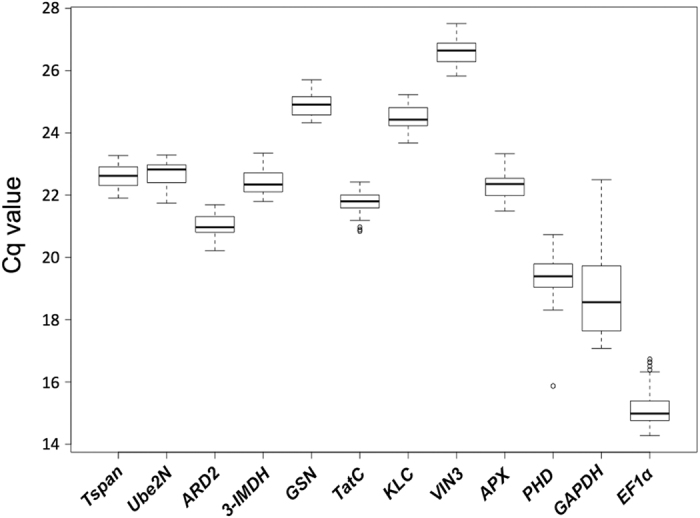
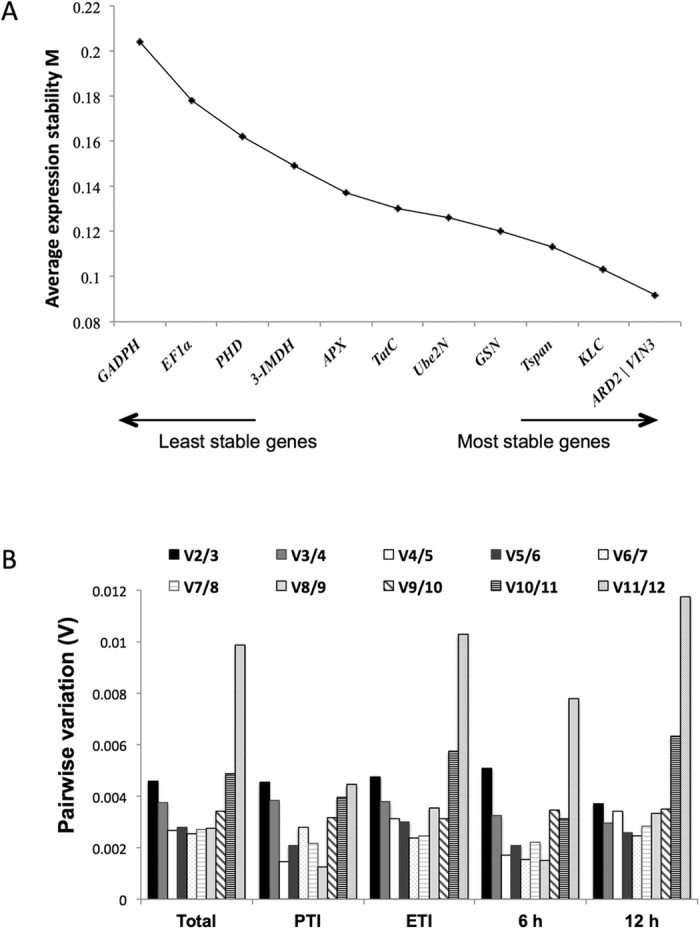
The agronomical relevant tomato-Pseudomonas syringae pv. tomato pathosystem is widely used to explore and understand the underlying mechanisms of the plant immune response. Transcript abundance estimation, mainly through reverse transcription-quantitative PCR (RT-qPCR), is a common approach employed to investigate the possible role of a candidate gene in certain biological process under study. The accuracy of this technique relies heavily on the selection of adequate reference genes. Initially, genes derived from other techniques (such as Northern blots) were used as reference genes in RT-qPCR experiments, but recent studies in different systems suggest that many of these genes are not stably expressed. The development of high throughput transcriptomic techniques, such as RNA-seq, provides an opportunity for the identification of transcriptionally stable genes that can be adopted as novel and robust reference genes. Here we take advantage of a large set of RNA-seq data originating from tomato leaves infiltrated with different immunity inducers and bacterial strains. We assessed and validated 9 genes that are much more stable than two traditional reference genes. Specifically, ARD2 and VIN3 were the most stably expressed genes and consequently we propose they be adopted for RT-qPCR experiments involving this pathosystem.
农业相关的番茄-丁香假单胞菌 pv.番茄病理系统被广泛用于探索和理解植物免疫反应的潜在机制。转录丰度估计,主要通过反转录定量 PCR(RT-qPCR),是一种常用的方法,用于研究候选基因在研究中的某些生物学过程中的可能作用。该技术的准确性在很大程度上依赖于选择合适的参考基因。最初,来自其他技术(如 Northern blot)的基因被用作 RT-qPCR 实验中的参考基因,但最近在不同系统中的研究表明,许多这些基因的表达并不稳定。高通量转录组技术的发展,如 RNA-seq,为鉴定转录稳定的基因提供了机会,这些基因可以作为新的、稳健的参考基因。在这里,我们利用大量源自不同免疫诱导剂和细菌菌株处理的番茄叶片的 RNA-seq 数据。我们评估和验证了 9 个比两个传统参考基因更稳定的基因。具体来说,ARD2 和 VIN3 是表达最稳定的基因,因此我们建议将它们用于涉及该病理系统的 RT-qPCR 实验。