Department of Radiation Oncology, University of California, San Francisco, CA, 94115, USA.
Helen Diller Family Comprehensive Cancer Center, University of California, UCSF Mail stop 0875, 2340 Sutter Street, Room N361, San Francisco, CA, 94115, USA.
BMC Cancer. 2017 Mar 20;17(1):203. doi: 10.1186/s12885-017-3140-9.
About 75-80% of breast tumors express the estrogen receptor alpha (ER-α) and are treated with endocrine-target therapeutics, making this the premier therapeutic modality in the breast cancer clinic. However, acquired resistance is common and about 20% of resistant tumors loose ER-α expression via unknown mechanisms. Inhibition of ER-α loss could improve endocrine therapeutic efficacy, benefiting a significant number of patients. Here we test whether tumor hypoxia might commonly produce ER-α loss.
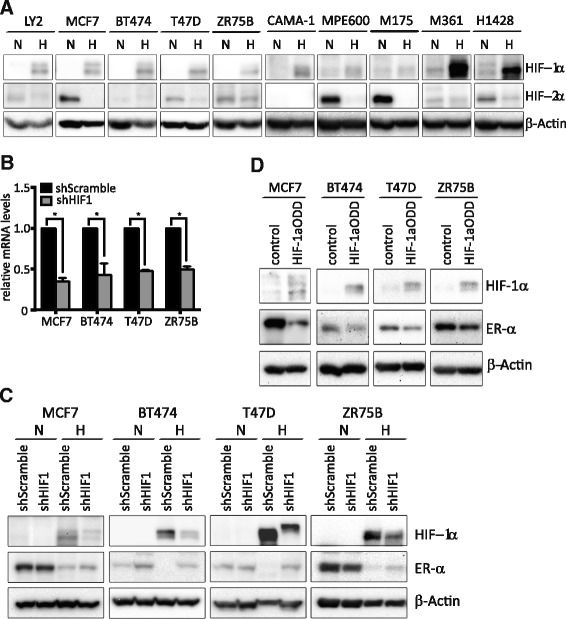
Using standard molecular and cellular biological assays and a work station/incubator with controllable oxygen levels, we analyze the effects of hypoxia on ER-α protein, mRNA, and transcriptional activity in a panel of independently-derived ER-α positive cell lines. These lines were chosen to represent the diverse genetic backgrounds and mutations commonly present in ER-α positive tumors. Using shRNA-mediated knockdown and overexpression studies we also elucidate the role of hypoxia-inducible factor 1-alpha (HIF-1α) in the hypoxia-induced decrease in ER-α abundance.
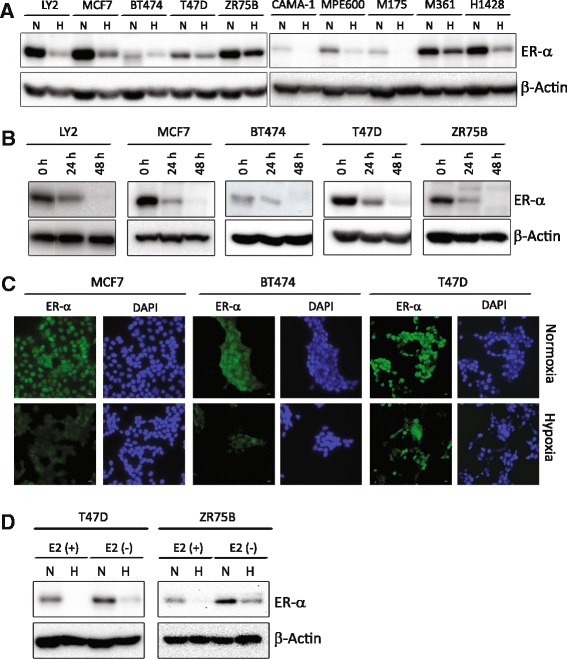
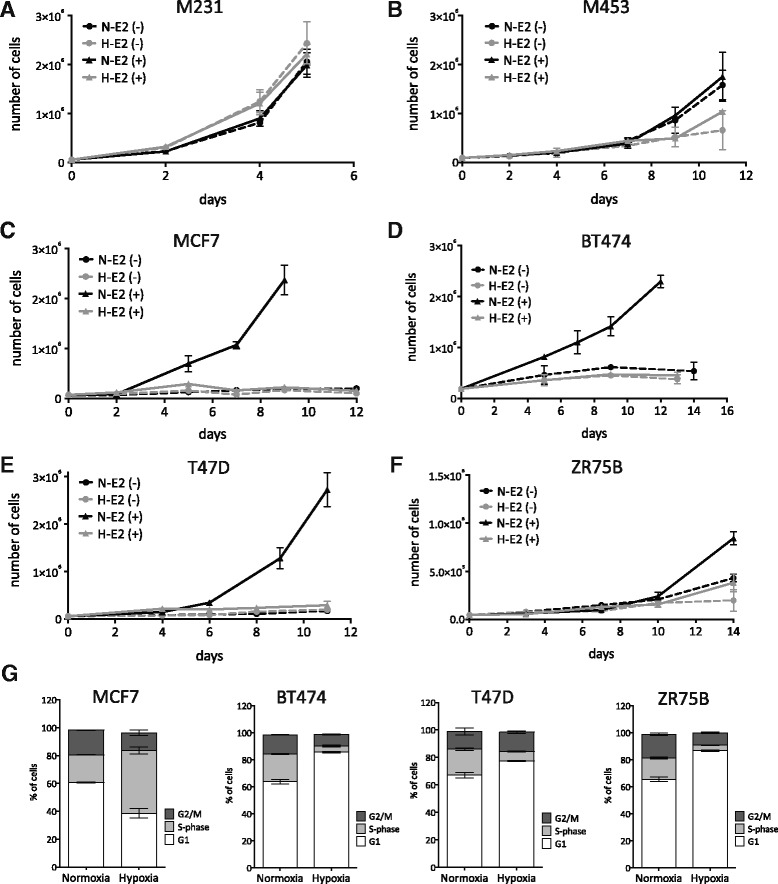
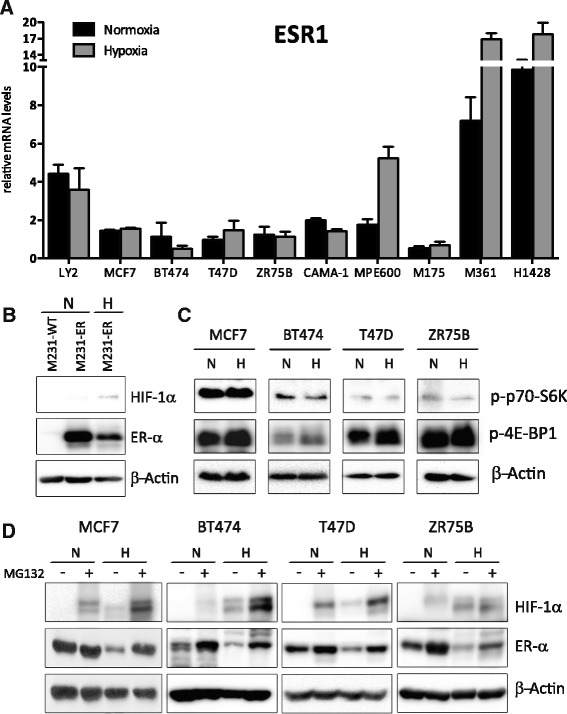
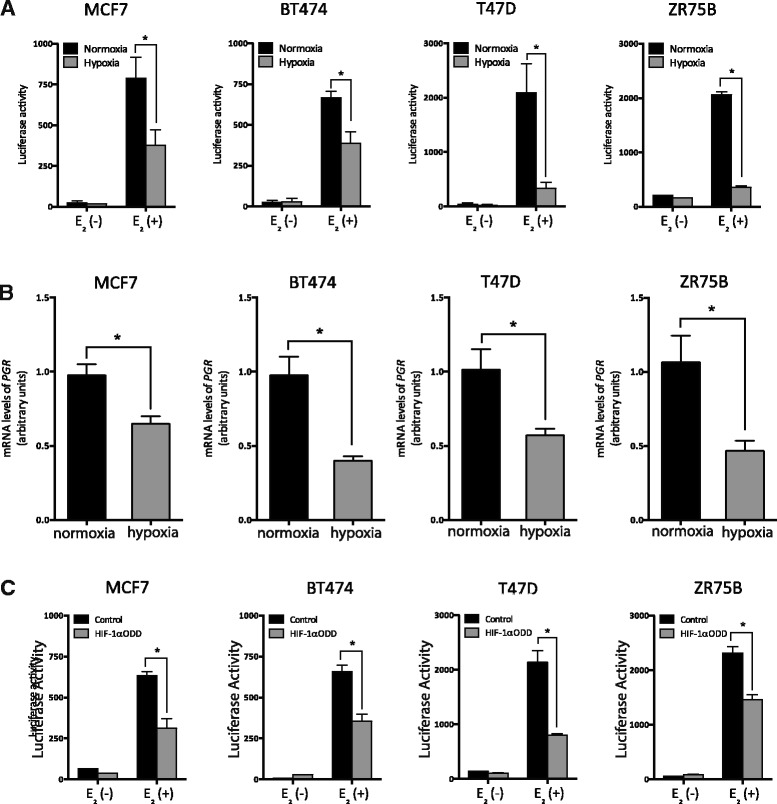
We present the first comprehensive overview of the effects of bona fide low environmental oxygen (hypoxia) and HIF-1α activity on ER-α abundance and transcriptional activity. We find that stabilized HIF-1α induces rapid loss of ER-α protein in all members of our diverse panel of breast cancer cell lines, which involves proteolysis rather than transcriptional repression. Reduced ER-α severely attenuates ER-α directed transcription, and inhibits cell proliferation without overt signs of cell death in the cell lines tested, despite their varying genomic backgrounds.
These studies reveal a common hypoxia response that produces reduced ER-α expression and cell cycle stalling, and demonstrate a common role for HIF-1α in ER-α loss. We hypothesize that inhibitors of HIF-1α or the proteasome might stabilize ER-α expression in breast tumors in vivo, and work in combination with endocrine therapies to reduce resistance. Our data also suggests that disease re-occurrence in patients with ER-α positive tumors may arise from tumor cells chronically resident in hypoxic environments. We hypothesize that these non-proliferating cells may survive undetected until conditions change to oxygenate the environment, or cells eventually switch to proliferation via other signaling pathways.
约 75-80%的乳腺肿瘤表达雌激素受体α(ER-α),并接受内分泌治疗,这使其成为乳腺癌临床治疗的主要方式。然而,获得性耐药很常见,约 20%的耐药肿瘤通过未知机制失去 ER-α 表达。抑制 ER-α 的丢失可以提高内分泌治疗的疗效,使大量患者受益。在此,我们研究肿瘤缺氧是否会普遍导致 ER-α 丢失。
使用标准的分子和细胞生物学检测方法以及具有可控氧水平的工作站/孵育箱,我们分析了缺氧对一系列独立衍生的 ER-α阳性细胞系中 ER-α 蛋白、mRNA 和转录活性的影响。这些细胞系被选择代表 ER-α 阳性肿瘤中常见的不同遗传背景和突变。通过 shRNA 介导的敲低和过表达研究,我们还阐明了缺氧诱导因子 1-α(HIF-1α)在缺氧诱导的 ER-α 丰度降低中的作用。
我们首次全面概述了真正低环境氧(缺氧)和 HIF-1α 活性对 ER-α 丰度和转录活性的影响。我们发现,稳定的 HIF-1α 会迅速诱导我们多样化的乳腺癌细胞系中所有成员的 ER-α 蛋白丢失,这涉及蛋白水解而不是转录抑制。减少 ER-α 严重削弱了 ER-α 指导的转录,并抑制了细胞增殖,而在测试的细胞系中没有明显的细胞死亡迹象,尽管它们具有不同的基因组背景。
这些研究揭示了一种常见的缺氧反应,该反应会导致 ER-α 表达减少和细胞周期停滞,并证明了 HIF-1α 在 ER-α 丢失中的共同作用。我们假设 HIF-1α 或蛋白酶体抑制剂可能会稳定体内乳腺肿瘤中的 ER-α 表达,并与内分泌治疗联合使用以减少耐药性。我们的数据还表明,ER-α 阳性肿瘤患者的疾病复发可能源于长期存在于缺氧环境中的肿瘤细胞。我们假设这些非增殖细胞可能在环境氧合之前未被检测到而存活,或者细胞最终通过其他信号通路切换到增殖。