Liegl Gregor, Gandek Barbara, Fischer H Felix, Bjorner Jakob B, Ware John E, Rose Matthias, Fries James F, Nolte Sandra
Department of Psychosomatic Medicine, Center for Internal Medicine and Dermatology, Charité - Universitätsmedizin Berlin, Charitéplatz 1, 10117, Berlin, Germany.
Department of Quantitative Health Sciences, University of Massachusetts Medical School, Worcester, MA, USA.
Arthritis Res Ther. 2017 Mar 21;19(1):66. doi: 10.1186/s13075-017-1273-5.
Physical function (PF) is a core patient-reported outcome domain in clinical trials in rheumatic diseases. Frequently used PF measures have ceiling effects, leading to large sample size requirements and low sensitivity to change. In most of these instruments, the response category that indicates the highest PF level is the statement that one is able to perform a given physical activity without any limitations or difficulty. This study investigates whether using an item format with an extended response scale, allowing respondents to state that the performance of an activity is easy or very easy, increases the range of precise measurement of self-reported PF.
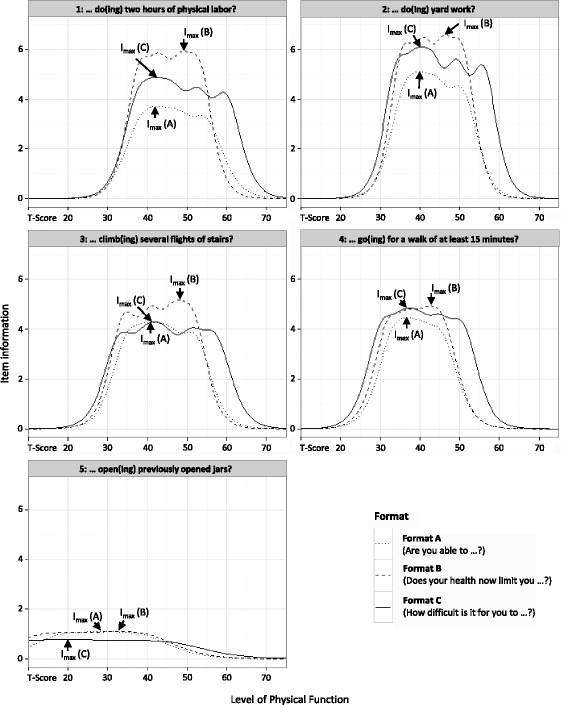
Three five-item PF short forms were constructed from the Patient-Reported Outcomes Measurement Information System (PROMIS®) wave 1 data. All forms included the same physical activities but varied in item stem and response scale: format A ("Are you able to …"; "without any difficulty"/"unable to do"); format B ("Does your health now limit you …"; "not at all"/"cannot do"); format C ("How difficult is it for you to …"; "very easy"/"impossible"). Each short-form item was answered by 2217-2835 subjects. We evaluated unidimensionality and estimated a graded response model for the 15 short-form items and remaining 119 items of the PROMIS PF bank to compare item and test information for the short forms along the PF continuum. We then used simulated data for five groups with different PF levels to illustrate differences in scoring precision between the short forms using different item formats.
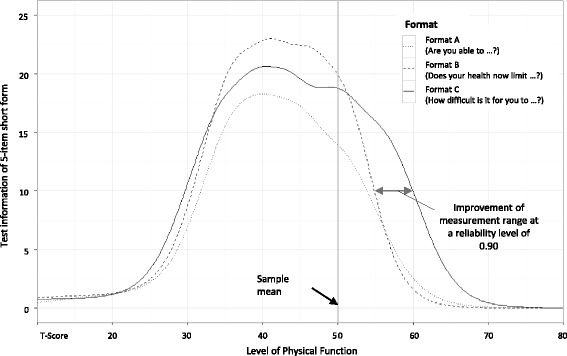
Sufficient unidimensionality of all short-form items and the original PF item bank was supported. Compared to formats A and B, format C increased the range of reliable measurement by about 0.5 standard deviations on the positive side of the PF continuum of the sample, provided more item information, and was more useful in distinguishing known groups with above-average functioning.
Using an item format with an extended response scale is an efficient option to increase the measurement range of self-reported physical function without changing the content of the measure or affecting the latent construct of the instrument.
身体功能(PF)是风湿病临床试验中患者报告的核心结局领域。常用的PF测量方法存在天花板效应,导致需要大样本量且对变化的敏感性较低。在大多数这些工具中,表明最高PF水平的反应类别是能够毫无限制或困难地进行特定身体活动的陈述。本研究调查使用具有扩展反应量表的项目格式,允许受访者表明活动的执行很容易或非常容易,是否会增加自我报告PF的精确测量范围。
从患者报告结局测量信息系统(PROMIS®)第1波数据构建了三种五项PF简表。所有表格都包括相同的身体活动,但项目主干和反应量表不同:格式A(“你能够……吗”;“没有任何困难”/“无法做到”);格式B(“你的健康状况现在是否限制你……”;“完全不”/“不能做”);格式C(“你做……有多困难”;“非常容易”/“不可能”)。每个简表项目由2217 - 2835名受试者回答。我们评估了单维性,并为PROMIS PF库的15个简表项目和其余119个项目估计了等级反应模型,以比较简表在PF连续体上的项目和测试信息。然后我们使用具有不同PF水平的五组模拟数据来说明使用不同项目格式的简表在评分精度上的差异。
支持所有简表项目和原始PF项目库具有足够的单维性。与格式A和B相比,格式C在样本PF连续体的正向一侧将可靠测量范围增加了约0.5个标准差,提供了更多的项目信息,并且在区分功能高于平均水平的已知组方面更有用。
使用具有扩展反应量表的项目格式是一种有效的选择,可在不改变测量内容或不影响工具潜在结构的情况下增加自我报告身体功能的测量范围。