Gonya Jenn, Ray William C, Rumpf R Wolfgang, Brock Guy
The Research Institute at Nationwide Children's Hospital, Center for Perinatal Research, Columbus, Ohio, USA.
The Research Institute at Nationwide Children's Hospital, Battelle Center for Mathematical Medicine, Columbus, Ohio, USA.
BMJ Open. 2017 Mar 20;7(3):e012985. doi: 10.1136/bmjopen-2016-012985.
The primary objective of the study was to investigate how patterns of skin-to-skin care might impact infant early cognitive and communication performance.
This was a retrospective cohort study.
This study took place in a level-IV all-referral neonatal intensive care unit in the Midwest USA specialising in the care of extremely preterm infants.
Data were collected from the electronic medical records of all extremely preterm infants (gestational age <27 weeks) admitted to the unit during 2010-2011 and who completed 6-month and 12-month developmental assessments in the follow-up clinic (n=97).
Outcome measures included the cognitive and communication subscales of the Bayley Scales of Infant Development, Third Edition (Bayley-III); and skin-to-skin patterns including: total hours of maternal and paternal participation throughout hospitalisation, total duration in weeks and frequency (hours per week).
Extracted data were analysed through a multistep process of logistic regressions, t-tests, χ tests and Fisher's exact tests followed with exploratory network analysis using novel visual analytic software.
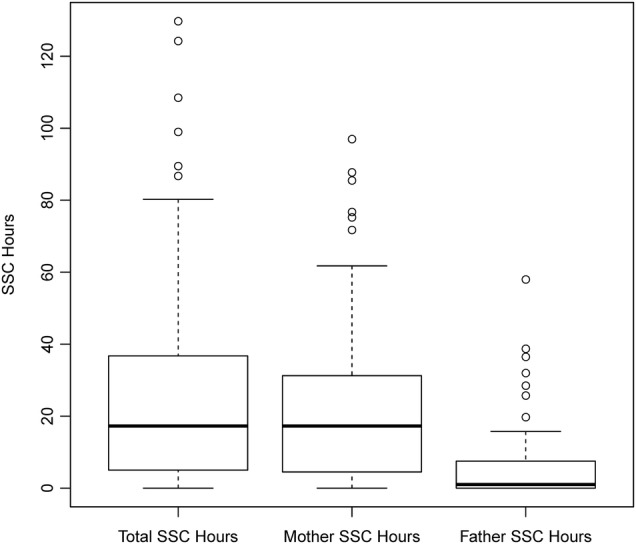
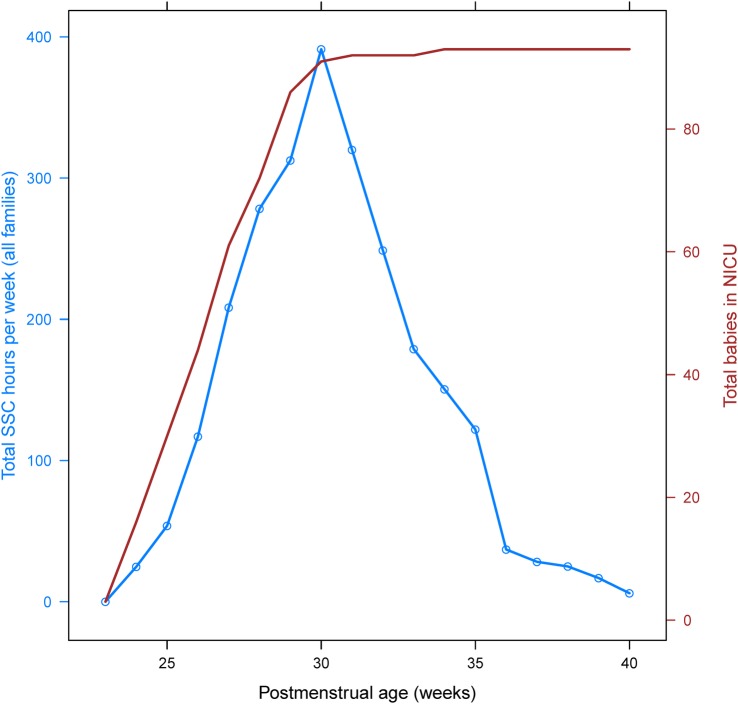
Infants who received above the sample median in total hours, weekly frequency and total hours from mothers fathers of skin-to-skin care were more likely to score ≥80 on the cognitive and communication scales of the Bayley-III. However, the results were not statistically significant (p>0.05). Mothers provided the majority of skin-to-skin care with a sharp decline at 30 weeks corrected age, regardless of when extremely preterm infants were admitted. Additional exploratory network analysis suggests that medical and skin-to-skin factors play a parallel, non-synergistic role in contributing to early cognitive and communication performance as assessed through the Bayley-III.
This study suggests an association between early and frequent skin-to-skin care with extremely preterm infants and early cognitive and communication performance.
本研究的主要目的是调查肌肤接触护理模式如何影响婴儿早期认知和沟通能力。
这是一项回顾性队列研究。
本研究在美国中西部一家四级全转诊新生儿重症监护病房进行,该病房专门护理极早产儿。
数据收集自2010 - 2011年期间入住该病房且在后续门诊完成6个月和12个月发育评估的所有极早产儿(胎龄<27周)的电子病历(n = 97)。
结局指标包括贝利婴儿发展量表第三版(Bayley - III)的认知和沟通分量表;以及肌肤接触模式,包括:住院期间父母参与的总时长、以周为单位的总时长以及频率(每周小时数)。
提取的数据通过逻辑回归、t检验、χ检验和费舍尔精确检验的多步骤过程进行分析,随后使用新型视觉分析软件进行探索性网络分析。
在肌肤接触护理的总时长、每周频率以及来自母亲和父亲的总时长方面高于样本中位数的婴儿,在Bayley - III的认知和沟通量表上得分≥80的可能性更大。然而,结果无统计学意义(p>0.05)。无论极早产儿何时入院,母亲提供了大部分的肌肤接触护理,在矫正年龄30周时急剧下降。额外的探索性网络分析表明,医疗因素和肌肤接触因素在通过Bayley - III评估的早期认知和沟通能力方面发挥平行、非协同的作用。
本研究表明极早产儿早期频繁的肌肤接触护理与早期认知和沟通能力之间存在关联。