Instituto de Ciencia de Materiales de Madrid (ICMM), Consejo Superior deInvestigaciones Científicas (CSIC), C/Sor Juana Inés de la Cruz 3, 28049 Madrid, Spain.
Moscow State University of Technology "STANKIN", Vadkovskij per. 1, Moscow, 101472, Russian Federation.
Sci Rep. 2017 Mar 21;7:44922. doi: 10.1038/srep44922.
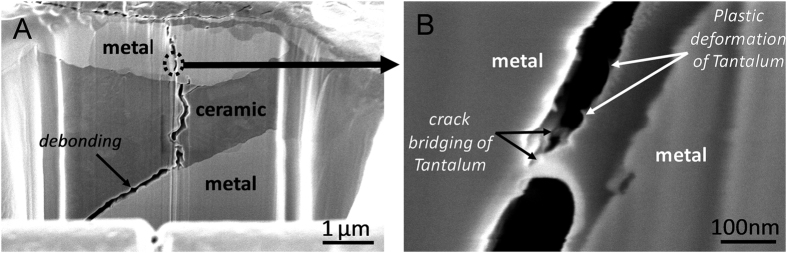
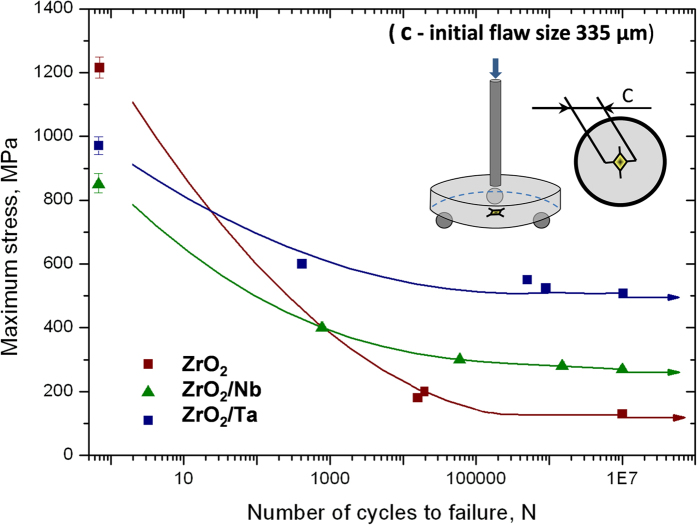
Dense (>98 th%) and homogeneous ceramic/metal composites were obtained by spark plasma sintering (SPS) using ZrO and lamellar metallic powders of tantalum or niobium (20 vol.%) as starting materials. The present study has demonstrated the unique and unpredicted simultaneous enhancement in toughness and strength with very high flaw tolerance of zirconia/Ta composites. In addition to their excellent static mechanical properties, these composites also have exceptional resistance to fatigue loading. It has been shown that the major contributions to toughening are the resulting crack bridging and plastic deformation of the metallic particles, together with crack deflection and interfacial debonding, which is compatible with the coexistence in the composite of both, strong and weak ceramic/metal interfaces, in agreement with predictions of ab-initio calculations. Therefore, these materials are promising candidates for designing damage tolerance components for aerospace industry, cutting and drilling tools, biomedical implants, among many others.
采用 spark plasma sintering(SPS)工艺,以 ZrO 和片状金属 Ta 或 Nb 粉末(20 体积%)为起始原料,制备出了密度大于 98%、均匀的陶瓷/金属复合材料。本研究表明,ZrO2/Ta 复合材料的韧性和强度同时得到了独特且出乎意料的增强,且具有极高的缺陷容忍度。除了具有优异的静态机械性能外,这些复合材料还具有出色的抗疲劳性能。研究表明,增韧的主要贡献是金属颗粒的裂纹桥接和塑性变形,以及裂纹偏转和界面脱粘,这与复合材料中既有强陶瓷/金属界面又有弱陶瓷/金属界面的共存情况相吻合,这与从头算计算的预测结果一致。因此,这些材料是为航空航天工业、切割和钻孔工具、生物医学植入物等设计抗损伤能力组件的有前途的候选材料。