Rudolf Frauke, Damkjær Mads, Lunding Suzanne, Dornonville de la Cour Kenn, Young Alyssa, Brooks Tim, Sesay Tom, Salam Alex P, Mishra Sharmistha, Storgaard Merete
Emerg Infect Dis. 2017 Apr;23(4):597-600. doi: 10.3201/eid2304.160485.
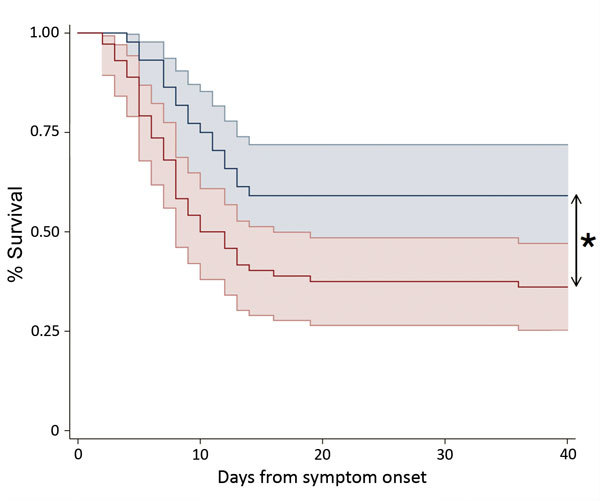
Case-fatality rates in Ebola treatment centers (ETCs) varied widely during the Ebola virus disease (EVD) outbreak in West Africa. We assessed the influence of referral pathway on ETC case-fatality rates with a retrospective cohort of 126 patients treated at the Mathaska ETC in Port Loko, Sierra Leone. The patients consisted of persons who had confirmed EVD when transferred to the ETC or who had been diagnosed onsite. The case-fatality rate for transferred patients was 46% versus 67% for patients diagnosed onsite (p = 0.02). The difference was mediated by Ebola viral load at diagnosis, suggesting a survival selection bias. Comparisons of case-fatality rates across ETCs and clinical management strategies should account for potential survival selection bias.
在西非埃博拉病毒病(EVD)疫情期间,埃博拉治疗中心(ETC)的病死率差异很大。我们对在塞拉利昂洛科港马塔斯卡埃博拉治疗中心接受治疗的126例患者进行回顾性队列研究,评估转诊途径对埃博拉治疗中心病死率的影响。这些患者包括转至埃博拉治疗中心时确诊为埃博拉病毒病的患者或在现场被诊断出的患者。转诊患者的病死率为46%,而现场诊断患者的病死率为67%(p = 0.02)。这种差异是由诊断时的埃博拉病毒载量介导的,提示存在生存选择偏倚。在比较不同埃博拉治疗中心的病死率和临床管理策略时,应考虑潜在的生存选择偏倚。