Institute of Immunology, Center for Pathophysiology, Infectiology, and Immunology, Medical University of Vienna, Vienna, Austria.
Institute of Immunology, Center for Pathophysiology, Infectiology, and Immunology, Medical University of Vienna, Vienna, Austria.
Immunol Lett. 2017 Sep;189:27-39. doi: 10.1016/j.imlet.2017.03.010. Epub 2017 Mar 18.
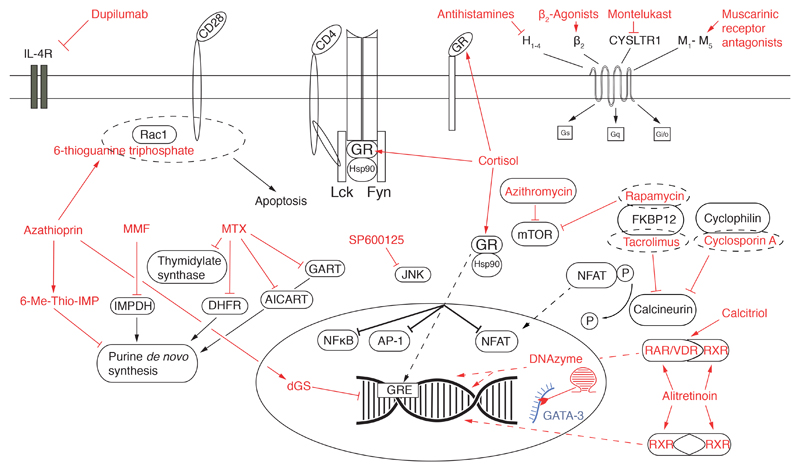
Allergic disorders are the result of a complex pathophysiology, involving major cellular lineages and a multitude of humoral factors of the innate and adaptive immune system, and have the tendency to involve multiple organs. Consequently, even standard pharmacological treatment of allergies is rarely specific but usually targets more than one pathway/cellular system at a time. Accordingly, many of the classic anti-allergic drugs have a critical impact also on T helper cells, which are pivotal not only during the sensitization but also the maintenance phase of allergic diseases. Recent years have seen a dramatic increase of novel drugs with the potency to interfere, more or less specifically, with T lymphocyte function, which might, possibly together with classic anti-allergic drugs, help harnessing one of the central cellular players in allergic responses. A major theme in the years to come will be a thoughtful combination of previously established with recently developed treatment modalities.
过敏症是一种复杂的病理生理学的结果,涉及主要的细胞谱系和先天和适应性免疫系统的多种体液因素,并且有涉及多个器官的倾向。因此,即使是过敏的标准药物治疗也很少是特异性的,通常一次针对多个途径/细胞系统。相应地,许多经典的抗过敏药物对辅助性 T 细胞也有重大影响,这些细胞不仅在过敏疾病的致敏阶段而且在维持阶段都是至关重要的。近年来,具有或多或少特异性地干扰 T 淋巴细胞功能的新型药物数量急剧增加,这些药物可能与经典的抗过敏药物一起,有助于控制过敏反应中的一个主要细胞参与者。未来几年的一个主要主题将是深思熟虑地结合以前建立的和最近开发的治疗方式。